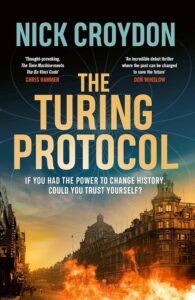
One of the joys of writing The Turing Protocol was to put down on paper real experiences that had happened to me over my life . I was also fully aware that readers would come from different countries around the world and purposely created story lines in the USA , UK and Spain with descriptive locations, albeit spanning 80 years of history.
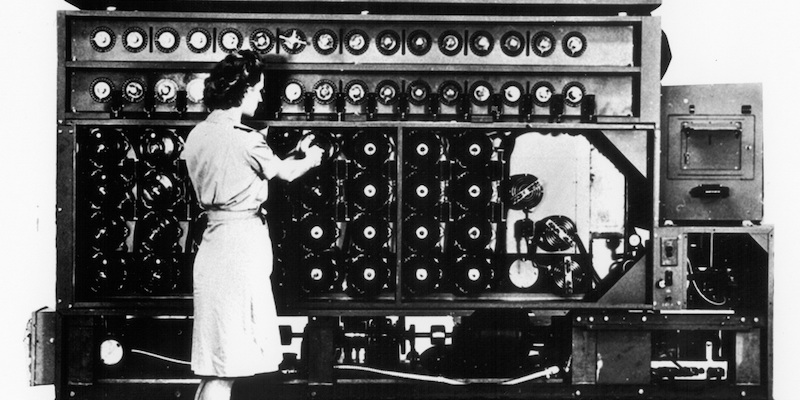
I have studied history and in particular military history all my life. Visiting Bletchley Park and reimagining the lives of the individuals who worked tirelessly at their endeavors in Hut 8 was a joy. Reading about Alan Turing, I was struct about his sense of purpose. For him cracking the Enigma code was a personal crusade and he was dogmatic in his determination to win, which I hope comes out in the book. Whilst walking around the grounds of Bletchley Park you are struck by a dichotomy of feelings. The surroundings, the gardens, are serene, the work places were functional and somewhat private. Imagine then when Turing cracked the code, the stress and responsibility of having the power over life and death. He was not a soldier or trained to be a spy. Yet he and he alone would allow a convoy to be attacked to ensure that the German High Command did not realise that their code was broken. It is hard to imagine what demons he had to live with from making these decisions, despite saving a multitude of ships by directing them away from the Wolf Packs.
Nautilus, his creation is housed in the basement of Harrods. One of the fun aspects of writing the book was to imagine Americans tourists arriving at Harrods and asking whether it is true that there are tunnels underneath the store where people ferry products around, unseen by the public. I’m sure they will be skeptical and intrigued when they discover the truth. I will say this, that my first job after University was with Deloitte the accounting firm, and my first audit was Harrods Bank, sadly no longer there, but my memory of literally having to count Gold Bars on deposit at the bank will live with me forever.
Research, I would say, is the most important stage of writing a novel. Look at The Pillars of the Earth by Ken Follett, The Champagne Wars by Fiona Mcintosh or one of my personal favourites, As I Walked Out One Midsummer Morning by Laurie Lee. All these authors spend a considerable amount of time visiting locations , studying history or in the case of Mr Lee, living in the moment. The authenticity jumps from their pages enriching the readers experience.
When you read the novel it will become clear that I have a love of Spain, a country steeped in history good and bad and populated by vibrant , passionate citizens who love life, respect family and create amazing food.
Rather unusually for a novel I describe in detail throughout the book what people eat and drink. I have spent many years in Spain , my wife is Spanish , from Madrid and the food is spectacular, the foundation of life in Spain where still today families sit at a table for lunch talking at a rate of knots drinking, expressing their opinions, together often for hours .
I describe small towns such Pedraza, north of Madrid or Mijas in Andalucia, they are all real and beautiful and my wish is that people will be encouraged to seek out these gems.
Using authentic experiences and real locations add the ability to use a rich descriptives text, Wilbur Smith was a master of this technique, his description of the African landscapes made you feel that you were actually there.
In my case I have added to the complexity by using actual historical people as my characters. I have read and listened to hours of dialogue from Churchill and I hope that when writing my fictional conversations that I have captured his voice, his movement and persona. My biggest challenge was Turing himself . My intention to shine a light on his genius . I put him there with the greats , Da Vinci, Newton , Einstein. His accomplishment saved thousands of lives , possibly millions by, as some historians suggest that he shortened the war by up to 2 years. His loss to the world was a tragedy and unnecessary . I am convinced that should he have lived the world that we live in would be considerably more advanced. Turing was talking about AI and machine learning as early as 1950 who knows where he would have led us.
I hope in reading the Turing Protocol that you are entertained, that you may ask google to discover whether my version of history is true or fictionalized, that you are tempted to visit a location or recreate one of the many dishes in the novel . But most of all I hope you gain the respect for all that Alan Turing achieved during his short life.
***