The creation of every book still feels like holding a newborn kitten in my hand, a small and fragile creature that I never quite believe will grow strong enough to survive on its own. Although I’ve done it nine times now — ten times, if you include the finished manuscript now awaiting the sharp red pen of my copy editor — writing a novel from beginning to end always seems impossible until it’s actually done.
I’m thinking about this now because I’m trying to come up with the next book in my Peter Ash series. As a novelist, this is one of my favorite moments, with many distinct joys and challenges. Interestingly, the challenges, which become more significant with each new book, are the inverse of the joys.
The joy of conceiving a new book begins with the recurring characters. By now, Peter Ash, June Cassidy, and Lewis have become old friends. I know their personal histories, how they think and talk, their secret fears and fierce loves. Sometimes I dream about them. Writing in their voices has become second nature for me, like a conversation around the dinner table with folks I’ve known forever.
On the other hand, the challenge of writing these characters arises from this very familiarity. For a long-running series to remain alive, its protagonists can’t remain stagnant. They must continue to evolve, grow, and deepen in convincing ways, yet remain themselves. And because my job is to create tension and put these characters in physical and emotional jeopardy, I definitely can’t let them get too comfortable.
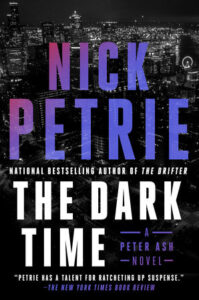
The challenge doesn’t stop with my protagonists. I also have to keep coming up with important new non-recurring characters — the “client” Peter is trying to help, as well as the villain causing all the trouble. This task becomes even more difficult with each new book. In The Dark Time, my latest release, the “client” is an influential tech journalist (known as KT to her friends and enemies) with the power to make or break entire companies with her ruthlessly capable reporting. I’ve written about the tech world and journalism before, but KT’s character allowed me to look at the intersection of both topics from a fresh angle.
For me, and for many other writers, the most important question to ask about every character is, what does he or she want? This is the main difference between simple characters and complex characters. Simple characters want one or two things. Complex characters want three or four or five, with at least two of those desires in direct conflict with each other.
As a series stretches its legs from book to book, some protagonists’ desires will remain the same and others will change. The beauty of complex characters is that they often contain within themselves the seeds of their own change, finding new ways to grow, just like people do.
But characters are only the beginning. A long-running series is also a world unto itself, a combination of attitude, language, and a specific range of available choices — everything from weather to food to real estate. An easy way to think about this is to compare, say, Sue Grafton’s fictional world with Walter Mosley’s, or Raymond Chandler’s, or Arthur Conan Doyle’s. On the most basic level, each writer tells detective stories, but the worlds they create are so distinct as to be almost on different planets. (Can you imagine Kinsey Millhone in the same book as Easy Rawlins, or Philip Marlowe hanging out with Sherlock Holmes? Don’t even try. Your brain might explode.)
After ten books, Peter Ash’s world is deep in my bones, as familiar and comfortable as an old sweater. But I can’t let it stay that way. As with characters, the world of a series must keep growing and evolving. The challenge lies in figuring out how to push the boundaries in new ways.
For series characters who are dug deeply into their settings, taking them out of that comfort zone for a single book is always a great way to enlarge their world. A book set in a radically different spot — like Iceland, for example, or rural Nebraska — has no choice but to expand a fictional world in new ways.
But I made the decision early on not to keep my characters rooted in one place, so for me, it’s not that easy. The first piece of the puzzle is to figure out where these characters go next — and why. I chose to set The Dark Time in Seattle and the Pacific Northwest — not the broader idea of a wealthy tech enclave that the reader might expect, but another, more specific version. Writers who stick to the same setting can use this trick to show us a different take on that familiar place. Specificity of setting also always contains certain narrative implications that help me find a new and different story to tell.
Finding that next Peter Ash story is another distinct joy. Because of how I’ve structured the series, my protagonist can go anywhere and get involved in anything. So, I ask myself, what’s going on with my characters, now? And what’s going on in the world? What am I interested in? What scares me?
The challenge arises when I start floating big plot ideas. No, I used this idea in book three. I used that element in book six. After ten books, I’ve already exhausted quite a few concepts.
So I’ve learned to stop thinking about big plot ideas or organizing principles. I no longer try to begin with a kind of story — a mafia story, a spy story, a technology story, a survival story. Instead, I try to come up with a few small ideas made evident in very specific moments. I lean into my process as an “improvisational” writer — a more elegant way to say “pantser” — and remind myself that I don’t need to know the whole story, not at the start. I don’t even want the whole story. All I want is a hint, a suggestion, the first toehold for the coming climb. I’ve learned to trust in my own skills and sensibility to chart a path forward from there.
The truth for me is that the only guiding principle is the one at the core of every element in this piece: the next book needs to allow for and encourage an evolution of the characters, the world, and the kind of story I can tell, while still remaining true to the soul of the series. In other words, to simultaneously meet reader expectations and subvert them.
It helps that I’ve become comfortable with the realization that, as a writer and as a person, I have a specific range of interests that I keep exploring from different angles. That’s what it means to build a body of work — the themes you return to again and again. Writers often say that there are no new stories in the world. Depending on who you ask, there are only two basic stories, or seven, or thirty-six. The number doesn’t matter. What makes stories worth telling is your specific point of view — that’s always new, because there’s only one “you” out there.
And that, I suppose, is the biggest joy of writing a long-running series. Having that conversation with myself, and with my readers.