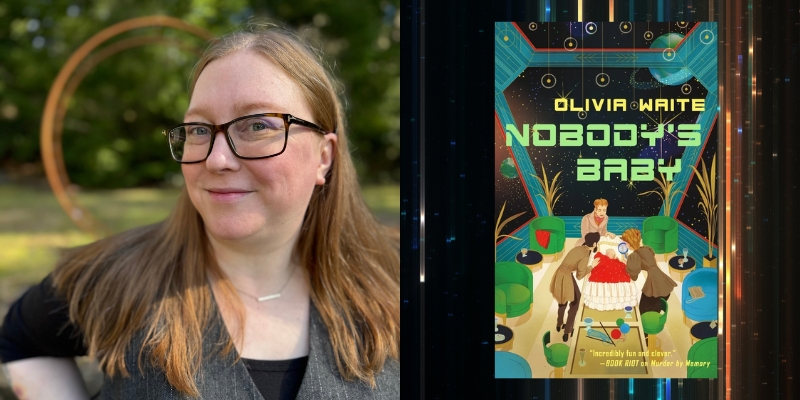
Olivia Waite is best known to many as a romance writer, the author of books like The Lady’s Guide to Celestial Mechanics, and the romance columnist for the New York Times Book Review. Last year Tor published Murder by Memory, a novella featuring Dorothy Gentleman, the ship detective for the HMS Fairweather, an interstellar ship carrying ten thousand people from Earth on a thousand year journey to a distant star system.
Her new book Nobody’s Baby is the second in the series and features the only thing more impossible on the ship than a murder, a baby. In a recent zoom call, where we spent far too much talking about mystery TV shows, I unintentionally helped Waite to realize a detail of the series. More importantly for readers, Waite spoke about the influence of P.G. Wodehouse on the series, her love for the novella form, and how there’s much more to come of her retrofuturist series.
*
Alex Dueben: I really enjoyed your new book Nobody’s Baby, and last year’s Murder by Memory, but I am curious where this idea of setting a cozy murder mystery on an interstellar ship came from?
Olivia Waite: This was one of those things where something rings your mind like a bell, and you’re like, why isn’t everybody doing this? This is so obvious! Of course, it’s bonkers.
It was the early pandemic. Everybody was still on lockdown. I was mainlining every golden age murder mystery series I could get my hands on. All your Marples, all your Poirot. I was thinking about like PG Wodehouse and that style of comedy. I was spending way too much time on Twitter.
I’ve looked for this post since and I still can’t find it, but somebody tweeted, why aren’t there more locked room mystery set on a generation ship? That just seems like a natural setting for this kind of thing. Somehow my brain took Wodehouse cruise ship full of aunts and nephews, golden age mystery locked room, and in space–and I’m like, I know exactly what that book sounds like. [laughs]
I think I had just turned in my last historical romance for Harper Collins. I was like, this seems like a pretty short idea. I banged it out in two weeks. It’s not the final version, obviously, there were many lovely polishing moments later.
AD: Still, the characters, the ideas, all in two weeks.
OW: Yeah. I knew who this person is, I knew how the relationships go. Generation ships make me sad because if I get to know somebody, I want to stay with them. I don’t want successive generations. So what if you got a new body every time yours wore out and it’s kind of like a generation ship, but it’s also like a thousand-year vacation? Doesn’t that sound kind of nice?
AD: Yes, but also, reminds me why I don’t want to go on a cruise. [laughs]
OW: Exactly! I’m fascinated by cruise ships, but I don’t know that I ever want to actually go on one. I just want to look at the maps. [laughs]
AD: You can see those influences and there is an old fashioned feel to the place where everyone sort of knows each other, they’ve clustered together in different ways.
OW: It’s not coincidental than ten thousand people is the population of the Fairweather and ten thousand people is also roughly the size of the college that I went to. This sense that if you don’t know somebody, you know somebody who knows them. It’s all one big small town. In a college you only have four years to get to know those people, but they’re three hundred years in. They’ve all done the circuits at this point.
AD: They may have forgotten some of those circuits by this point, but it does have that small town feel.
OW: I love building contained societies like that. When I do write small towns, or even when I write groups of families in Regency London, everybody always overlaps. People help each other out, there’s new people coming in, but there’s also people who are going out and making new connections with other places.
Maybe some of that does come from my background as a longtime reader of sci-fi and fantasy where huge world populations that nevertheless all have the same important people. McCaffrey and Pratchett were huge influences. The way that Ann Leckie structures things is very interesting.
AD: I was going to guess that Leckie was an influence, if only because the back of the book mentions Dorothy L Sayers and Ann Leckie.
OW: [laughs] It’s not intuitive.
AD: Not even not intuitive, but I guessed they were direct influences because if you were going to pick a mystery writer and a space opera writer, just to catch people’s eye, those are not the two most recognizable.
OW: It’s true. I’ve been an omnivorous reader for forever. Dorothy L Sayers was somebody I came to through romance. Knowing so many romance people with excellent taste who said, Gaudy Night is amazing, but you’ve got to read the two before. Those are wonderful. Blends of romance and mystery in particular, can be really exquisitely and elegantly done.
I haven’t read as much Mary Stewart as I need to, but I read a bunch of hers growing up. I confuse her with Mary Renault, which is very funny in some ways. [laughs] It’s only now that I’m like actually reading the romantic suspense and I’m like, this is my jam. This is incredible.
But part of me is always thinking, how does she get from here to the Arthur books? I’m like, No, that’s the other one. [laughs]
AD: In each book, there’s a mystery, but more than a mystery they’re about something impossible happening.
OW: That’s always been the fun of of those classic mysteries for me. Something that looks impossible, but isn’t. We were watching an episode recently–either a Sister Boniface or Father Brown. Something like that–where somebody has been stabbed, but they can’t find the murder weapon.
It’s a stopped train in the middle of a field of snow. I’m like, somebody got stabbed by an icicle. The fact that these impossible problems get implausible solutions–which then become predictable solutions!– is so fun. It’s like a game you’re playing with a bunch of people you’ve never met.
I sat down and I wrote the first Dorothy Gentleman book and by the end I had notes for like six more of them based on questions that I knew I wasn’t going to have space to get into in the first book. The baby came up pretty quickly because I’m like, are there children here?
Again, this was early in the pandemic. I’m like, nobody wants the complications. We’re all super worried about the kids. We can’t think about that yet. How do you have a baby on a spaceship where babies are supposed to be impossible? And even more interesting, how do you have a baby that the parents don’t remember making? That was just really fun. And of course, people reacting to a surprise baby after three hundred years of no babies at all. It’s very destabilizing. [laughs]
AD: Dorothy is worried that once passengers start thinking about babies, then more of them will want babies and then candles and then weapons. I did enjoy that candles are one of the most dangerous possibilities she can imagine.
OW: That’s me reading too much about the space program where the most ordinary things become huge problems. Like you can’t have graphite pencils in a space shuttle. There’s that joking meme that gets passed around the internet, NASA spent like millions of dollars to develop a ballpoint pen that would work in zero G and the Russians just used a pencil. No, you can’t, because little flecks of graphite get into the electronics!
AD: In the second book especially, it’s clear that know a lot about how the ship functions. There’s kind of this slow burn about the historical background of everything.
OW: We’re going to get a lot more of that in book three,. Some of these things that we haven’t been talking about? There’s a reason we’re not talking about them. I’s just fun to play in like the retrofuturist sandbox.
I think one of the things that keeps drawing me to retrofuturism is less of the nostalgia and more because I have an interest in history, it feels like a historical future, which is so interesting. Seeing which which era has mapped itself on to this imagined future and how far can you untangle them, and how much are they locked in. The idea of techno-optimism.
We have these lovely images, paintings and cartoons, from French newspapers from the 1890s and the art deco era of what the future was going to look like. It’s just fun.
Thinking, if we’re in the 1920s and we imagine future tech doing what we like to imagine future tech doing– memory preservation, sentient robots, instant communications–how does that look from a 1920s perspective where you haven’t invented things like video phones?
If you look at Star Trek, that’s an incredibly television-based culture. Everything is on big screens that everybody’s looking at together. You don’t have that on the Fairweather. This is the 1920s and movies were still more like a form of theater. You still have live music. They had an improvisational element that modern films with their built in soundtracks don’t don’t have.
How does that carry forward to things like surveillance on board the ship? You’ll notice there’s no cameras pointed everywhere to capture people’s faces. That’s like a different branch of the tech tree that we never walked down. It’s complicated, but it’s fun.
AD: It is complicated, but for example Dorothy has a pocket watch, and she refers to it as a pocket watch, but it’s a communicator.
OW: Exactly. It’s clearly something like a touchscreen phone, except that nobody’s face ever shows up and it’s all text typing notes. I haven’t decided how the typing happens.
AD: On this ship, when people age or get injured, they grow a new body and have their consciousness downloaded, and Dorothy is both fascinated and repulsed by bodies. As she describes finding a baby in this book, “someone had made a baby the old-fashioned way. Two human bodies, gooey bits out, overlapping in space and time.”
[laughs] I don’t know that I’ve heard it described it that way. But there is this visceral strangeness that gets into that mind body dichotomy.
OW: [laughs] Yes. I’m always trying to trouble that. We’re minds, except when we’re not. Except when the body wants something and it makes us feel or think things. I believe in the duality, but as a working team, rather than a hard boundary. Some of that is coming from romance, where the body often expresses truths that the mind isn’t aware of.
You’ll see characters who want someone desperately and they know they shouldn’t and they have a whole list of reasons in their head, but they reach for them anyways. They’re trying to pretend like they’re unaffected, but the body will react. This tension is definitely something that comes from romance.
But also, my god, bodies are hideous. That comes from science fiction like Alien, which is very bodily and visceral. Even the robots. Is it Ash in the first one? It’s not your basic movie robot where we smash his chest and there are circuits. It’s supposed to look really alien. What’s the milk stuff? We hate it. [laughs]
I think a lot of that also comes comes from my own experience as somebody who’s often frustrated by the body, for aging and medical reasons, but also fascinated by it. My mom was a nurse growing up and so I was paging through anatomy textbooks really early.
My dad was a real estate appraiser and he had floor plans and house diagrams and neighborhood maps everywhere, and my mom had Gray’s Anatomy. Then of course the classic story “They’re Made Out of Meat,” which probably rewired my brain in a fundamental way. Which I still love to this day. [laughs] Talking meat. Singing meat.
AD: You had these two things and in your young mind, they both had funny names and do strange things.
OW: It was also very tied in with the tech for me. When we got our first computer, we had the CD-ROM game called Body Illustrated. It was a really in depth pixel anatomy trivia game. Again, my mom was a registered nurse. She worked in the ICU for forty years. At the time when I was playing this game, I was actually getting higher scores than her just because I could figure out which little tiny patch of pixels the cursor was supposed to go on. I would have been horrible in an actual medical setting, but I could nail this video game. [laughs]
My poor mom thought, we’ve got a future doctor in the family! And I’m like, absolutely not! I like to know things. I don’t want to ever hold a scalpel. That’s a terrible idea.
AD: The passengers on the Fairweather are on this ship for a thousand years, which is kind of forever. Seeing the same people in the same spaces over and over.
OW: One of the interesting things about the pandemic for me was realizing how much of my memory was location based. I remember things based on where I was when they happened. And so if I’m spending all of my time in one small set of rooms, my memory just gets completely discombobulated.
AD: It’s interesting to pair that sort of society and way of thinking about the body, with this I don’t want to say fetishization, but they’re very focused on the handmade. Dorothy is obsessed with knitting, but it’s one of many things that people obsess over.
OW: Part of that comes from the lockdowns as well. For a while, a lot of people were able to just stop. They had time to fill, and how did they fill it? A few people sat back and did nothing, but most people were like, I’m going to pick up a hobby, I’m going to learn a handcraft, I’m going to bake all the bread in the world.
If you handed somebody a lifetime supply of money, they probably wouldn’t just sit on the couch watching movies. Or if they did, they would probably have thoughts about those movies. They would do something like start a bar or a restaurant or a bookstore. They would learn to paint. There’s so many things that people want to do if they have time.
On the Fairweather, you have nothing but time. It’s set up to incentivize interactive businesses. That was a very deliberate choice as well. I wanted something that gave people an incentive to do things that would improve the quality of life on the ship. To open that bakery, to have street food, to show movies, things like that.
But that didn’t necessarily lead to the kind of consolidation and conglomeration that we’re seeing. So you have a lot of small businesses run by one or two people. You have a lot of sports clubs. You have a lot of members clubs, like the Antikythera Club, which is where all of the nerds go to swap nerd ideas.
AD: Of course, in this society, the nerds have power.
OW: Well, yes and no. The board is the power. The nerds are kind of just noodling. They’re more of the Drones Club. A lot of the things they invent are useful, and so the board takes them. But a lot of the things they invent are actually quite terrible, and the board is like, please never speak of this to anyone. There is somebody collecting those.
AD: Interesting. That would make sense. But your previous novels were good length, how are you finding the novella form?
OW: This actually feels like coming home for me. My very first novels with Ellora’s Cave were very short romances. I like to think of it as plotting from A to B. [laughs] I enjoy the short form because it lets me focus on the sentences. You have to be so much more economical. I haven’t quite nailed short stories. I always want a little more space than that. I sit down and try to write a blog post and it ends up 2500 words. [laughs] I’m not a short, short writer–or talker apparently. [laughs]
I really love a novella. I grew up with a lot of short books. Those slim fantasy novels and Douglas Adams-style short novels. Or things collected in anthologies. It’s always nice to write something that’s the length that’s meant to be. The biggest feedback I get from readers is they always they always want more from the Dorothy Gentleman. Some people are like, these are just so short. I’m like, yeah, but I’m gonna write a bunch of them.
AD: Also, it’s nice to have something where on a nice snowy day, you can sit and have tea and read this entire book.
OW: Exactly. I won’t take up too much of your time. [laughs] I mean, I love a doorstopper. I’m slowly meandering my way through Proust–and have been for several years now. Every couple of weeks I pick it up and I go through a couple of pages and I’m only as confused as I should be, I feel. [laughs]
It’s very pleasant. I can appreciate the longer things, but I don’t think I’ll ever get to quite that extent. I didn’t think that publishers were still doing it on the same level until Murderbot came out. I was like, oh, you can do a novella series. It’s like a serial novel.
AD: You mentioned Woodhouse as an influence of sorts. Dorothy’s nephew is one of the people running the ship. Or rather, keeping the ship running, that’s an important distinction to make. I really enjoy their relationship.
OW: It’s just a ton of fun. I’ve always loved a Wodehouse aunt. I love that they’re kind of like Eldritch horrors in a way. And who doesn’t love a Bertie Wooster type? The hapless young man who’s lovable and trying, and his capabilities might not meet the moment, but he’s got a sweetness that makes up for it.
Getting to write that relationship from the aunt’s perspective is really fun. It’s a little parental without being an actual parent. I think that adds some tension that wouldn’t be there if you had a mother and son solving mysteries. I feel like that’s a different color palette somehow.
I think with aunts and nephews, it’s a little bit more like a found family where they’re choosing to maintain the connection. They’re family and they’re related, but you have a different relationship to your aunts and uncles than you do with your parents.
Both my mom and my dad have several siblings, so I had a plethora of aunts and uncles to choose from growing up, as well as all of the various family friends that get called aunt and uncle and are brought into the family. People who are adults, and so they have a certain amount of authority, but they can also give you windows on the other adults with authority that might trouble that hierarchy a little bit. Having a mom whose younger sister tells you all the shenanigans she got up to as a kid is a really useful learning point for kids. [laughs]
AD: Olivia, this has been so much fun, and I’m glad you’re enjoying writing it as much as we are reading it.
OW: I’m very excited about book three. I think it’s my favorite. I had so much fun writing it. It was one of those rare writer moments where you’re typing along and you’ve got your plot points all stretched out, so you’re just having fun, walking the characters through them. Doing wordplay and sentence things. Then you realize you’ve set up something amazing.
I didn’t think I was doing that on purpose, but we get to do something really cool. [laughs]
***