On the 1968 Film Which Introduced the Trope of the "Black Guy Dies First"
"Spider Baby helped introduce the modern horror concept of the Black character existing solely to die"
It may not be possible to definitively pinpoint when horror movies turned into racial minefields, but there’s little doubt that 1968 was a watershed year. That’s when two films that would help shape the genre through the turn of the century splayed high-profile Black deaths across the screen, ingraining these images on the minds of future generations of filmmakers and moviegoers.
Spider Baby or, The Maddest Story Ever Told and Night of the Living Dead were grimy little black-and-white indies whose provocative content—and eventual success—reflected the anti-establishment shift of the decade. It was an era of social and political upheaval that forced the nation to confront its long-held standards of race, gender, religion, and sexuality, while cultural shifts in drug usage, fashion, music, literature, film, and art pushed boundaries of morality and personal hygiene.
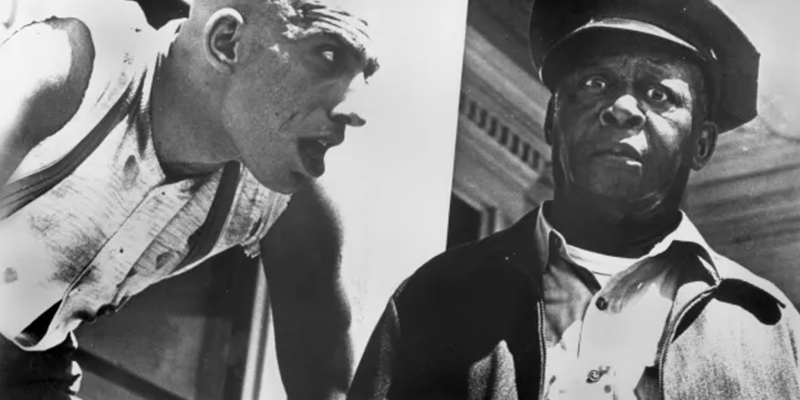
Spider Baby—released in 1968 but finished way back in 1964 before its producers went bankrupt and their assets, including the film, were frozen—actually doesn’t revel in explicit, bloody displays of violence like contemporary “splatter” films from Herschell Gordon Lewis. It does, however, gleefully mine the macabre (its original title being Cannibal Orgy) by telling the tale of a family of inbred, cannibalistic serial killers suffering from a degenerative mental illness that drives them increasingly insane as they age. And their first victim? The “Black Guy.”
The “B.G.” in question is portly comic legend Mantan Moreland, whose brief appearance in Spider Baby may be his most impactful role outside of his trailblazing heyday of the ’30s and ’40s, when he regularly starred in all-Black “race films” and played supporting roles in studio productions, most notably the long-running Charlie Chan series. These mysteries, along with horror fare like King of the Zombies (1941) and Revenge of the Zombies (1943), played to his vaudevillian strengths, cementing his legacy as a poster child for one of the primary Black archetypes used in horror movies: the “Spook.”
In the early days of cinema, the Spook was a happy-go-lucky, dim, nonthreatening sidekick (read: servant) who provided laughs with high-strung reactions to scary situations: wide-eyed exclamations like “Feets, do yo’ stuff!” Think Shaggy from Scooby Doo, as reimagined by D. W. Griffith. A celluloid descendent of minstrel show performances by bumbling blackfaced buffoons, this portrayal exploited the stereotype that Blacks were overly superstitious—and by inference, ignorant and cowardly. But in that kinder, gentler era, bloodletting wasn’t as much of a prerequisite for horror, and as the likable comic relief, Spooks were particularly safe from danger, despite their perennial paranoia.
Spider Baby writer-director Jack Hill, a protégé of B-movie king Roger Corman, chose Mantan Moreland in part to undermine those expectations. Moreland was recognizable to audiences as an amiable comedic actor who, in previous decades, would never die in a film. The shock of seeing him bumped off so viciously in the opening scene would set the tone for this audacious horror-comedy.5
In this way, Spider Baby helped introduce the modern horror concept of the Black character existing solely to die, adding to the bloodshed in order to establish the movie’s genre cred. Of course, in this new age of edgy horror, Black characters weren’t the only ones dying, but since Blacks were still allowed to play only ancillary roles, they suddenly found themselves in the cinematic crosshairs. And the more ancillary the role, the greater the chance they would die first, before the character is developed and audiences can come to sympathize with them. Not even Moreland’s charismatic charm could save him in this bloody new world order.
He plays a version of his old Spook character, in this instance an unnamed messenger delivering a letter to a creepy, isolated house straight out of the Norman Bates edition of Architectural Digest. After knocking on the front door, he asks, “Anybody home?” And then, using his well-honed comic skills, he ad libs his own punch line: “Please say yes, somebody’s home!”6 Unfortunately for him, someone IS home: a homicidal girl from a psychotic, inbred family, who slashes him to death when he peers inside an open window. It’s the end of one era and the start of another: the literal death of the old Spook stereotype and the birth of the B.G.D.F. (Black Guy Dies First).
_____________________________


Robin R. Means Coleman and Mark H. Harris
Dr. Robin R. Means Coleman is Northwestern's vice president and associate provost for diversity and inclusion. An internationally prominent and award-winning scholar, Dr. Coleman's work focuses on media studies and the cultural politics of Blackness. Dr. Coleman is the author of Horror Noire: Blacks in American Horror Films from the 1890s to Present and African American Viewers and the Black Situation Comedy: Situating Racial Humor. She is coauthor of Intercultural Communication for Everyday Life. She is the editor of Say It Loud: African American Audiences, Media, and Identity and coeditor of Fight the Power: The Spike Lee Reader. She is also the author of a number of other academic and popular publications. Dr. Coleman is featured in, and executive produced, the critically acclaimed documentary film Horror Noire which is based on her book Horror Noire: Blacks in American Horror Films from the 1890s to Present. Mark H. Harris is an entertainment journalist who has written about cinema and pop culture for over twenty years for New York magazine, Vulture, Rotten Tomatoes, About.com, PopMatters, Salem Horror Fest, Napster, MadAtoms, Pretty Scary, Ugly Planet, and THEiNDI. A lifelong horror fan, he created the website BlackHorrorMovies.com in 2005 as the premier online source chronicling the history of Black representation and achievement in horror cinema. He was a featured commentator in the acclaimed documentary Horror Noire and the Shudder series Behind the Monsters.