
Most novels are written in solitude. A single author with their laptop—slowly getting lonely, disappearing into plot knots, and opening and re-opening Instagram. My partner, Jo, kept saying: if we write a book together, it’ll be half as much work, and twice as much fun. I couldn’t help wondering if he was right.
We’re both writers, something that probably drew us to each other in the dating phase. We’d spent roughly a decade filling our spare time writing solo projects: screenplays, stage plays, and other ambitious ideas that taught us a lot but never made it into the world. We each dreamed of writing a novel one day, but like many people, we kept postponing it. Life was busy and writing a book felt enormous.
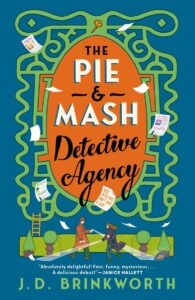
Then, six months before our wedding, Jo woke me up to tell me he’d had a dream. It involved two amateur detectives loosely inspired by us, named Jane Pye and Simon Mash (thus the Pie & Mash Detective Agency). While the premise was charming, I was forced to point out that it didn’t really have a plot. Two mornings later, he woke me again. He’d had another dream—this time, about an actual mystery, a genuinely clever one. For some reason, I only have dreams about cruise ship disasters. So we went along with his idea, and began writing our novel.
Later that year, under the pseudonym J. D. Brinkworth, we secured an agent and an international multi‑book deal with Penguin. Our debut series, The Pie & Mash Detective Agency, launches March 10, 2026. So, was writing as a pair “half as much work,” as Jo had promised?
Reader, it was not.
But it was worth it. If you’re considering co‑authoring a novel—whether with a partner, friend, or long‑suffering writing buddy—here’s what we learned the hard way.
1. Choose a partner for your weaknesses, not your similarities
On paper, my partner and I are mismatched writers. Our strengths barely overlap.
I obsess over dialogue, humor, and emotional texture. He obsesses over plot mechanics and mystery logic. I’ll happily polish a joke for an hour; he’ll happily diagram a murder timeline (then accidentally open that gory timeline during a presentation at work).
Our jigsaw-shaped mismatches have turned out to be ideal. When you write with someone else, complementary skills matter more than a shared voice. You want someone who notices what you routinely miss—and who is comfortable telling you when something isn’t working.
2. Plot more than you think you need to
Writers love to debate plotting versus “pantsing.” (We dislike the term intensely, but that’s another article.) Both approaches can work for solo authors.
For us, as co‑authors, plotting feels non‑negotiable. Passing the book back and forth, each making up the next chapter, may be how some writing partnerships do their best work. For us personally, it would feel like watching our masterpiece devolve into a mad lib, and would inevitably end with one of us frustrated that the other had chosen to end with “it was all a dream”.
We planned our first book while stuck at home with COVID, which gave us the time and space to talk through every major beat. We use a digital whiteboard (Miro) covered in virtual Post‑its: clues, jokes, character quirks, red herrings, emotional turns. Eventually, this turns into a detailed scene list in a shared Word document. By the time we started drafting, our plot outline was over 15,000 words long. We find that the clearer our roadmap, the fewer arguments we have later about where the story is “supposed” to go.
3. Don’t split the book in half
It’s tempting to divide chapters and conquer. It’s also a great way to end up with a novel that feels like two different books awkwardly stitched together. Instead, to keep our voice consistent, we use a relay system: one of us drafts an entire section, then hands it over to the other for a full rewrite before we continue. Every sentence passes through both brains at every stage. Yes, it means we each write roughly a book’s worth of words. But the voice stays cohesive, and the final product feels authored, not assembled.
(Again, plenty of successful author duos do actually divide and conquer, so take this with a pinch of salt – it’s just what works for us.)
4. Treat your partner as a bonus editor
A single change can ripple through a novel in unexpected ways. A small tweak in chapter three might quietly break chapter thirty.
A co‑author is not just somebody who writes with you: they’re also a second editor who understands the book inside out. Having this gift – an extra member of the editorial team who lives in your house with you – forces you to fix problems properly, not patch them temporarily.
And when you finally send the manuscript to your official editor, there’s an unexpected comfort in knowing that at least one other person has already decided the book is readable.
5. Use each other for accountability
The greatest practical benefit of writing together isn’t creative—it’s logistical.
When writing alone, procrastination is easy. When your co‑author is sitting by your desk, twiddling their thumbs because they’ve cancelled a rock‑climbing class to edit a chapter you haven’t finished yet, procrastination becomes . . . uncomfortable. Deadlines feel real when someone else is depending on you. Writing becomes a shared project, not a private intention.
6. Remember to enjoy it
One of the strangest things about adulthood is how rarely our biggest achievements are truly shared. You finish something monumental, and the world says, “Congratulations,” without fully understanding what it took, or how it feels.
Writing with a partner changes that. Every breakthrough, every rejection, every unexpected win is shared with someone who gets it. That joy is real— and rare.
Writing as a pair isn’t for everyone. It requires patience, communication, and a willingness to compromise constantly. But if you’re considering a collaboration with your BWF (Best Writing Friend)—or your spouse—consider this your nudge.
Start small. Get coffee. Talk it through.
And if it somehow ruins your relationship… we accept absolutely no responsibility.
Happy writing.
***