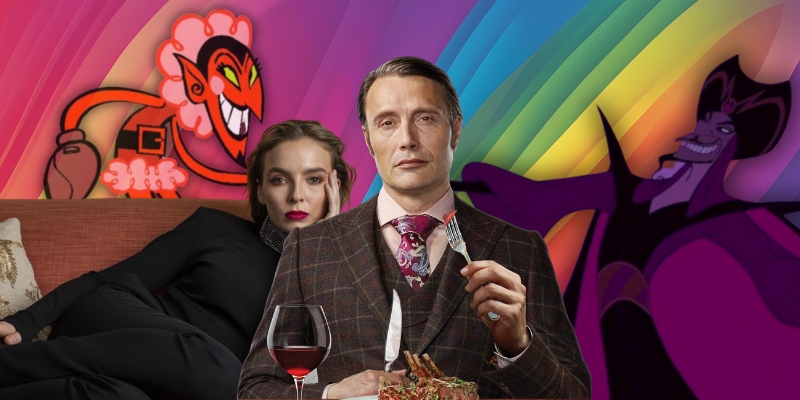
It’s one of those ‘once you see it, you can’t stop seeing it’ things: a lot of villains in media are…kinda gay. Characters like HIM in The Powerpuff Girls, Jafar in Aladdin, and Scar in The Lion King. They all seem to exhibit queer traits, or queer-coding.
It’s never bothered me as a queer person. Villains tend to be my favorite characters. They always seem to get the most compelling backstories, the most interesting character traits, the best design.
Narratively, that tracks. Any good antagonist needs a reason for their dubious morality—an origin story. The protagonist may be able to get away with “I want to help people because it’s the right thing to do,” but it’s much harder to justify why someone might want to cause harm.
Moreso, in order to be remembered by audiences who have an index of compelling villains to choose from, a good villain must be distinct. Since we get much less time with the antagonist, sometimes they have to stand out even more than the protagonist. Any hero is only as memorable as their villain, after all. So why are so many of them queer-coded?
Some of it could be audience interpretation. After all, queer-coding is just that—coding. It is never explicitly stated. Though, in the case of characters like Ursula in The Little Mermaid, who was inspired by drag queen Divine, it is more obvious. And when we look back on the history of censorship in media tracing back to The Hays Code, it becomes clear that there was once a point in history where filmmakers could get away with implying queerness only when it came to villain characters.
But with The Hays Code no longer in effect after 1968, this practice of assigning queer traits to villains did not disappear along with it. Of course, even with official censorship no longer in effect, homophobia did not just magically disappear. The continued trope of queer-coding villains could be queer writers and artists finding subtle ways to feel seen on screen.
Or maybe there’s just something inherently homoerotic about being that obsessed with your same-gender nemesis. It could also, of course, be the result of unconscious biases. In reality, it’s probably a mix of all that and more.
Despite this, almost all of these queer-coded villains are celebrated by the community. There is something beautiful about queer people wanting to accept everyone, especially outcasts.
Which is what a lot of villains are: misunderstood, mistreated people on the fringes of society. This may be why so many of these queer-coded evil characters are so celebrated: because it is an existence that many queer people can unfortunately relate to.
Some may argue that the queer-coded villain trope is harmful, to which I disagree. This trope can be dangerous when the only representation of queer people is as villains, however, I do not think that’s the case any longer. Queer media is becoming more and more mainstream with shows like Heated Rivalry and books like Bury Our Bones in the Midnight Soil.
So many different aspects of the queer experience are being shared and loved. I think it’s just as important to show that queer people can be immoral—just like any other human being can be. The sweet stories are just as important as the depraved ones.
So, the issue with gay villains is not the queer-coding itself. It’s that queer-coded villains throughout history lack depth and nuance. So the obvious solution is—make them gayer.
It wasn’t until very recently that queer-coded villains upgraded from stealing the show to center stage. Shows like NBC’s Hannibal (2013) and Killing Eve (2018) star villain characters. Hannibal and Villanelle are given backstories and character arcs whilst also not shying away from their more dark and deprived actions. They commit some of the worst sins: murder, betrayal, deception.
And yet the audience is enthralled by them, they cannot look away. There are moments where they might even feel compelled to root for them.
It is a sign of tremendous growth as a society that both Hannibal and Villanelle are allowed to be explicitly queer, with compelling on-screen love interests of their own. Especially since their queerness is never seen as one of their many sins. Yes, they make bad decisions, and yes, they are evil, but that is entirely separate from their queerness.
Their sexuality is not something these characters struggle with either. The concept that Hannibal and Villanelle are so messy that homophobia is the absolute least of their concerns is so refreshing.
This reclaiming of the queer-coded villain trope is still a relatively new one. There are still so many archetypes of villains to depict, so many aspects of queerness to celebrate.
That’s the heart of why I felt so compelled to write You’ll Never Forget Me, a story centering a South Asian lesbian who also unashamedly takes what she wants—even if it may come at the detriment of others. The Hollywood setting felt even more fitting when I learned about the history of censorship in filmmaking with The Hays Code.
Dimple Kapoor is a struggling actress, every aspect of her identity is one that is designed to be overlooked, and that’s what makes her such a good villain. She makes the wrong choices and she jumps through hoops to justify them to herself, but we also get to see her thought process, her origin story, and we get to sympathize with her.
It was just as important to me that her queerness could have nothing to do with her dubious morality. Even when her actions are questioned and when she experiences consequences as a result of them, her queerness is still something that is celebrated. Because if there is one thing I’ve learned, it’s that at the heart of the queer community there is always celebration.
***