The queer community is no stranger to horror. Life as we know it horrifies. Scarcely a minute goes by without gruesome news flashing across our close-held screens, casting stark light on the dangers LGBTQIA+ people contend with daily. Our acceptance and protection comes mostly in our own close-knit communities, while those in the highest offices care little for our survival, and indeed some actively campaign against it. How do we cope with such a reality? How do we live when the minutiae of our lives is so contentiously debated among our leaders and neighbors?
Speaking for myself, I read and write horror because I live it. I find comfort in the discomforting because in horror, the terror of our physical realities isn’t debated; it’s convention. Bodies are not expected to conform or behave politely. When horror protagonists have bodily autonomy wrenched violently away from them, there is no well-meaning justification. They scream. They fight. We who watch and read are granted catharsis. But reality, ironically, does not have the clean resolutions awarded in our slashers.
Not a day goes by without queer folks’ basic humanity and physical existence being politicized and judged. Though quips about “septum ring theory” and “blue hair and pronouns” may seem innocuous, they reveal that to many in the day-to-day, physicality reflects morality. Racism, ableism, anti-fatness, anti-queerness, and transphobia all take umbrage with the mere existence of bodies outside the “norm.” We are seen as abominable simply for how we take up space – when we have children (or don’t), when we have sex (or don’t), how we dance, eat, get medical care, dress ourselves, adorn our bodies, how we talk – the list goes on forever. The body is never neutral ground, and it is exhausting.
Is it any wonder, then, why the queer community is drawn to a genre where the loss of bodily control, and the transformation of the body into something horrific, is accepted and explored with care?
Horror provides us an outlet for the exploring of unruly bodies, where the transgressive and gruesome are accepted and celebrated. It puts to rest the tired conversation of how we should exist, and allows us to loudly assert that we do, for better or worse. Queerness thrives in horror, specifically body horror, because the transgressive is the rule, not the exception.
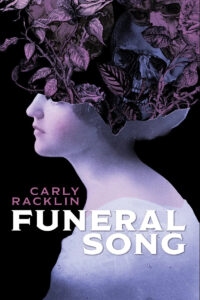
In Funeral Song, I set out to explore the trauma of striving to exist in a body that does not feel like your own, in a community that manipulates the body’s narrative to suit its own ends. In the town of Cairney, the dominant power is a religious one, that worships the gift of undeath, a gift bestowed upon the protagonist Friede specifically against her will. Friede and her wife Lor, in life, intentionally resisted the religious norms, planning to pass on to the unknown afterlife when their times came instead of join the ranks of the town’s revenants. In this way, even in a town that accepts queerness, Friede and Lor’s relationship is transgressive. They swear “until death” and not beyond.
After Friede’s murder and subsequent resurrection by her best friend Bastian, her body becomes a reminder of her greatest betrayal, but no one in Cairney acknowledges this as such. They cannot conceive of a narrative for the body outside of the social and spiritual norm. Just as the seeking of gender-affirming care in our world is demonized, those in Friede’s world see her insistence on bodily autonomy as an insult to the powers that be. This body dysmorphia drives Friede’s main conflict in the book.
This struggle is even more prominent for Lor, whose quest for autonomy in a life ravaged by pain leaves the bloodiest trail by far, culminating in her transformation into a dybbuk—a possessing spirit in search of a body that feels like home. Lor’s scenes comprise the most gruesome of the book, and those most befitting of the body horror label. It is her fight for bodily autonomy that sets the plot of Funeral Song in motion.
I found another exploration of this theme in Gretchen Felker-Martin’s Black Flame, one of my favorite recent reads. The intensely-closeted protagonist Ellen constantly contends with commentary on her body, from her family, in her workplace, and from herself most of all. Her mother’s cries of, “you’re mutilated!” when Ellen is accidentally (and possibly supernaturally) injured at work take on a new significance when Ellen later finds freedom in fantasies of mutilation. After suffering compounding violations, she thinks, “I wish I was a monster. I wish I was a man.” The tension of the novel escalates in time with the afflictions festering in Ellen’s body and mind, and her growing acknowledgement of her queerness takes shape in tandem.
The moment when Ellen decides to cut her hair stands out as a triumph, one where her gender euphoria is palpable. But her act of agency disgusts her overbearing mother. Visible queerness is disgusting to some, but a comfort to us. As becomes true for Ellen, the disgust visibility earns can be a kind of power, but it can also be a danger. The weight of these truths can’t be overlooked; they are all critical to the conversation when it comes to queerness in horror and beyond.
This leads me to an interesting conundrum: the problem of visibility. For too long, visibility has been dangerous for queer and trans folks. When we’re out and proud, we unsettle, and can put ourselves at risk of severe harm. When we shirk visibility, we’re seen as self-hating, hiding in the closet. How can we win? Though it is painful to reckon with, the reality is that visibility does not protect us. A growing number of pride parades does not change the fact that, far too often, visibility directly endangers us.
Conversations about queer visibility (and in the world of literature, queer representation) miss the point, in my opinion. Without acceptance, visibility is a toothless cause. Queer and trans people have always existed, and we will continue to exist, visibly or otherwise, and our visibility has nothing to do with our worth. We are part of a whole, whether deep in the closet or out in the sun. But we deserve more than dark corners.
Those who hate us will call us monsters no matter where we dwell. They want nothing more than to degrade us into disappearing. Yes, in fiction we can accept and explore monstrosity on our own terms; we can fantasize a different world. But the business of making one happens off-page.
I don’t want a safe place for my community to only exist in books. Our horrific, bloody tales can help pave the way to the world we want to see, but we must set our sharpened teeth to the task with the same fervor and ferocity with which we set our pens to paper. I believe the highest purpose of fiction is not to escape reality, but to reckon with it. We can’t do that from the shadows or from spilled ink alone.
***