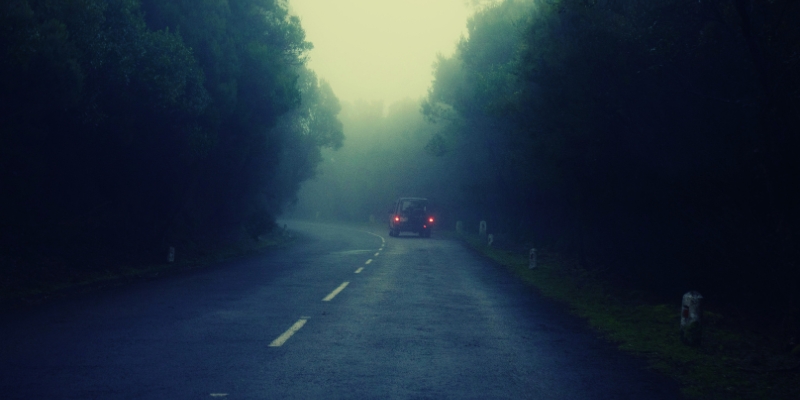
The open road has long been a symbol of freedom; a blank stretch of land ignorant of your past that offers nothing more than a fresh start, an opportunity to shed your old skin and become someone new. And if those open roads are flanked by dark ditches, shadowed forests, by farmhouses with black windows and broken doors, who cares? We’re finally free…right?
But us, clever readers; we know better. The promise made by that wide sweep of land is an illusion, as skewed by our hope as the horizon is skewed by the rising heat from the asphalt. After all, why do we need that open road unless we have something to run from?
And if the thing we’re escaping is a dead body—paired with either punishment or the fear that we might be next—then the stakes are suddenly skyscraper high. Because what is freedom if not the chance to live unconfined and without threat? And when our mortality and liberty are at stake, that threat forces everything else into focus, including our own humanity.
For many crime novels, the humanity lies at the victim’s feet. We’re encouraged to understand who they are in order to work out who might have wanted them dead; a who-were-they as much as a whodunnit. On a road trip, when our focus is lasered on the lives of our hero, or antihero, or a human just trying their best to survive the wildness of life on earth, the humanity is tucked deep inside the protagonist’s back pocket. They’ve taken a life; how will they morally, emotionally and physically survive?
Take one of the most well-known and loved road trips of all time: Thelma and Louise. Here, the critical murder doesn’t simply represent near and present danger—in this case in the form of a would-be rapist had Louise not pulled that gun—but a shedding of skin, a determination to not accept the life laid out for them, either in the parking lot of that dive bar or in their kitchens back home.
The act forces their hand and makes the decision: you will go forward, forward, forward: you can never go back. If murder in a standard crime novel represents the axis of action, on a road trip it is a guillotine separating past and future, confinement and liberty, hope and the death of all hope.
That idea of “back there” is as important as the road trip’s destination, if not more so. For Thelma and Louise, it promises either a potential murder charge and death sentence, or a life of stifling dissatisfaction and monotony, filled with unhappy marriages, lackluster jobs and little chance of improvement or escape. If the police don’t believe it was self-defense they’ll be locked in prison. If they do, the two women will be locked inside their past lives. They would rather keep on driving, even when the asphalt runs out.
Sometimes, however, those deaths represent a firm psychological shift, particularly when that asphalt seems never ending.
In Cormac McCarthy’s The Road, the land ahead is starkly similar to the land behind and tomorrow offers nothing more or less than yesterday, yet the characters must journey on. There is no life they are fleeing, no social situation they dread, only the father’s desire to keep his son alive in a post-apocalyptic world by moving him ever forward on a long, lonely and dangerous road.
The first death not only represents a change in pace—again, we must go forward because it’s not safe behind—it is also the first step in the boy’s realization that life is more complicated than hero versus villain, good versus bad. Who is his father, really, if his father—this man who has kept him alive in the direst of circumstances—is capable of murder without regret?
The journey forward is as much about him finding himself and understanding his father as it is about seeking safety and survival. What is life if we do not know ourselves? What is freedom if there is no humanity?
The deaths in Harmless Women offer similar guillotine moments for the thief Avalon, and her intended target, Prim. Here, a series of murders sever Avalon and Prim from their pasts, disrupt the presumed trajectory of their lives and force them into a wide, open landscape that offers them little but each other. Later, these deaths represent something else; not just the lengths the women would go to for self-preservation, but how far they would go to keep others safe.
Can you be a villain and a hero? Can you, as Avalon so fervently wants to believe, make up for past catastrophes by saving someone else from a similar fate? And can you place your liberty in someone else’s hands if you’ve witnessed them take a life?
Murder on the open road becomes a fight for freedom, but it also makes us question what that freedom means to us, how far we would go to protect it and, in the case of Harmless Women, how far we would go to protect the personal, emotional and mental freedom of those who stand by our side.
***