First, a promise: This is not one of those introductions that assumes you’ve already read the book. No spoilers. It’s safe to keep reading.
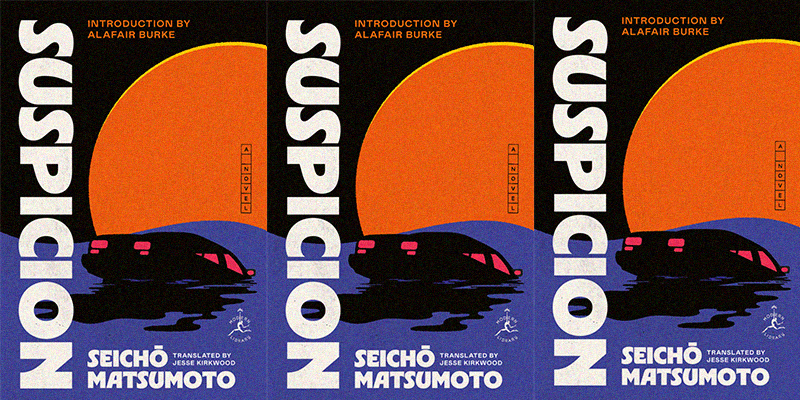
Second, a confession: When I received the email inviting me to write this introduction, I had never read Seichō Matsumoto. Also, I was in a rut, both in my reading and my writing (the confessions keep coming). Most of what I’d been reading lately was sent to me unsolicited by publishers. Lucky me to get early reads of some wonderful novels, but the books were sent to me for a reason. They fell squarely within my lanes: domestic and psychological suspense and legal thrillers. And on the writing front, I found myself questioning my current novel-in-progress to the point of near paralysis. Had I read so many page-turners with killer plot twists that I was doubting my ability to keep landing my own?
Writing this introduction felt like a well-timed solution to both of my problems—a 1982 novella by Japan’s best-known crime writer would surely be different from the contemporary American suspense in which I’d immersed myself, and it would allow me to write something other than that godforsaken novel that refused to be cracked.
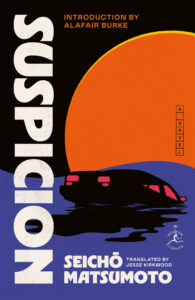
I had no idea that reading Suspicion and taking time to reflect on where it fits within the crime fiction genre would turn into a master class on what makes for a terrific crime novel and a reminder of why I love to write them.
Playing “What If?”
Like many novelists, Matsumoto was often inspired by real-life cases. But good writers do more than rip from the headlines. They ask themselves, “What if this happened next?” or “What if he did x instead of y?” until they develop story, character, and their own take on that initial kernel of an idea. And the direction of those “what if?” questions often reveals the themes that most interest a writer.
Suspicion was loosely based on an infamous 1974 crime known as “the Beppu 300 million yen insurance murder.” A car crashed off a ferry dock into the sea, killing a woman and her two children. The sole survivor of the accident was the woman’s husband, an ex-convict she had only recently married. The man insisted that his wife had been driving, but suspicions arose when police learned that he had recently taken out several different insurance policies on his new wife and stepchildren. After appearing on a live television show to proclaim his innocence, he was arrested backstage and charged with murder.
Matsumoto retained those basic facts for his story but . . . What if? What if the one who dies in the accident is the husband? And what if the surviving newlywed wife is a beautiful woman with a shady past? And what if an ambitious local reporter builds his name on a series of articles portraying the wife as a cold-hearted killer? And what if the public’s hatred of the woman is so intense that even her own defense lawyers fear for their reputations if she were acquitted?
Each of these “what if?” moves allowed Matsumoto to take the simple setup of the real-world case to fresh and surprising places. Switching the surviving spouse from a husband to a wife gave Matsumoto room to play with the gendered stereotype of a gold-digging, city-slicking temptress fleecing a guileless old man from the country. When Kumako Onizuka is depicted in the press “as some sort of femme fatale,” is the reader supposed to accept this characterization, or wonder whether she’s the victim of easily digestible tropes? Adding to the ambiguity is Matsumoto’s decision to keep our femme fatale completely off the page. We learn about her only through the thoughts and dialogue of our male characters—the reporter who’s convinced that she’s a killer, and the defense lawyers who may or may not believe her.
These men seemingly can do nothing but think and talk about Onizuka, repeatedly emphasizing the ways that she fails to conform to societal expectations for a proper woman of the time and place. Physically, “she’s a big woman,” “five foot seven, nine and a half stone.” She’s “the buxom type,” “tall and glamorously proportioned.” She’s vocal, talking to anyone who will listen, impossible to stop once she gets rolling, thrusting out her chest when she speaks, “which, given her figure, makes quite an impression.” She’s a high-school dropout with a hot temper and ties to organized crime. Even the first letters of her name symbolize danger, as the character “oni” (鬼) means “demon.” Like her real-world male counterpart, Onizuka stars in a media tour up to the very moment of her arrest, appearing on television shows to swear that the crime was a tragic accident. But can such a large, loud, and scandalous woman possibly get a fair shake?
Matsumoto’s “what ifs” about the ambitious local reporter and Onizuka’s conflicted defense attorneys allowed him to portray both the media and the criminal justice system in ways that feel surprisingly contemporary. Matsumoto explores whether Onizuka can be adjudicated fairly when one-sided, high-profile media coverage shapes the public’s opinion of guilt or innocence before the trial even commences. He poses the question of whether the intrepid reporter is searching for an objective truth or allowing his own implicit biases to shape his version of reality, which he then feeds to the public. The reader wonders whether Onizuka’s lawyers care more about their client or themselves. Matsumoto manages to incorporate what would have then been cutting-edge social science to demonstrate the malleability and fallibility of human memory and some leading causes of mistaken eyewitness identification. When I got to the pages that included notes from the trial transcript, I felt like I had slipped into a Scott Turow or John Grisham legal thriller . . .
And then I found myself thinking about that novel of mine that refuses to crack. What if I change the victim to . . . ? And suppose ten years earlier . . . ? Oh . . . now that’s interesting.
“Motive: That’s What Interests Me”
When readers pick up a crime novel, they expect a puzzle, a mystery, that aha moment when all the clues come together to reveal the solution. Matsumoto’s Japanese predecessors largely met those expectations, producing traditional mysteries that emphasized deduction and puzzle-solving (think the locked-room whodunnits of Agatha Christie or Ellery Queen).
But according to one of Matsumoto’s former editors, Yomota Takashi, part of what drove him as an author was the reason behind a crime instead of the bare facts. According to Takashi, the author would often say, “Motive: that’s what interests me.” Why do people commit crimes? What makes an otherwise ordinary person engage in horrific acts? When and how are the seeds of the idea planted? And what can those deeds tell us about society, our institutions, and even ourselves?
Why did Onizuka marry Shirakawa, and why might she have killed him? Why did he marry her, and why might he have planned to divorce her? In Suspicion, Matsumoto searches the potential motives of not only his suspect and victim, but all his characters.
Why is this ambitious local reporter, Moichi Akitani, so convinced that Onizuka’s guilt is “beyond doubt,” when the evidence we learn about is entirely circumstantial? Why does he go so far as to suggest to her own defense attorneys that they should abandon her? Is it because she offends so many of his expectations of what a woman should be? Or could it be because the tabloid reporters from Tokyo have come to town all because of his series of articles? He can’t possibly be wrong, could he?
As the reader watches the initially cocky and confident Akitani begin to doubt his own convictions, his internal mental conflict becomes a source of tension and eerie sense of paranoia that today’s readers might expect from writers like Gillian Flynn, Laura Lippman, Tana French, and Megan Abbott.
So . . . Play what if. Justice isn’t always tidy. Focus on motives. Show your characters’ interior conflicts. Matsumoto is reminding me of what I love about good crime fiction. Maybe there’s a way out of this rut.
What else can I learn here? Turns out, you’ve got to keep doing the work.
“There Is No Vacation from Writing”
Born an only child in 1909, Matsumoto grew up in modest circumstances and completed only elementary school, but he educated himself through a passionate love of reading and eventually became a journalist and editor at The Asahi Shimbun, one of the oldest newspapers in Japan.
His first foray into fiction did not come until he was forty, when he entered a short story into a magazine contest and came in third. Two years later, he was awarded the prestigious Akutagawa Prize for his autobiographical story “Aru ‘Kokura nikki’ den.” But it was his transition to crime fiction that brought him commercial success. His first detective novel went on to sell more than a million copies, introducing him to a worldwide readership.
Profiles of Matsumoto depict the author as a devoted writer who would sometimes work on five manuscripts at once, often writing around the clock and calling his editors anytime, day or night. A favorite mantra was “there is no vacation from writing,” and he was still writing his latest and forever unfinished work-in-progress when he passed away at the age of eighty-two.
Learning about his dedication had me remembering how lucky I felt when I published my first novel and how excited (and terrified) I was to owe my publisher a second. I never dreamed that twenty-two years later, I would have authored fifteen novels and co-authored another eight with the Queen of Suspense, Mary Higgins Clark, whose novels I read as a child. I think about my father (James Lee Burke), who continued to write every day for more than a decade after his first few books fell out of print, who still writes every day at the age of eighty-eight after authoring more than forty novels since his first crime novel got him published again. I think about the fact that Mary and I were still exchanging pages only two days before she would pass.
There is—or should be—no vacation from writing.
So goodbye, rut. When I hit “send” on this introduction, I will be back at it, making up my own stories, hoping that forty years from now, an author like me might be asked to write an introduction for a reissue of one of my novels.
Happy reading.
__________________________