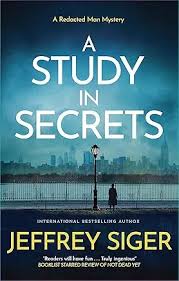
After having had fourteen critically acclaimed police procedurals about Greek Chief Inspector Andreas Kaldis published, I decided to risk publishing a brand-new mystery series—one set in New York City featuring a Sherlock Holmes-worthy amateur sleuth possessing a complicated retired-secret-agent past (think George Smiley). Michael A is a true gentleman who lives a quiet, comfortable life since retiring from the intelligence services. Practically a recluse and partially handicapped, he spends his days imagining the lives of the anonymous people he watches in the park beneath the windows of his elegant New York City townhouse–number 221–his every need tended to by his housekeeper, Mrs. Baker.
It’s been a long time in coming, but A Study in Secrets is the debut novel in my new “Redacted Man” series. Michael A is the protagonist I’ve sought to bring to life for decades; borne of my nearly lifelong fascination with Sherlock Holmes.
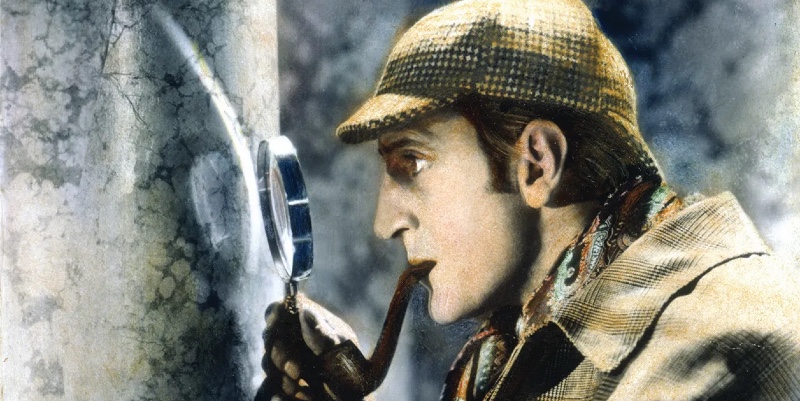
It all began when I was about twelve and toying with the idea of becoming a writer, I received a compendium of Conan Doyle’s four novels and 56 short stories as a birthday gift. It was a welcome change from the many copies of Huckleberry Finn I’d received on past birthdays from well-meaning gift-givers. But back then, I never immersed myself fully into the Holmes canon. Rather, I kept telling myself that one day—when I had time—I’d read those brilliant works in their entirety.
That opportunity took almost twenty years to present itself. I was a Wall Street lawyer and had injured my back in a manner that laid me up for more than a month. Only then did I take the opportunity to read all of the Sherlock Holmes stories and novels.
By the time I’d finished I’d come to appreciate Conan Doyle’s gift for Victorian prose and his keen insights into the human condition. So much so that I was often able to solve many of the mysteries before their actual denouement.
So, why did it take me so long to actually write A Study in Secrets? The answer is twofold. First, we must acknowledge the general reluctance on the part of many publishers (and authors) to risk losing an established audience for an author’s already proven series—in my case, Chief Inspector Kaldis.
But a more significant element involves the Fates—and a different 12-year-old boy.
I’d left Wall Street and was brainstorming on how to move beyond the Inspector Kaldis series.
I first envisioned a character who typically imagined the lives being lived by strangers passing into a park beneath his windows –never realizing that once out of his sight, their actual and his imagined lives for them merged into one.
I’d had no trouble writing the first chapter, nor in selecting a New York City neighborhood for the setting. I’d come to know NYC well, having practiced law there amid a raucous five decades. But I still couldn’t bring myself to write beyond that first chapter…
Until the Fates intervened.
It began at a taverna on my Greek island home of Mykonos, when great friends from London brought their three children to lunch, their youngest being twelve. Let’s call him Dimitri. His parents had asked me about the new Kaldis mystery I was working on.
That’s when Dimitri asked if I was working on anything else. I smiled and told him about the book I wanted to write, but was stymied getting beyond the first chapter. He politely asked me questions about the setting, the plot, and the characters. I tried to keep up with a barrage of questions that would have done the most probing of editors proud.
Fast forward two years. I’m back on Mykonos, once again having lunch with my friends and their youngest son. Dimitri asked me how the writing was going. I told him all was fine with Kaldis.
But immediately he asked me about that other book. I told him I’d not made much progress on that front because I was concentrating on the Greek series. With a rueful look he said, “I’ve thought a lot about our conversation the last time we had lunch together, and I think the problem you’re having is, you’re trying to introduce too many characters. Each one has three lives—the perceived, actual and resultant. That’s too many characters and permutations for you to juggle.”
I sat there dumbfounded. He was right! I was stuck because I was trying too hard to create multiple complex characters antithetical to the fast-paced framework and through-line that underlies my other work. I was trying to juggle two sets of balls per character, each of different shapes and weights, only to then merge them into a third set even more complex than the first two.
Bottom line: it wasn’t the sort of book I wanted to write. Somehow that young man had intuited that fact. Now I had a clear path for the new series revealed to me.
So here we are, and the Redacted Man series is ready for its debut.
My takeaway from this decade-long Odyssey to create an homage to Sherlock Holmes is simple: Don’t underestimate the role of the Fates in how things turn out by dismissing signs of their presence as mere coincidence. I feel particularly strong on that point, for in the context of A Study in Secrets there are tangible signs of something more magical than serendipity at play.
Specifically: the three sister Fates as a group are called the Moirai… Interesting because the adversary most often found threatening Holmes’ fate is named Moriarty.
Also, my new publisher’s initials are S. H. (for Severn House).
But most significantly—Sherlock Holmes’s father’s name was revealed to be… SIGER HOLMES.
So, for all of their much-appreciated assistance, I thank those dear Fates… along with wise young Dimitri.
***