I had spotted the man earlier on. He didn’t quite fit in the usual mid-morning crowd. I was in one of those medieval European cities full of twisty streets that are useless for cars and little alleyways that lead you to a huge gothic cathedral. The kind of place where you have every reason to stop, to linger in front of a fascinating building or duck into a little café to down a quick espresso. In short, a perfect place to figure out if you have a tail.
The first time I’d seen the man, I’d thought he wasn’t quite well dressed enough to be an office worker in a European city. But nor was he a tourist: he didn’t look like he was enjoying himself. Instead, he had a military bearing, a purposeful look.
Surveillance teams recruit “grey” men—the sort of everyman that you see and forget. But this man was too grey—everything about him was nondescript, except an inability to pretend to be interested in shopping. I saw him a second time as I stepped out of a café. He was feigning an unconvincing interest in a window display of porcelain ornaments. That was enough.
Spotting a follower, or more often a team of them, a technique known as anti-surveillance, is one of the basic skills of espionage. If you want to meet your source you need to be sure that nobody sees you do that.
But there’s more to it than just spotting: you need not to give anyone following you the slightest reason to suspect you of being a spy at all. Someone who keeps stopping and turning around, obviously looking for followers, is telling the world that they are an intelligence officer.
For this reason, it is drummed into spies in training that their behavior has to appear “natural.” What does “natural” mean? It doesn’t mean, “don’t worry, do whatever comes naturally.” It means that you’re constantly thinking about your behavior, asking yourself if it can be justified, if it fits your ostensible reason for being there. It means you don’t look over your shoulder for followers, but perhaps when crossing the street, you take the opportunity to do a sweep of the people coming up behind you. It means that if you go into a café to grab a coffee, you aren’t going to be able to do that again ten minutes later.
If your normal pattern of life involves you walking to an embassy office and spending most of the day at your desk, the day you wander through narrow streets like an unhurried tourist, you’re sending the message that you’re doing something unusual and interesting.
So, being a spy means thinking like a spy, all of the time. A kind of muscle memory. It’s not just about spotting followers. It’s about imagining that everything you do is watched and judged.
These habits die hard. When I go into a bar or a coffee shop, I try to do an inventory of all the faces I can see, to commit them to memory, even though I have no reason to believe that anyone is taking the remotest interest in me. Some people call it paranoia, or hypervigilance. In the world of intelligence officers, we call it keeping our sources alive.
In my first novel, A Spy Alone, I open the book with a description of my protagonist, Simon Sharman, realizing that he is being followed, having relied on a traditional method of spies everywhere—staring at shoes: “it is their shoes that give them away… a walker might change their jackets, pull on a pair of glasses, even a wig. But nobody changes their shoes on a job.”
He has already used another distraction tactic to throw some of his followers off course: “earlier that day, Simon had deliberately left his phone on a train at Reading, switched on and broadcasting a false trail as it headed into the West Country.”
Like any profession, espionage has its own culture, its specific techniques, a language all of its own. But unlike many professions, in the spy world, these are largely hidden from outsiders. Coming to spy writing as a former intelligence officer is a huge advantage if you want to write realistic contemporary espionage fiction.
It’s not that those who haven’t worked in this world can’t write believable stories: many have, often helped by extensive research and interactions with former intelligence officers. In recent years, the authors Merle Nygate, Charles Cumming and Simon Conway are all examples of people writing excellent novels about contemporary spies that are full of fascinating detail which I recommend highly.
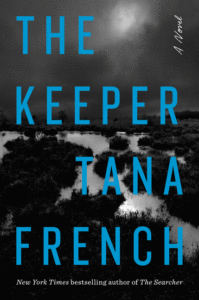
But if I was to pick out two authors who have written novels from a perspective of having worked in intelligence themselves, I would point to David McCloskey and I.S. Berry, both of whom served in the CIA. There’s something about having “been there, done that” which can give a real frisson to the reader.
For example, McCloskey’s Moscow X is probably the best contemporary account of the shadow war being fought between Russia and the United States, including the use of non-official cover (NOC) officers. Berry’s novel The Peacock and the Sparrow gives an insider’s account of the Arab Spring that is more insightful than numerous nonfiction narratives I have read.
McCloskey and Berry are in a long tradition of intelligence professionals turned authors: most famously, John le Carré, but also Graham Greene, Somerset Maugham and John Buchan, all giants of twentieth-century spy literature. Having worked as an intelligence officer in various war zones and unstable countries certainly has made it much it easier for me to write about them.
My second novel, A Spy at War, set in Ukraine after the 2022 Russian invasion, draws on my own visits to that country since the war began, as well as numerous conversations with journalists, spies, special forces soldiers and other experts, to give a feel for what it’s like on the frontlines.
But the story also unfolds in meeting rooms in London and in smart hotels in Geneva. I wanted the reader to understand that Ukraine’s fate is as much about an information war in the West as it is about the armed struggle on the battlefield.
I also wanted people to know that spies are not always heroes. Often, they are very ordinary people finding themselves trying to do a very difficult job in impossible circumstances. In that sense, I couldn’t put it better than Le Carré himself, who wrote that he felt his work’s chief merit, “was not that it was authentic, but that it was credible.” In a world as mysterious and opaque as espionage, achieving credibility may be the ultimate goal.
***