In 2007, I spent a chunk of the summer in the glorious Canadian Rockies, a land of towering, snowy peaks and sapphire and emerald lakes glistening like hidden jewels in the mountain valleys. Teal rivers wind along sweeping valley floors, vistas almost too beautiful to believe.
While camped at the Columbia Icefield, I came across a missing poster for Stephanie Stewart, a fire tower worker who had vanished the summer before. She’d worked this same fire tower for more than twelve seasons, keeping watch for forest fires in the stunning landscape just outside Jasper National Park. The poster showed her smiling, bespectacled face framed by tousled grey and auburn hair. It listed her height as 5’ 2”. She weighed only 105 pounds.
The case drew me in, and I looked into her life. At seventy years old, she was not only a seasoned fire tower worker, but she loved nature and exploring the outdoors. She had recently cycled solo across Canada and had climbed Mt. Kilimanjaro the year before. As someone who hiked and camped extensively and spent a lot of time in remote parts of the wilderness, I felt a strong kinship with her. I longed to know what had become of this lively woman who loved her job and cared about nature like I did.
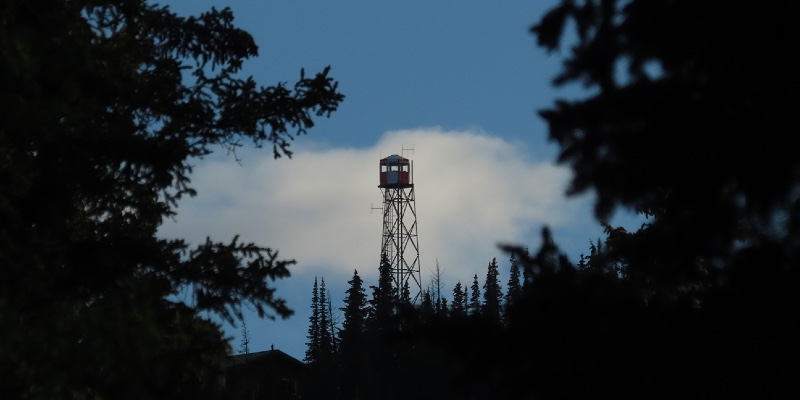
Stephanie worked at the Athabasca Fire Tower in William Switzer Provincial Park, just east of Jasper National Park. It’s a steep and densely treed area where the teal and white Athabasca River winds through the forest. The tower itself, with its orange and white observation enclosure at the top, looms above the surrounding terrain. At the base stands a house where the fire tower worker lives. Here Stephanie spent her off hours painting, reading, and tending a large garden. Every morning she would boil water to use throughout the day. She was a strong, resilient, and dependable person who radioed in to base on time every day. The night before she vanished, she talked to her family on the phone at 9 p.m.
But on the morning of Saturday, August 26, 2006, she didn’t radio in. Her supervisor tried to call her. Someone picked up the phone, said nothing, and hung up. The supervisor tried again. Then the phone was disconnected. So he sent an employee out to the tower to check on her. Back then, you could drive up a steep, pitted, dirt road to the tower. When the employee arrived, they found blood on the stairs leading up to the house. Water set to boil on the stove was still warm, as if she’d been interrupted in her morning ritual. Stephanie was nowhere in sight. Other things were missing, too — her gold analog watch, a duvet, a burgundy bedsheet, and two pillows with blue cases from her room.
Immediately law enforcement was called in. Authorities ruled out an accident and a medical event, as Stewart was incredibly fit with no known health issues. They also eliminated the possibility of any kind of animal attack. Not only are animal attacks exceedingly rare, but an animal would not have taken the pillows and bedding and watch. Nor would it have unplugged the phone, as had been done. A massive search and rescue operation began. Hundreds of searchers scoured the area. A tipline was set up for any hints from the public. Scent dogs were brought in. The search went on for days.
But no sign of Stephanie was ever seen again. Neither her nor her missing items were ever found.
In 2018, a renewed search took place, with more than 100 individuals, including from the Royal Canadian Mounted Police, search and rescue, and an underwater recovery team. Once again they combed the area where she vanished. But found nothing.
Last summer, after following the case all these years, I wanted to see the area firsthand. I hiked up to where the tower stands. I wanted to get a better sense of the terrain, of how she could have disappeared with no witnesses, of how someone could have left the area with her, perhaps wrapped in those blankets, or hidden her somewhere nearby.
You can no longer drive up to the house. Stephanie’s disappearance led Alberta to tighten security at all of its 128 fire towers. A locked gate prevents unauthorized persons from accessing the area in a vehicle. Fire watchers are now trained in self-defense and equipped with two-way radios with panic buttons.
So I made the trek on foot via the Athabasca Lookout Trail. At the trailhead, I spotted a faded missing poster for Stephanie stapled to the trail kiosk. The route itself is an incredibly steep trek enclosed in trees. I climbed the rugged terrain, stopping repeatedly to gaze at the surrounding topography, wondering how often Stephanie had walked along this very route. At last I emerged at the top to a breathtaking view of dramatic, jagged peaks and an emerald valley below. Clouds gathered over the mountains in the distance, and the wind brought with it the scent of sun-warmed pine. Above me, the fire tower stretched up into a searingly blue sky. I got a true sense of how she had lived and what joy she must have gotten from the stunning scenery around her.
So what had happened to Stephanie Stewart? She didn’t leave to start a new life. Her truck was still parked at the house the day she vanished. The tower is located 3.6 miles from Highway 40, a main route, and back then, the public could visit fire tower workers, and thousands of hikers did this every season. Stephanie regularly welcomed such visitors.
Did some member of the public stop by the tower sometime between when she last spoke to her family at 9 pm the night before she vanished, and in the morning when she began boiling the day’s water? Did an altercation take place, resulting in her kidnapping or death? Did the person know Stephanie previously or was the attack random? Did someone come by hoping to rob the place, thinking no one would be in the house? To me, it seems an extremely unlikely location to go looking for money or valuables.
As I stood gazing up at the tower, I was struck by the steep, dense nature of the forest around me. It would be difficult to heft a body around on foot in such rugged terrain. Wrapping her in a blanket and placing her in a car seemed much more likely. Because scent dogs at the time did not find a trace of her in the tower’s vicinity, this further made me think she was transported elsewhere. And since her own truck was still parked at the tower, it made me think whoever had done this used their own car to transport her. Which meant they went in and out on the pitted, rugged, 4WD road up to the residence that is now gated off. The 3.6 miles of roads from the tower out to Highway 40 are dirt and rough in places, forcing a car to go slowly. Did a hiker, on their way to enjoy the trails in the park, see the perpetrator’s car drive out that morning? Could the employee who checked on her even have passed it?
There are so many questions. I think of Stephanie and her family often, and am upset and horrified that someone took her from the life she loved so much, a protector of the forests, a lover of nature. Perhaps one day someone who knows something will come forward, or something of hers will be found out there, providing a lead in the investigation. But for now, her disappearance remains a complete mystery.
A $20,000 reward has been offered by the Alberta government and the Alberta Union of Provincial Employees. Anyone with any information is urged to call Hinton RCMP at 780-865-2455. If you want to remain anonymous, you can call Canadian Crime Stoppers at 1-800-222-TIPS (8477).
***