The suburbs are typically seen as safe—it’s even an adjective; “suburban” is used to describe something as tame, conventional, a little boring. In real life, people gravitate towards the suburbs for safety and stability, and in fiction, we love to explore this.
The idea of the manicured lawn and the gleaming windows hiding all kinds of secrets and danger once you scratch the surface. Traditionally, the secrets and danger come from inside the house, or from neighbors who aren’t what they seem, or sinister strangers who encroach on the suburban idyll, disrupting utopia.
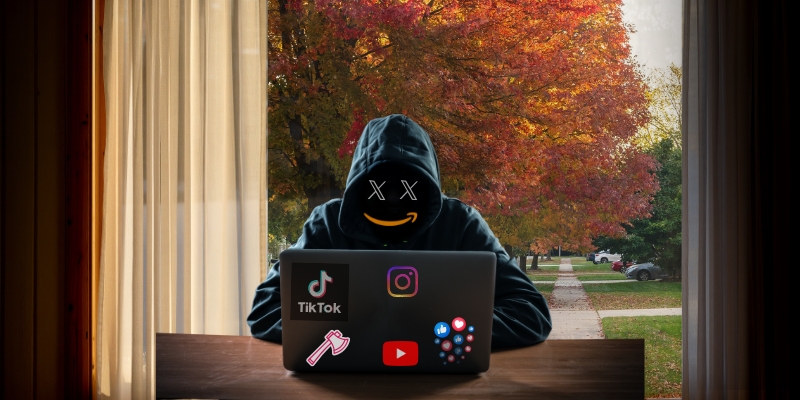
But today, there’s a new intruder. We can lock our doors and windows against the real world but it’s much more difficult to keep the virtual world at bay. The internet and social media can creep in through every crack of our lives, into the darkest corners, onto our laptops, onto our children’s phones.
In real life, social media can disrupt, terrorize, and haunt. So how does this affect fiction—why are stories involving social media so relatable and does online threat make stories darker and more terrifying? And for the author, does it make the challenge greater, or does it give us a whole new world to explore?
Picture this. The gated complex. The long driveway. The imposing double-fronted house with its locks and its keys and its codes. The family indoors, protected from the outside world. The parents, keeping their children out of harm’s away. The children, safe inside. Those same children, talking on their phones, typing on their screens. The messages coming back. The messages that might be from anyone, anywhere.
In the twenty-first century, even in the safest places, can we ever keep ourselves truly protected from the outside world?
Parents make plans. We won’t let them have phones in their rooms or until they’re teens or actually—maybe not at all. We’ll check their phones, every night. Every other night at least. Every now and then. The best laid plans….
For every parent who successfully monitors their teen’s social media, there’s another—like me—who fails. If you’d asked me five years ago if I’d let my kids have unfettered access to screens, I’d have said no way.
But then they became teenagers. And I remembered what it was like when I was their age—how important it was to speak to my friends at every opportunity. Pulling the house phone into the small den off the hall so I could speak in private. Talking about boys we liked, what we’d wear to the disco. How I’d have hated if my parents listened in on those calls. How my kids need to be able to chat to their friends in private too.
Only we don’t have a house phone and my kids don’t call their friends—they message on social media. So I found ways to check their phones a little, but without reading all of their private messages. And bit by bit, they got older, and checking didn’t feel quite right, and I found I left them in peace. Instead, I process my fears for my kids through writing books.
And of course it’s not just children who are subject to harm from social media. Adults too can be trolled, cyberbullied, catfished, scammed. Deep fake videos look astonishingly credible, and AI brings a whole new scope for cons. How can we ever know if anything is real anymore?
This—the pervasive and invasive element of social media—is something I explore in my novel, Someone In The Attic. Julia has just moved to a luxury gated complex with her two children. The house is in a leafy, wealthy suburb in south Dublin, and there are locks and codes to keep her children safe.
But then her teenage daughter, Isla, sees a video on TikTok that seems to be filmed inside their house. The video shows a masked figure letting themselves out of the attic and creeping around their home. Julia has to work out, is it real or fake? Is there someone in the attic?
The idea for the book came from TikTok—a video my daughter found which appeared to show a girl being kidnapped. I explained it was a set-up, a pretend kidnap for TikTok clicks, but it made me wonder, how would we ever know for sure? Every time the tech world finds solutions to identify fakes and track down anonymous accounts, the instigators find new ways to target and better ways to hide.
For the author, this poses new and ever evolving challenges. Characters can call for help now in ways that most twentieth century characters could not. Almost everyone has a mobile phone, and there’s only so often an author can get away with batteries running down or bad cell service. Phones have GPS and Find My Phone apps. Calls ping off cell towers. Deleted texts can be retrieved. Photos are saved to clouds. Emails are not as easy to destroy as letters.
The digital footprint is very real and very permanent. How quickly would captive Paul Sheldon have been rescued if he’d had his cell phone with him, in Stephen King’s Misery? What if the poison pen letters of Agatha Christie’s The Moving Finger were sent by email with traceable IP addresses? And the identity theft storyline of The Talented Mister Ripley would be difficult to execute in a world of smartphone photographs and social media.
But of course, challenges often double up as opportunities, and social media gives authors scope for new types of crimes and new kinds of clues. Novels such as People Like Her (Ellery Lloyd), Friend Request (Laura Marshall), All The Rage (Cara Hunter) and In The Blink of an Eye (Jo Callaghan) use social media as a primary plot device.
Happily for the crime writer—less so for the real-life user—social media lends itself to countless malevolent opportunities. The anonymous message, the fake account, the altered video. The character who uses Maps on Snapchat to track their victim, or photos on Instagram to work out where their target lives.
But social media isn’t just for carrying out crimes—it helps with solving crimes too and works wonderfully well for dropping clues along the way. The affair that’s discovered through a chance photo on Instagram. The Google Timeline that shows someone’s been where they shouldn’t. The Fitbit that provides an alibi. The fake video with the real shadow. The anonymous email with a familiar turn of phrase. The Facebook friend who’s not who they say.
Social media is a threat and a promise; a promise of intrigue in fictional crime and a playground for authors, overflowing with possibilities.
Yes, it’s scary that social media can so easily invade every corner of even the safest homes but just as we’ve always done, we the readers can live out our fears through fiction, where there’s invariably a satisfying resolution, with guaranteed mystery, entertainment and some food for thought along the way.
***