The original pitch for The Survivor—a guy on the subway gets a text message from a killer, letting him know who their next victim is—never specified on which subway it took place, but there was never any doubt in my mind that it would be set in New York. A big part of it was gut instinct. The vibe, if you will.
A lifetime of media consumption has tuned—or fried, more likely—my brain to the point that I attach different genre sensibilities to different subways. If you want something spooky, you go for the London Underground. London is a giant graveyard, and every swerve of the line is another mass of skeletal remains they couldn’t dig through. A spy thriller? Paris. Espionage in fiction is all about the aesthetic, and that Art Nouveau style evokes the elevated, stylish air you’re looking for.
And if you want a high-stakes, cat-and-mouse game with a killer? That’s New York. I thank—or blame—Walter Hill and The Warriors for the association.
The question was, though, how to write it? I don’t live in New York and, lacking the budget and time, couldn’t swing a trip there to scout the location. I could look at a map and match up the timeline of my book to a live timetable, the list of stops on the 1 train becoming chapter headings for my outline, but I needed more than that to bring the subway to life.
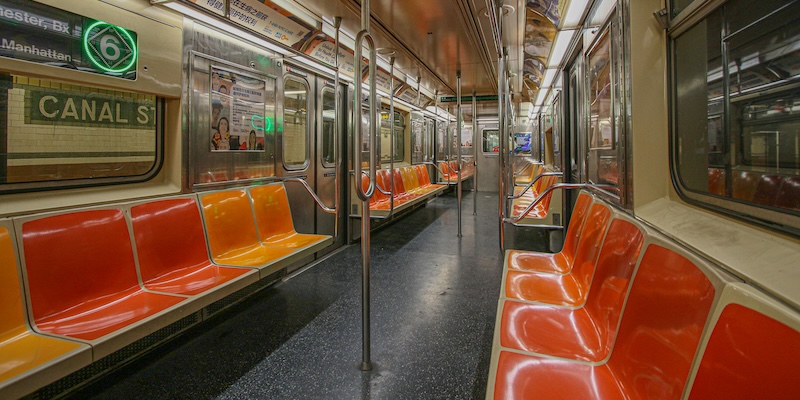
The great thing about New York is that other people have scouted the city already. It’s one of the most photographed cities on the planet, and the subway is no exception. Want a walkthrough of any station from the point of view of a commuter? You can find a video. Want to find out the differences between one type of subway train and another? There’s a field guide to help you out. You might not be able to experience the city firsthand, but you can crowdsource enough information to get you most of the way there.
It helps that the New York subway is an iconic location. It has appeared in film, television, music videos, ads, video games. Sesame Street has its own station, even if it has been some time since we last saw it. Few settings may have the same cultural ubiquity, and the image people associate with it might not be very up to date, but it saves a lot of heavy lifting when a reader comes to the page primed with an idea of what to expect.
Once you’ve done the research, you have to put it to one side when you sit down to write the book. Nobody wants a lecture. I wanted The Survivor to be accurate enough that you could ride the 1 train and see every chapter in your head, but at the same time I didn’t want to be so focused on the details that I lost sight of my characters.
You can and should take reasonable liberties, as long as they serve the story you’re trying to tell. My favorite word when it comes to description is verisimilitude. The appearance of reality. Your setting, your characters, and the action should feel real, even when you are deviating from the truth.
A great way to build this sense of reality is to sketch the big picture, then focus on a single detail. The detail should be something universal, something that readers will recognize.
A great example is in the William Gibson novel, Idoru, where a character walks through the airport. Rather than trying to describe the whole building, he takes a moment to focus on describing the slot that the bored airline employee pushes the character’s passport into: “The slot had beat-up aluminum lips, and someone had covered these with transparent tape, peeling now and dirty.”
The description instantly conjures an image of every airport check-in we have ever endured, the collision of the technological marvel of modern travel with the eroding power of millions of passengers passing through it every year.
The subway is a great place to find this kind of detail. Every single day, people head off to work or to another part of town and wonder if it is everyone else’s first time using public transport. Some guy with no headphones listening to the lowest fidelity music you have ever heard in your life. Some kid holding their mobile phone horizontal next to their face like they plan to take a bite out of it. A lady with a bag as big as she is dumped on the one free seat pretending like she can’t see or hear anyone asking her to move it.
People trying to get on as soon as the doors open. That one person who jumps ahead of you at the gate only to realize that they now need to dig their card out of the deepest recess of their bag. Being trapped in a metal box underground with hundreds of strangers is an experience in shared endurance, and that’s even before anyone yells, “It’s Showtime!”
The final part of the process is the edit. I was very lucky to get picked up by Minotaur—who are based in New York—and even more lucky to have an editor who went the extra mile (eleven miles, if we stick to the subway map) for me. He actually rode the subway and made sure that every chapter worked once you were on the train.
I had copyeditors and proofreaders that did the same thing, albeit from their own experience of living in New York and riding the subway, commenting not just on the physical details of the subway itself, but the way people spoke and acted about it. I may have ignored or excluded some of the advice, but their efforts and input were essential in polishing up the subway of The Survivor.
Once we were done, it was no longer the thing I built in my head from scraps of pop culture and a stack of videos. It was the New York subway, or as close as we could get it. It only remains to say that whatever mistakes or deviations remain are entirely my own.
***