Opening shot: Mongyr, a small town in Bihar Province, British India, in 1935. Palm trees rise up and ripple across a clear blue sky. The camera slowly moves from the lush treetops to focus on a historic yellow bungalow with a peaked roof, tall windows and a long, wrap-around veranda.
A slender, intense-looking Indian man in a crisp white shirt and a dhoti, is sitting at a cane-legged desk set on the veranda with a whirring fan nearby. His brow is furrowed as he slowly writes in Bengali on the legal pad in front of him.
Sitting cross-legged on a mat nearby, is a well-groomed boy who appears to be seven or eight years old. He’s neatly dressed in shorts and a kurta shirt. In his hand he carefully holds an antique pencil sharpener, which he is using to shape a pencil’s point to perfection. His concentration on his task just as strong as the writer in the chair.
The boy turns his head at the sound of footsteps. A middle-aged woman slowly treads up the path and onto the verandah. But Saradindu Bandyopadhyay, the writer at the table, works steadily, as if in a world of his own.
I can picture this scene in so many Bollywood historical films—my favorite genre. But the story is true. Saradindu Bandyopadhyay was born in 1899 to a very respectable Bengali Hindu family and was trained as lawyer. Yet since his college days, he’d engaged in creative writing, a passion that was perhaps less respectable, but more emotionally thrilling.
Sometime in the 1920s, Saradindu brought his private passion to the forefront and began writing mystery short stories in his mother tongue, Bengali. He created a protagonist named Byomkesh Bakshi, a mild-mannered married man and householder who becomes known in the community for finding answers to crimes that can’t be brought to the police—or that the police are witless about.
The stories are narrated by a sidekick, Ajit Bandyopadhyay, a young writer who stays with Byomkesh and chronicles the unfolding of events. Given Byomkesh’s erudite thinking and Ajit’s admiring narrative, the pair are sometimes called India’s Holmes and Watson. The formidable output of thirty-two stories and novels featuring Byomkesh, and at least twenty-five films and television series, heightens the ongoing affection of Indian readers for Byomkesh. And why did it work so well—with his work still in print on bookshelves today, and his name known to all?
I wonder if’s because the stories showed a society that dealt with injustice and crime during the British Colonial era, World War II, and the early decades of India’s new democracy: a long time period during which multiple generations of readers could become fascinated—while never feeling lectured. Saradindu’s support of India’s freedom movement was evidence through this courtly, well-mannered character who had everything to do with traditional values and family life.
In English, just a few anthologies of his work are in print—among them The Menagerie and Other Stories, Byomkesh Bakshi Volume II and Picture Imperfect & Other Mysteries. Some of the filmed versions of his stories are accessible with subtitles on Netflix (Detective Byomkesh Bakshy!). Amazon also has subtitled versions of the TV series Byomkesh and the film Byomkesh Parbo. YouTube is a treasure trove with many vintage Hindi and Bengali-language productions, alas, without subtitling.
When I began writing my own mystery novels in the 1990s, my father gave me one of the Saradindu Bandyopadhyay English-translated collections. He told me something that was just as intriguing: that our family had a link to this great author. My maiden name is Banerjee, the anglicize version of Bandyopadhyay.
My father, a geophysicist named Subir Banerjee, comes from a huge Bengali family where every generation seemed to bear a lot of children. His father, Benoy, was sent off in his late adolescence to stay at the Bandyopadhyay home in Mongyr (now Munger) so that he could study at a local technical college and gain an electrician’s license.
The unlikely connection was actually through the family’s women. Based on a family tree from our Banerjee clan in Calcutta, Benoy’s mother was a beloved aunt of Sarandindu’s wife. Between them, the plan was probably made for Benoy’s studies in Mongyr. And while Banerjee is the anglicized version of Bandopadhyay, that fact didn’t make Saradindu and Benoy blood relatives.
Reading the stories, which show Byomkesh’s high esteem of his wife, Satyabati, it seems likely that Saradindu would allow his wife freedom to bring whoever she wanted into the house to stay. And what an enchanted time this must have been for my grandfather—away from his parents, learning new skills, and watching a master write stories for a breathless public.
Around the same time that Saradindu was creating his highly original character of Byomkesh and his family, a glamorous young Bengali married couple, Himanshu Rai and Devika Rani, were returning from years abroad in England, France and Germany. They had gone from stage to film studio, both as performers and students of everything related to film: costume, set-building, camera lighting, and direction.
At Emelka Studios near Munich, Devika applied makeup to the legendary Marlene Dietrich, while Himanshu was bonding with director Fritz Osten and cinematographer Josef Wirsching. These two had worked with Himanshu on several silent films set in India during the 1920s, and in the mid-thirties, left Germany to join Himanshu’s start-up studio called Bombay Talkies.
Films had been screened in India since 1896, when a representative of France’s Lumiere brothers screened a film at Watson’s Hotel in Bombay. And in 1913, Dadasaheb Phalke, a Bengali, produced the first Indian-made silent film, Raja Harishchandra, a mythological story. Other filmmaking innovators followed in cities like Karachi, Madras and Bombay. Classical theatres that once held live performances were transformed into silent film venues with live musical troupes playing accompaniment. People in rural areas watched flickering films presented in tents that moved from town to town.
Devika and Himanshu saw the future in long, dramatic stories—some inspired by Hindu mythology, but increasingly stories about romance and social change in India—even with German filmmakers as part of the team. It also was unusual for Devika, a beautiful actress at the top of box office, to become an executive producer at a studio. She was both revered and criticized, especially during a brief period when she vanished from her home and Bombay Talkies and was allegedly discovered at a Calcutta hotel with the studio’s leading male actor, Najmul Hassan. He was fired, and she returned to work. And as more of the studio’s original workers decamped, she and Himanshu found new talent.
And as the film world gathered steam, Saradindu Bandyopadhyay received invitation to become part of the new visual storytelling magic in Bombay. Recruited by his fellow Bengalis Devika Rani and Himanshu Rai, he signed on to become the leading scriptwriter of Bombay Talkies. Among his films were Byomkesh Bakshi tales, romances and family sagas, and retellings of Hindu religious stories.
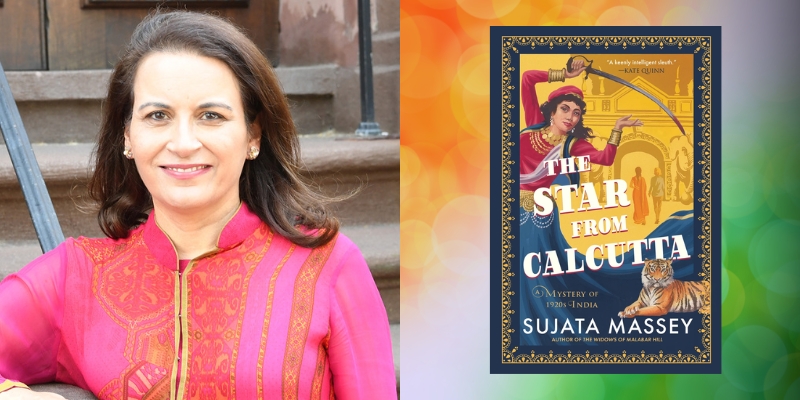
When I started writing my new novel, The Star From Calcutta, my mind was filled with the drama of the Himanshu Rai and Devika Rani marriage. It was a big surprise for me to discover that Saradindu had chosen to work with the exact same film people who fascinated me. I wonder if subconsciously, the people who are part of our ancestry are known to us—and bring ideas to us.
This is not the only time my imagination has danced backward and found coincidences in my family’s life.
For instance, my novel’s central character, Perveen Mistry, is Bombay’s first woman lawyer. I haven’t studied law, but within our Bengali family line are several nineteenth-century lawyers, the most famous of whom is Calcutta’s first barrister, Womesh Chandra Banerjee. Womesh was sent to London to study law in the 1860s.
I had wanted to incorporate a lawyer into my Indian mystery series to give a protagonist a recurring reason to brush up against crime. While there were no female lawyers in my family lineage, I learned from reading that two women from Western India, Cornelia Sorabji and Mithan Tata Lam, went to Oxford in the 1880s and 1920s. Cornelia became India’s first female solicitor, and Mithan who studied after her became India’s first lady barrister. Having studied their memoirs and several excellent biographies, I began to feel like these women were both older, wiser cousins.
And my mother, who is German, plays a part in this book, too. I was so pleased to have conversations with the filmmaker and historian Amrit Ganger, who has written books and lectured about the impact of Germans on early Indian cinema—particularly Franz Osten and Josef Wirsching.
For months, as I labored on this mystery novel about the Indian film world, I clicked through the internet looking for archived clips of old Indian films and found some, most notably at a website called http://indiancine.ma that has clips from many lost silent and early talkie films made in India. It was the best gift imaginable to find that some of these clips have been restored and are broadcast on large screens at the National Museum of Indian Cinema.
Built in 2019 by India’s government and managed by the National Film Development Corporation, this vast and unique museum is surrounded by greenery in busy South Bombay. There’s a lot to see, because visitors can tour both a modern four-story building and also a heritage mansion with gingerbread woodwork that’s filled with exhibits and enlarged photographs of old cinema treasures, ranging from film posters to censors’ certificates. Because of the fragility of film, very few feature films have remained intact to this day; among the easiest to find is Karma, a Himanshu Rai-Devika Rani-starring production from 1933 that plays on YouTube.
While Devika typically played a very feminine lady, there also existed a parallel type of character—the action-adventure girl, best characterized by Durga Khote and the Fearless Naia, who drove box office hits from the 1920s through the 1930s. Many of the actresses in both categories came from Baghdadi Jewish, Anglo-Indian, and other immigrant community families.
According to accounts in scholarly books like Bombay Hustle: Making Movies in a Colonial City by Debashree Mukherjee and Wanted; Cultured Ladies Only! Female Stardom and Cinema in India, 1930s-1950s by Neepa Majumder, many Indian families thought it would be shameful to have their daughter’s image subject to staring and catcalling from men in a theater audience. The limited pool of available female actresses meant many films predating World War had princesses, wives and daughters played by slender men in the film company tarted up with makeup and wigs.
Imagining this with a smile, I was sure to insert such a young man into my fictional movie company.
*
The National Museum of Indian Cinema’s curator is Amrit Gangar, the filmmaker who gave me background on Wirsching, Osten, Devika and Himanshu. Our conversations started as long emails and finally culminated at a 7 a.m. breakfast meeting during one of my research visits.
As we sipped coffee and ate masala dosa, Amrit explained about how the British government installed film censorship during the early 1920s. He also explained how director Fritz Osten was jailed by the British government when World War II broke. The jailing of his friend and colleague—who served in the German army in World War I and may have later joined the Nazi Party—apparently caused Himanshu so much emotional distress that it’s believed to be the cause of his premature death in 1940. After his death, Devika worked to keep Bombay Talkies going—but business partners pushed her out of a position of authority, a number of films failed, and ultimately, the studio lost its way.
Devika Rani slipped out of Bombay quietly in 1945 and into a new life, living in Bangalore with her second husband, the Russian painter Svetoslav Roerich, a Russian painter. It was a long and happy marriage that lasted until his death in 1993.
Saradindu, who left Bombay Talkies after Himanshu’s death, stayed in Bombay working another twelve or so years but ultimately decamped in the 1950s to return to the quiet writing life, this time in the green hills of Poona (Pune). He had the freedom to write widely, in any genre he wanted, and spent time writing children’s fiction, ghost stories, and fiction based on ancient Hindu history for adults. He died in 1970, but his legacy lives on with the constant reissue of his books and remakes of Saradindu stories for television and the big screen.
And Sarandindu still has a way of slipping into people’s lives when least expected. This certainly happened for me, years after I’d read the Byomkesh Bakshi stories.
I was at the University Club in Washington DC one autumn evening. The private club hosts a book fair, and I’d been invited to sign books. I noticed a South Asian man a little older than me at a neighboring table with his book, a gorgeous coffee table of photography he’d taken in Bhutan. His name card read Suparno Banerjee, a most Bengali name. As a pleasant conversation unfolded, I learned about him, and he learned that I wrote mysteries.
“Ah! You know,” he began, “My father used to sharpen the pencils for India’s very first mystery writer: Saradindu Banerjee. He was my grandfather.”
“Take a moment to absorb this,” I said, “But it sounds like….It can’t be….” As he looked at me curiously, I close with, “We may be related.”
And there we were, two Banerjees flung far into the diaspora, trying to put together pieces of an ancient, complicated puzzle.
***