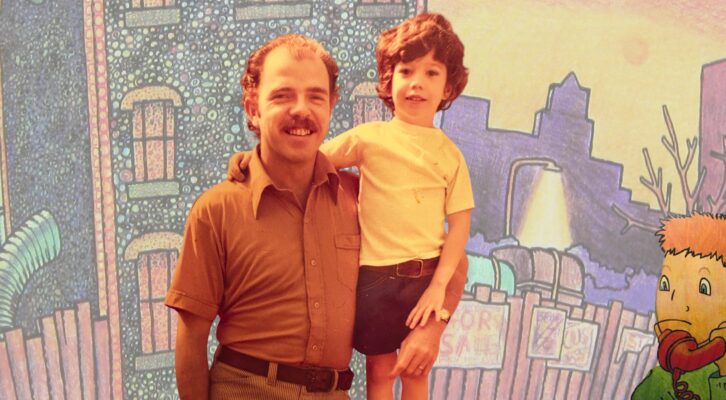
Apparently I fell in love with the idea of crime stories intersecting with the supernatural at a younger age than I realized. My first attempts to write short stories came in the fifth grade, when I invented a character nicknamed “Kahn,” a gangster murdered by his cronies who returned from the grave to hunt down his former friends.
They were pretty bad, as I recall. Not even stories so much as amateur hour encyclopedic entries recapping who Kahn was, his relationship with a certain fellow gangster prior to his murder, and the horrible state that gangster was later found in after Kahn caught up to him.
Again, probably not very good, but in my defense I was ten years old.
Thirty-six years later, my third novel is a detective/horror hybrid, and it’s given me a ton of reason to look back on horror stories crossed with crime fiction that have impacted me, whether as an influence on my writing, or purely as a work of fiction that I enjoy and would recommend.
As much as I love straightforward detective stories, with Devil in a Blue Dress being a personal favorite (shouldn’t it be everyone’s?), my affinity for horror makes me want to put a supernatural twist on Raymond Chandler’s tried and true cure for the common creative stagnation.
“Chandler’s Law,” as it’s known, is as follows: When in doubt, have a man come through a door with a gun in his hand. And that definitely is a way to liven up any detective mystery story. Hell, it would liven up a romantic drama, a tragedy, a comedy, a poem, pretty much everything, but “my” spin on this chestnut would actually employ some theft from fellow horror writer Clay McLeod Chapman.
At last year’s Stokercon, during a panel, he talked about having an inclination while writing to “Put a ghost in it.” So may I offer to the mystery writers of the world, for the pleasure of the mystery readers of the world, “Compton’s Law (By Way of Chapman and Chandler)”: When in doubt, put a ghost in it.
Or a demon. A vampire. A werewolf. A witch. A haint. Any ol’ variety of supernatural terror will do, really, so long as it’s done well. Here are a handful of stories that do just that.
*

William Hjortsberg, Falling Angel
Originally published in 1978, and somewhat infamously adapted into a film in 1986 starring Mickey Rourke, Robert Deniro and Lisa Bonet (the favorite film of Horror Writers Association President L. Marie Wood; what better recommendation is there than that?), Falling Angel is unapologetically in love with the detective potboilers that preceded it.
Its lead character is a detective named Harry Angel, he’s hired to track down a missing singer and World War II veteran named Johnny Favorite, and his client’s name is such a blatant reference it’s begging you to second and third guess whether the twist will be that it’s a misdirection, or that it’s actually going to be exactly the revelation that’s too obvious.
Angel’s pursuit of Favorite brings him dangerously close to lowlifes, bad cops, and black magic practitioners alike, and the investigation not only imperils his life, but his very soul. An absolute classic.

Cassandra Khaw, Hammers on Bone
Has a title alone every made you wince, imagining the pain? Because every time I read this one I think of a hammer smacking a shinbone, not quite breaking it, but sending a jolt of pain up through the body that somehow makes you think a clean break would actually hurt less.
Such is the power of Cassandra Khaw, that they can deploy that much damage in three words before you even flip to the first page of the book.
This novella, a 207 Locus Award finalist, centers on a P.I. named John Persons hired by a child to kill their monstrous stepfather, and if you’re asking whether I mean monstrous in the literal or figurative sense, the answer is “yes.” Then again, Persons is also a bit of a monster himself, which makes him perfect for a job, provided the investigation doesn’t result in him becoming something worse than the evil he’s hired to kill.

H. R. Wakefield, “Used Car”
I feel like I’ve seen at least three different comedians make a joke about the potential danger of buying a car from a police auction, because what if the criminals who originally had the car impounded come back for it? Or what if some rival of theirs sees you driving around in it and decides today is the day they’ll even the score with their old nemesis, with a strafe of gunfire as they drive past?
As scary as those distant possibilities might be, I think I have something a little scarier: What if you take that car formerly involved in some murderous activity and put a ghost in it.
Yes, I just sort of spoiled the reveal of this wonderful short story, but it’s worth reading (and re-reading) still, to see how the haunting associated with this used car develops, and how the couple who purchases it reacts to the dread it instills in them.
Every time I revisit it, despite knowing what’s coming, I get a little chill when the cold, simple brutality of the crime committed in this car is revealed, when the last words heard by victims are spoken, and when I consider the implication of a specter spending eternity in the small space where they died, but spending it with their killers.

John Hornor Jacobs, Southern Gods
We’re coming back around to detectives searching for mysterious musicians in post-WWII America with a book that became an instant favorite when I read it. Professional tough guy Bull Ingram is hired by a DJ to track down a missing blues man Ramblin’ John Hastur. Sucker that I am for stories about supposedly cursed songs, urban legends, and Southern Gothic settings, I had a strong suspicion that I would fall in love with this novel from the first review of it I read, and hell yes was I proven right.
Jacobs’ 2011 debut brilliantly blends cosmic horror with hardboiled detective fiction. It’s like George Stark and Sutter Cane summered together in Memphis working on the perfect partnership, and yes, I did reference two fictional writers (well, one’s a penname turned evil doppelganger, but it still applies), but that’s because, despite having met the man, it’s hard for me to believe an actual person wrote this exceptional novel.
***