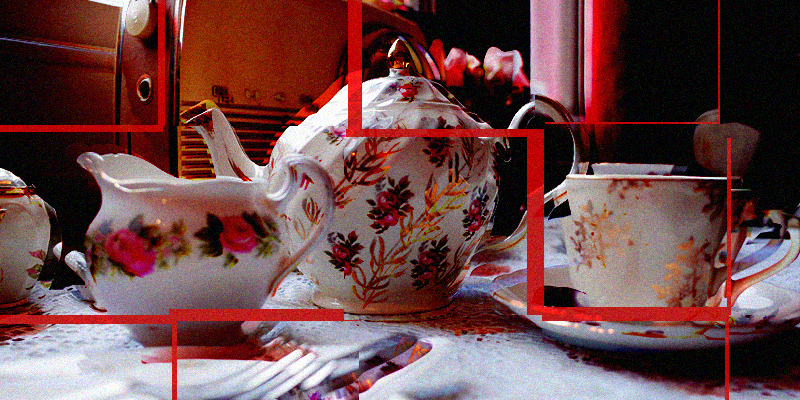
Tea has a long history—not simply because of the flavor and use of it, but because of the emotions and purpose that seem to accompany it. Starting with the ordinary, my background with tea began when I was a child. Colds found my mom brewing tea. She not only brewed tea and brought it with a caring smile, but sometimes she added orange juice and cinnamon. Tea meant care. Maybe that’s why I decided to write two cozy mystery series where tea plays an important role.
Care is exactly what the concept of tea has to do with mystery—caring about victims, suspects, detectives, clues, and evidence. I’ve chosen five streaming mystery series to point out how tea is used in solving murder investigations.
I’ll begin with The Marlow Murder Club from Masterpiece Theatre. Marlow is a well-to-do town by the river Thames in Buckinghamshire, England. In Season 1 Judith Potts, an archeologist, is witness to her neighbor’s murder. In this season there is one mystery serialized into 4 episodes. Judith’s neighbor is an art dealer and she decides to solve the mystery when the detective seems stuck. She teams up with dog walker Suzie, because Suzie hears all the gossip, and she’s missing her daughter who is going to University. Becks, the Vicar’s wife, joins the group because she has access to her parishioners lives and secrets and needs a distraction from her duties. A clue left at the murder scene leads them to new evidence.
Tea always comes into play when emotions are involved. Suzie is a mother who’s about to have an empty nest. She has tea with her daughter Zeta to have that last connection and chat before she leaves. Something about drinking tea together solidifies a bond. However, sipping tea alone creates an introspective mood. Whenever Judith tries to put the puzzle pieces together, she sits in her aunt’s mansion sipping tea. The calm of the tea tradition clears her mind to find the answers.
Season 2 of the Marlow Murder Club consists of three mysteries with two episodes for each mystery. The first cozy in two episodes is characterized as a locked room mystery. Sir Peter Bailey, a baronet, invites Judith to a celebration before his wedding. The invitation is accompanied with the warning that “something might happen.” It does. He is killed when a monumental bookcase falls on him. But no one else was in the room. How could the killer escape? Tea often leads to sudden inspiration. When Judith has tea with an older married couple, sun hits a glass object and helps her figure out the locked room dilemma.
Attempting to catch a killer leads to anxiety, an emotion that calls for cups of tea. Maybe sipping a warm liquid calms the soul as well as the throat. While Judith, Suzie and Becks wait for a killer to strike in Sir Peter’s mansion, they sip, think and discuss. Because tea and sympathy often go together, in a final scene, tea with Sir Peter’s daughter gives her the warm camaraderie with Suzie and Becks she needs and helps tie up the case.
In another mystery in Season 2, a member of a boating club is killed by the boom of his sailboat. Judith concludes murder instead of an accident. Deliberation is always a cause for a cup of tea. Unexpectedly Judith realizes there is drone footage of what happened at the docks. As she is discussing it with Suzie and Becks, they study the murder board in her mansion. Their drink of choice is tea complemented with delicate tea cups and a sterling tea pot.
Is tea always an element in The Marlow Murder Club mysteries? It is, either subtly or more obviously. I believe tea in the series adds the element of civility in serious situations or in a case of life and death. Murder is never taken lightly but the tea tradition and it’s place with royals as well as farmers helps us believe humankind isn’t completely off kilter. The Marlow Murder Club presents with plotlines that, representative of cozies, are enjoyable to watch. The club always gets their killer and justice wins.
Turning to another Masterpiece Theatre series, Miss Scarlet, the time period offers a peek into Victorian London. The series began as Miss Scarlet and The Duke, which lasted four seasons, after which Detective William “the Duke” Wellington was written out. Inspector Alexander Blake replaced him as Eliza Scarlet’s foil and love interest. Eliza’s father was a private detective. When he died and left her without a livelihood the spunky, curious, and smart character took over his practice.
Does tea coax secrets from criminals? In Miss Scarlet we enter a time period filled with beautiful costumes, carriages and horses, and a growing city grappling with rapid innovation and increasing inequality. Tea has two purposes in this series. Ivy Woods ,who was Henry Scarlet’s housekeeper, is a mother figure to Scarlet. When Eliza is home, the tea pot is always on bringing comfort and a sense of home she misses since her father’s death. A teapot with sugar and creamer are front and center in Eliza’s house—for example, in Season 6, episode 4, Ivy’s new husband is upset and naturally goes to the table for a cup of tea. Tea means conversation, gentility and welcome against what Ivy considers Eliza’s unladylike occupation of crime solving.
Tea means conversation, gentility and welcome…tea can also mean romance and treachery
In this historic setting, tea can also mean romance and treachery. In the setting of Scotland Yard, a young detective, George Willows, falls for a young woman, Isabel Summers, who becomes the switchboard operator. During Season 6, episode5, he asks her if she wants to go for a “cuppa.” They are both proper. During prisoner riots and the expected transfer of a high profile prisoner, Miss Summers brings a tray of tea to the officers. Willows says “it’s a little milky for his taste” and after she leaves the room, he dumps it. It turns out that Isabel is a plant to ruin the switchboard and communications. She drugged the tea so the officers fell asleep and the prisoner could escape. In this Victorian setting, tea is a gentle reminder of warmth and comfort, and sometimes it’s a vehicle to do harm.
Broadchurch from Masterpiece Theater is a fictional Dorset town along the coast. The three seasons of episodes provide an exceptional mystery series with talented actors that make the storylines come alive. Each season is a stand alone mystery but there is a connecting arc through all three. The cliffs and sea automatically summon a mysterious mood. The most recent season revolves around a woman who is raped. The writers and actors handled the topic with sensitivity. The part that tea plays in this series is less obvious than other PBS series but worth noting in a community with deep bonds.
Alec Hardy is a Detective Inspector solving cases with Detective Sergeant Ellie Miller. We recognize the power of tea when the victim is taken to the sexual assault center and asked for a mouth swab after which she can have a cup of tea. The quiet coaxing voices of the two detectives help Trish remain calm. Tough guy Alec is soft spoken and gentle. As soon as they drive Trish home, Ellie asks Alec to make Trish a cup of tea. A day later Trish is having tea when her assigned counselor calls to set up a meeting. Later in the mystery, when Trish’s daughter and a football game ease Trish back into the community, she is immediately asked if she wants a cup of tea.
Another evidence of tea not only as a comforting agent but as an energizer is the tea pot in the kitchen area of the police station. It is always on the counter ready to be used. In a humorous note, tea-drinking fans of the series were outraged when Alec poured tea from an apparently cold tea pot and set the mug in the microwave to warm. A quote from Oscar Wilde sums up the part drinking tea plays in Broadchurch. “Tea is the only simple pleasure left on us.”
In like manner I’ve been noticing on Law and Order Special Victims Unit that Olivia Benson who grows from detective to Captain of the Special Victims Unit over twenty seven seasons is offering tea to her sexual assault victims. Not only to victims but to suspects who she persuades to reveal more about themselves. The warm brew convinces both that she really cares…and she does. The offering is a soothing gesture in the midst of the squad’s chaos of finding the perpetrators of horrific crimes.
My final example of what tea can add to mystery is another Masterpiece Theatre series now on Prime video—Magpie Murders. This is an engaging series with a mystery within a mystery. When Alan Conway, a whodunnit author, dies from a fall, clues lead his editor Susan Ryland to decide he did not commit suicide but was murdered. She can’t find the last chapter of his latest manuscript which she believes has detailed who killed him. In this novel he used everybody from his real life who hated him as characters. The murder within his latest whodunnit set in the 50s is investigated by Atticus Pünd. A rich man who collected antiquities was beheaded with an antique sword. He also has his share of enemies. A novel aspect of this series is the intersecting of the 50s timeline with the present when Atticus leads Susan on the right road to solving who killed her author.
The purpose of tea in this series is two fold. Atticus is a tea drinker. As an expert investigator he brings kindness, gentility, wisdom and precision to his case. He is very different from free spirited sometimes chaotic, wine drinking Susan (she also smokes) who zooms into her investigations in her vintage red sports car. At his roll top desk, sipping tea, Atticus tells his assistant “murder can be solved.” In his certain manner Atticus visit suspects, enjoying tea with a few. Tea service and an interview with a main suspect bring forth new clues and past history that echo in Atticus’ mind, revealing an old death with consequences in the present. Susan does have tea with her sister when she slows for a minute. The tea drinking tradition casts a light on two very different personalities—staid but thoughtful Atticus, but rambling and uncertain Susan. The other purpose of tea drinking in this series is respite from the swirling rhythm of the case.
The sipping and serving of tea in a mystery series provides opportunities for introspection and deliberation, a tradition that can soothe and calm, bonding moments between characters, a ritual that supersedes class and differences. I use tea for all those purposes in my cozy mysteries, whether it’s served in a tea garden…or a bookstore.
***