Technofascism: whether or not you want to think about the term or what it means, you’re probably living in its shadow right now. To paraphrase Catherine D’Ignazio, Director of the Data + Feminism Lab and Associate Professor at MIT, technofascism can be understood as the fusion of an authoritarian state with the forces of big money and big tech. When animated by worship of conventional masculinity, reactionary pronatalism, eugenics, ethnic cleansing, and other hard right ideologies, technologies like social media, AI, and others that were naively intended to make the world a better, more efficient, more innovative place become the ingredients for control, domination, and death.
My new novel, Haven, is a meditation on techno-dystopia masquerading as a locked room mystery. Caroline is a new mother spending the summer on a remote barrier beach with her husband’s friends from Corridor, the Big Tech company that employs them. Seduced by their hedonistic lifestyle, Caroline begins to let down her guard. But when her infant son disappears, Caroline embarks on a frantic search that will lead her to dark truths about her marriage, the island, and the far limits of human progress. Haven may be a thriller about a missing baby, but it’s also a novel about elites living beyond the reach of the law as they fashion a world for themselves, the pace of technological innovation outstripping ethical standards, and the consequences of selling one’s soul in exchange for power that paradoxically destroys our humanity.
Though technofascism is our current reality, it is also the stuff of fiction, particularly genre-bending thrillers that employ elements of sci-fi, noir, and horror to explore what happens when the imaginations of the powerful serve the most venal and repressive of goals. Is there anything more frightening or compelling?
***

Super-Cannes by J.G. Ballard
At the beginning of Ballard’s dystopia-disguised-as-utopia novel, a married couple arrive in Eden-Olympia, a technologically-sophisticated corporate community on the French Riviera called both “the anteroom to paradise” and “the face of the future” – a community still placidly humming along in the wake of a recent mass murder perpetrated by one of its residents. The luxurious, idyllic veneer of the multinational business park just barely conceals its true identity as a hotbed of “endangered pleasures” kept alive by the ultrarich, where adultery and cocaine are considered “rather old-fashioned.” But what seems like libertine excess derives from corporate control, as employees learn how to wield power more ruthlessly and efficiently by accessing “the darkest heart of themselves.” Ballard’s hero Paul Sinclair attempts to solve the mystery of the massacre, but the real villain here is the psychopathy of profit motive.

The MaddAddam Trilogy by Margaret Atwood
Atwood’s masterful trilogy (beginning with Oryx and Crake, continuing with The Year of the Flood, and concluding with Maddaddam) might be the best, scariest dystopian series I’ve ever read. Yes, there’s a plague that wipes out most of humanity in nasty fashion, as well as roving bands of genetically-engineered homicidal pigs, and even more dangerous human alumni of a Grand Guinol reality entertainment called Painball. But the real turn-on-all-your-lights, double-check-that-your-doors-are-locked moments in Atwood’s series have to do with corrupt biotech corporations and their role in destroying both the lives of individuals and humanity at large. Did I forget to mention that these books are also laugh-out-loud hilarious? It’s the end of the world, and maybe the beginning of a new one, told with enviable levels of inventiveness and wit that few writers besides Atwood can pull off.
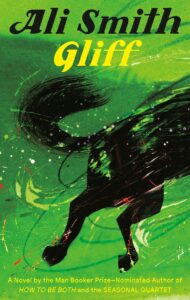
Gliff by Ali Smith
A harrowing and heartbreaking novel, Gliff, like all great thrillers, demands to be read in a few breathless gulps. Siblings Bri and Rose were raised by their mother to reject new technologies and the grasping tentacles of the algorithm in an attempt to hold on to their freedom and humanity, a choice which renders them “unverifiable” and uniquely vulnerable. When their mother is called away, Bri and Rose find themselves running from an authority that is both inexorable and faceless, a threat made visible by the seemingly inescapable painting of red lines around the dwellings of undesirables—a detail both banal and chilling. Gliff explores the terrifying consequences of surveillance and intolerance in a grim, technocratic and totalitarian society that is perilously close in character to the present, and finds possibilities for resistance and resilience in language, art, and connection.
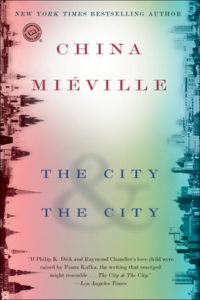
The City & The City by China Miéville
Miéville’s much-lauded police procedural is something special. What seems at first like a straightforward murder investigation of a foreign student quickly becomes more than meets the eye– though actually, in the fictional Eastern European city of Beszél, choosing what does and does not meet your eye is a matter of grave consequence. Beszél has a twin city, Ul Qoma– the two cities are so close that they are intertwined, sharing much of the same geographical space, but the citizens of each metropolis must “unsee” the other. To acknowledge the other city is known as breaching, a violation which brings on the full force of Breach, an inescapable, all-seeing secret police. Breach, and you disappear forever. Inspector Tyador Borlu’s investigation leads him through iron doors and puzzle boxes of bureaucracy in what becomes a search for a rumored third city hiding between Beszél and Ul Qoma. Miéville deftly conjures a sense of surveillance and control so oppressive it feels physically palpable.
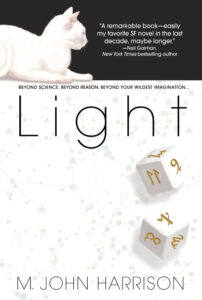
Light by M. John Harrison
Is Light a thriller? It’s got a serial killer—physicist Michael Kearney, who keeps murdering women around London in between pursuing a breakthrough in theoretical physics at the turn of the millennium. It’s got some legitimately scary characters, like an old woman with a horse’s skull for a head who may be just a hallucination, and a revolting drunk who professes to be an all-powerful magician. But it’s also got a space-time anomaly called the Kefahuchi Tract, and the two-thirds of the novel’s braided structure set in 2400 AD are rife with cloning, genetic modifications, virtual reality addiction, and weird and various aliens. In some ways Light defies genre– it’s been called a space opera, a noir, and straight-up hard sci-fi. The world it imagines is a techno-dystopia where life is cheap and disposable– a society that pushes the alienation of humans (and human-like entities) from their humanity, the kind of world that incentivizes an adolescent girl to join the military and cybernetically fuse her body and consciousness to a killer spaceship. If anything, Light is a thriller in that it is truly thrilling in its prose and possibilities. It’s a novel that changed what I thought was possible in fiction— a novel I will think about for the rest of my life.
***