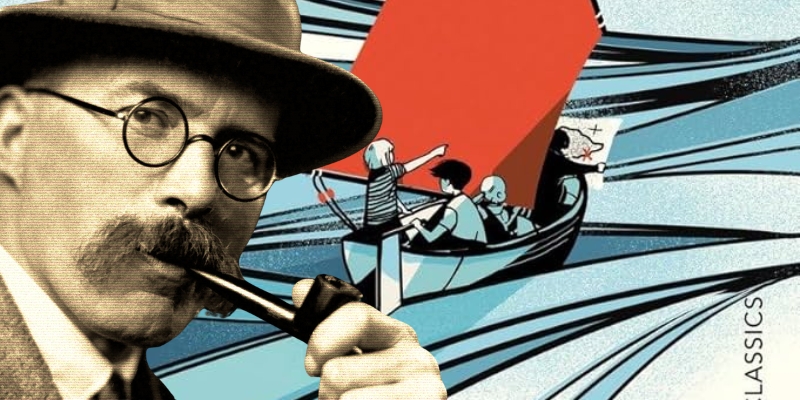
Arthur Ransome, beloved British journalist and author, was no stranger to mystery and espionage in his lifetime. A noted Bohemian and adventurous spirit, he went to Russia initially to escape an unhappy relationship and research Russian fairytales, but ended up becoming an eyewitness and frontlines observer and correspondent of the Russian Revolution—it’s never been proven one way or the other, but there has been some historical speculation he may have been a spy or a double agent for the U.K. and Russia for some of those years.
Some of his friends and acquaintances included left-wing historical radicals and politicians like Lenin, Trotsky, Soong Ching-Ling and Karl Radek and he was a witness to the Estonian independence movement.
If that wasn’t enough, Ransome was also friends with prospectors, sailors and explorers who provided a great deal of inspiration for his literary characters. Growing up holidaying in the Lake District gave Ransome a lifelong passion for boating, camping, swimming and other outdoor pursuits.
As one might imagine, given all of that, Ransome was a lover of excitement, exploration and intrigue. These passions all carried into his beloved children’s book series Swallows and Amazons.
The basic premise of Swallows and Amazons is British children having intrepid and independent adventures that are largely adult-free in the 1920s and 1930s pre-WWII world. While the core of the stories keep the suspense and action focused on more minute elements like a boat race or a rivalry between two groups of children, several of the books in the series have a stronger mystery or crime plot that might intrigue anyone who has yet to give these timeless classics a go.
In the first two books, Swallows and Amazons and Swallowdale, readers are introduced to the five Walker children (called Swallows, after their boat) and the two Amazon children (again, also named for their boat), their initial rivalry, and then their fast friendship and collaboration on anything from sailboat racing to mountain climbing to setting up camp.
The third book is seen by many readers as a metaphysical fantasy where the children and an Amazon’s uncle are sailing around the world and get involved in a hunt for pirate treasure. Again, more thrill than actual mystery, but a rather unconventional swashbuckling jaunt. Ransome continues to build tension and create nail-biting situations in the following Winter Holiday with Arctic-inspired explorations, ice skating and a heroic sheep rescue.
The mystery elements start to kick in the series’ fifth book, Coot Club. Readers are introduced to some new faces to the adventurous crew: notably Dick and Dorothea, as well as their companions, who are motivated by environmental conservation (quite possibly one of the earliest books in children’s literature to grapple with the subject) to set a rowdy tourist boat adrift when it threatens a coot’s nesting site on the Broads.
Here’s where some of Ransome’s love of intrigue kicks in: the mystery line in this particular book is who, exactly, betrayed the Coot Club in terms of setting the boat adrift to save the eggs? And why?
In Pigeon Post (book six), the intrepid Swallows and Amazons attempt to find a lost gold mine in the Lake District. While the primary elements of the story are much more adventure and activity-based, there is still a mystery aspect to the tale: the children are followed around by an elusive character they dub “Squashy Hat,” who is thought to be an enemy rival in competition for their prospecting attempts.
In fact, tracking Squashy Hat’s whereabouts results in one of the scariest and most suspenseful scenes in the entire series, when some of the kids follow him in an old mine and a tunnel collapse occurs. Ransome had initially studied chemistry prior to abandoning that course of study, but one can see it creep into his writing in his depiction of the children smelting and experimenting with gold ingot production.
The absolutely thrilling and suspenseful We Didn’t Mean To Go To Sea is a fairly intrigue-free plot, but then the following Secret Water picks up a mysterious air when the Swallows camp in Hamford Water and notice strange footprints and an eel totem in their camp.
The Big Six, the series’ ninth book, is where Ransome really gives us a bit of a children’s lit whodunnit: returning to the same cast of characters and setting from Coot Club, many small boats start being set adrift, and our intrepid Club members come under community blame. But who is really to blame?
Some of the unique details of this nautical crime-solving escapade involve some amateur photography (portrayed in the film adaptation with a 1929 Voigtlander Bessa), narrow escapes on bikes, and—unrelated to the crime, but still highly memorable—an ultimate “big fish” catch of a massive pike.
So, adult readers, even though these books were targeted towards children (and still hold up—if you have any young avid readers in your life, it could be time to introduce them to Swallows and Amazons), there’s something to be said for reading them as a grownup. The suspense in many scenes can be palpable—Ransome is excellent at creating buildup, and he does a great job with action, whether on the water or on land.
Fans of the series might also enjoy watching some of the BBC adaptations of the books, which have held up pretty well over the years, such as Coot Club and Swallows and Amazons.
And even if Ransome never actually was part of a spy network, based on some of the attempted espionage that goes on in his novels…he certainly had a knack for capturing the atmosphere!