On the evening of August 11th, 1949, Margaret Mitchell and her husband John Marsh were crossing Peachtree Street to see a movie called “A Canterbury Tale” at the Peachtree Art Theatre. An off-duty cab driver named Hugh Gravitt swerved wildly, skidded, and hit Ms. Mitchell. She was taken to Grady Hospital, but she died five days later. Her obituary appeared in the New York Times. It was subsequently discovered that Gravitt had a remarkable twenty-two previous traffic offences. He was tried and convicted of involuntary manslaughter and spent eleven months in jail.
Everything in the rest of this story is verified by Phillip DePoy, who observed the following phenomena firsthand.
___________________________________
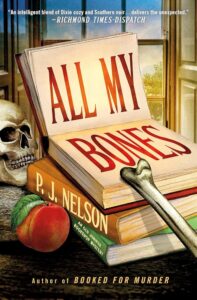
P.J. Nelson is the author of the new book, All My Bones, now available from Minotaur Books.
___________________________________
By the mid-1980s the Peachtree Art had become the home of The Academy Theatre, the south’s oldest professional theatre company. Phillip DePoy was their composer-in-residence and musical director then. One of their most famous productions was a version of The Canterbury Tales. They were reviving it for a September opening when DePoy was called in to work on it.
They were rehearsing quite late one night—on August 11th to be exact—when everyone heard a horrendous squealing of tires and then a lot of people shouting. Despite the fact that they were three days behind in the rehearsal schedule, they all went to investigate. But when they opened the front doors of the theatre, Peachtree street was empty. No cars. No people. Just the sticky August air.
If they hadn’t all been so exhausted, they might have been more curious about the phenomenon, but none of the songs were working, half of the costumes were wrong, and the Wife of Bath couldn’t seem to remember most of her lines. She kept saying that her religious beliefs made it difficult for her to portray what she referred to as “medieval pornography.” Which they all found amusing, especially when someone reminded her that the Peachtree Art movie house had become, in the 1970s before the Academy took over the building, an “adult” movie palace. Pornography, it was said, was in the very walls of the building.
So, back onto the stage, they began to work through the first song in the show, when they heard the noises again, and the distant wail of a siren. Unwilling to sacrifice more time, the director sent only the stage manager to investigate while the rest of the cast continued to do terrible things to the beautiful music that DePoy had written.
But moments later the stage manager came running in and said she had to get into the offices to make an emergency call (in the days long before cell phones). There was a woman lying in the street.
That was enough to break everyone’s resolve, and they were all back out of the front door of the theatre while the stage manager tried to find office keys.
But there was, in fact, no one lying in the street. There was no siren, only the buzz of the streetlamp overhead, and the clicking of the traffic light at the end of the block changing from green to red.
That’s when someone started talking about Margaret Mitchell. There were a few jokes made, a couple of very rude remarks—because actors curse worse than sailors—and everyone headed back indoors.
Only once they walked through the lobby, they discovered that all the lights in the theatre were out. No house lights. No stage lights. Not even emergency lights.
They heard the stage manager call out, “I can’t find the office keys, and I don’t know what’s happening with the lights!”
It was black as the inside of Jonah’s whale. Some of the actors tried to feel their way down the aisle, but most of them just stayed where they were. Some sat down in the audience seats.
“You know,” the director said, mostly in an attempt control his ire regarding their circumstance, “Margaret Mitchell was going to see a movie in this very building called ‘A Canterbury Tale’ when she got hit by a car.”
The actor playing The Knight said, “I’ve seen it. It’s a WWII film. It’s about three people trying to solve the mystery of ‘the glue man.’ Some guy is pouring glue into women’s hair near the village of Canterbury during the war. Turns out he’s doing it to keep women away from the soldiers because the soldiers have important war stuff to do and women are, you know, distracting.”
(During World War II Mitchell volunteered for the American Red Cross, where her primary job was writing letters of encouragement to soldiers.)
There followed some discussion of the movie, Chaucer’s tale, and the fact that maybe the ghost of Margaret Mitchell was just confused about what was going on in her theatre.
But when there was a lull in the conversation, in the darkened theatre, a single light came on onstage.
“Ghost light!” someone whispered instantly.
Of course it wasn’t. A ghost light in the theatre is usually an exposed incandescent bulb in a wire cage on a portable stand, a standing lamp that’s placed in the center of the stage. They exist primarily for safety reasons. But superstitions prevail. Lots of theatre people will say that the light’s there so that ghosts can perform after everyone else has gone out of the theatre. Or, on the other hand, that it’s there to keep the ghosts away.
Not too long after that, all the lights came on, and the stage manager appeared.
“Someone left a radio on in one of the offices,” she told us all. “Looks like it shorted out somehow and took the lights with it. I found the breakers and voilà: let there be light.”
“So, all the sirens and voices,” the director asked her, “that was on the radio?”
She shrugged. “I guess.”
(It was later reported that there had been a live radio television broadcast from Grady Hospital where pandemonium involving a hostage situation had occurred. Everyone in the cast assumed that’s what they’d heard.)
“And that’s what made all the light go you, you think?” he went on. “A radio shorted out?”
“Yes,” she said slowly, “that’s what I’m putting in my rehearsal report.”
With that, everyone went back to work. Everything was explained.
But DePoy cornered the stage manager later, during the next break.
“What about the body you saw laying in the street?” he asked her.
She didn’t look at him. “Yeah. What about it?”
“I mean, what was that?” he went on.
“Uh huh,” she said softly. “And what made that one light come on before all the rest of them? Before I flipped the breaker.”
The show opened a few weeks later. By then everyone knew their lines and the songs sounded great. But every night of the run, at around a quarter to eight, all the lights in the building went out for thirty seconds or so. Every night.
A quarter to eight. That would have been about the time Margaret Mitchell and her husband were crossing Peachtree Street to go into the theater.
***