*no spoilers*
The Hindenburg crash was a horrifying spectacle caught on newsreel for the world to see. The terror and the despair of the radio host on the scene would become something ingrained in our language, “Oh the humanity!”
For decades the going theory was that as the Hindenburg was about to land in Lakehurst, New Jersey —delayed for twelve hours due to a storm in the area— the friction from the landing ropes, along with the static electricity in the air from the storm front and lightning in the area, the hydrogen cells erupted. From the initial explosion to the burning carnage on the ground, less than 60 seconds passed. But was it just a natural disaster? Or was there more behind it? These questions led to it becoming one of the most conspiracy theory-driven disasters of all time.
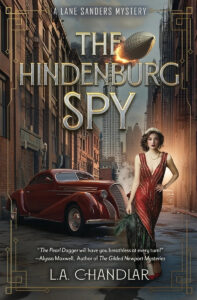
That’s what I get to play with in The Hindenburg Spy. What is fiction and what is reality? How can I, as a writer, toy with the infamous disaster believably —even when the circumstances themselves are beyond belief.
One of the tools I use to make the plot interesting and authentic to the time, is to use real-life cameos and events. In fact, one of my principle characters, Mayor Fiorello LaGuardia, was such a sensational figure, that I often tell my readers that the more wild his stunts are in my novels, the more likely it is he did it in real life. For instance, jumping into a cop’s sidecar and yelling, “I am not a sissy!” as he raced through the city to get to the scene of a fire.
An especially inspiring tool is to use real crime stories, so the readers get to experience the parts that are not typically told to us in the history books. The opening mystery in The Hindenburg Spy is introduced by Fiorello hearing the news that two children had been taken to Harlem Prison —an adult men’s prison— instead of Child Society. On top of the fact that they shouldn’t have been in an adult prison, the children hadn’t been taken because they committed a crime, but because they witnessed one. And were given bail comparable to a year’s wages for about 10-15 people. It was a typical (and horrifying) practice at the time, to hold witnesses. But not usually children.
Fio sped up to Harlem, discovered the guards were nowhere to be seen, located the kids, and took them to Child Society. After he set the prison straight, of course, making sure that they remembered the inmates were citizens, too, and he’d take care of all New York citizens. What the history books leave out of this little morsel of intrigue is what exactly did the kids witness? That’s where I take up the tale. Who and what was so important, so crucial?
Another tool I love to use in writing mysteries, is locating firsthand, primary sources. Magazines are priceless to get a feel for advertising and themes that were meaningful to the people. I also found an amazing book by Hulbert Footner from 1937 called, “New York: City of Cities.” It’s the size of a novel, but is basically an in-depth tour guide. But he didn’t just tour the famous sites like the top of the Empire State Building or Rockefeller Center. He went to City Hall and even got a tour of one of the police precincts and a night court adjudicated by the mayor. Since it was written in the exact time frame of my novels, I got an authentic viewpoint from someone who had seen the Great War, but not World War II. They were right in the era without seeing history with the future’s 20/20 hindsight. And you can find little gems such as the detective’s practice back in the day of having what we would call an “open mic night” for the arrests to determine indictment. The more cunning of the arrested men often realized that if they could get a laugh out of the detectives, they might get a little more leniency.
The mystery of just what those kids witnessed kicks off the novel and the story winds its way to discovering threats that may be happening on the Hindenburg, which sends Lane Sanders to the airship.
Using another primary source, I took a good look at the Hindenburg manifest to see who was onboard. Every passenger had to be wealthy because of the sheer expense of the flight. So anyone could be the target or the instigator. A final tool: What would I do? I put myself in the shoes of saboteur and as I studied the design of the mammoth airship from the elegant dining room, to the study, to the vacuum-sealed smoking room (yes, smoking room), to the catwalks that extended from tip to tail…how would I have accomplished it?
There was one passenger that grabbed my attention and as you read the novel, just know that in real life, this passenger was under suspicion for specific talents and notoriety. I dabble with the idea of not only the cause of the disaster, but the aim. If it was indeed sabotage, was it intended for this ride? Or the next? Who was onboard who could have been the target? Or the mastermind? The real life events surrounding the disaster are actual historical events. I use the real names of the passengers and crew where possible.
After I researched and wrote this novel with my own characters in play, I have to say my account may turn out to be more factual than fiction. Weird pieces of truth have been left unaccounted for in real life: a gun was found in the remains of the crash. A threat of sabotage had been sent to one of the captains of the airship prior to takeoff, but they took the trip anyway. And the crash manifest was only half full, but the one following was sold-out. Was that the actual target? Is truth stranger than fiction?
Take a ride with The Hindenburg Spy and see what you think.
***