What’s the difference between a paid assassin and someone who lives a ‘normal’ life? According to the eponymous hitman at the center of the long-running French comic “The Killer,” the answer is simple: nothing. “We’re all murderers, one way or another,” he narrates near the beginning of the series. “Any life, whatever it is, requires a kind of permanent violence to take its place in the world.”
If you’re not a comics fan, you’re probably most familiar with “The Killer” as the basis for David Fincher’s 2023 film of the same title. The comic, written by Matz (the pen name of Alexis Nolent) and illustrated by Luc Jacamon, is a sprawling affair, its anti-hero jetting between France and New York and Venezuela and other points, tangling along the way with assassins, drug lords, cops, and assorted weirdos. The movie adapts a few elements from it, most notably an opening assassination in Paris and a vengeance subplot, but Fincher molded a very different beast—a laconic parody of the hitman genre rather than a philosophy-infused dive into a bad man’s psyche.
And even if comics aren’t your thing, the collected edition of “The Killer” comic is worth buying or borrowing if you’re a fan of existential assassin dramas and you don’t feel like re-watching Melville’s “Le Samourai” or Scott Ryan’s “Mr Inbetween.” Movies and television shows have an obligation to move, and to end in a relatively timely manner; that alone keeps much of the existential musing to a relative minimum, even with the French New Wave; you can include only so many shots of someone staring moodily at the ocean before the audience starts throwing things at the screen. And most novels are capped at 200 or 300 pages, lest a publishing company begin to sweat over production costs; that also limits how far down the mental and spiritual rabbit hole an author can descend with their subject.
But the full run of “The Killer” clocks in at 750 pages, and the combination of word and image makes comics an especially information-dense medium. By the time you’re done with the book, you understand the assassin (whom others refer to as ‘killer,’ but whose real name might be ‘Christian’) better than he understands himself. At that extreme page length, his constant refrain—that his own actions are nothing compared to the evils of history, from the Conquistadors terrorizing the New World to the Rwandan Genocide—comes off as increasingly delusional, the hitman equivalent of whistling past the graveyard.
“I’ve always thought that pulling the trigger was nothing. Real power comes in giving orders. I know I can be manipulated, and that the less I know about things, the more I’m laying on the line,” the killer muses at another point. “But I really didn’t care. Not about good or evil. Only money.” And yet, as the narrative progresses, it’s clear that even this tenet of the killer’s existence is a carefully constructed lie: when he decides after some agonizing to pull the trigger on a famous peacemaker, unleashing riots and threatening to destabilize a region, he’s pulled into a broader conspiracy that makes him uneasy. Rather than flee, though, he makes more choices that elevate him from mere triggerman to a real capitalist player, at the nexus of oil and government.
For someone so dedicated to staying aloof from the chaos, the killer eventually finds himself completely ensnared in it. I won’t spoil the ending, but it’s questionable whether he really evolves as a character—his inner monologue justifies murder while criticizing humanity right up to the bitter end.
You can see what attracted David Fincher to the material as a candidate for adaptation. When the Killer opines about others “wasting [their] days in a mediocre job for mediocre pay, surrounded by mediocre people,” you can hear echoes of Tyler Durden, the enigmatic terrorist at the heart of Fincher’s “Fight Club” (itself adapted from Chuck Palahniuk’s famous novel) and John Doe, the serial killer who guides events in “Seven.” The comic’s subtext about capitalist alienation is a theme that runs deeply through much of Fincher’s work, as well.
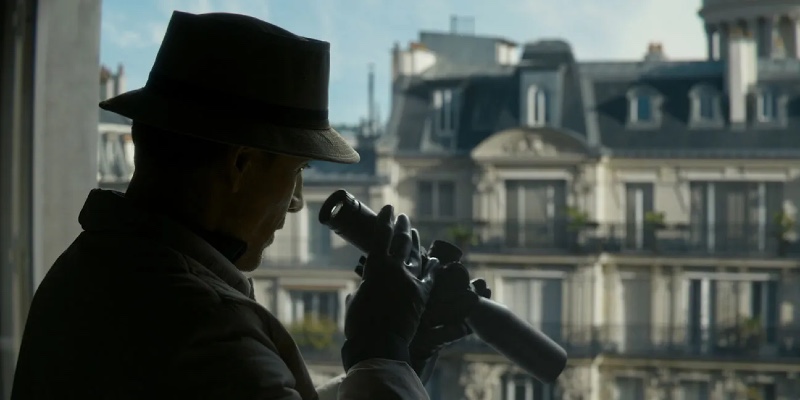
But as adapted by Andrew Kevin Walker (who wrote “Seven”), the movie version of “The Killer” proceeds in some radically different directions from the comic. The assassin’s internal monologue is more focused on process than historical atrocities; as he noodles around Paris in the opening minutes, waiting for his victim to show up, he talks about everything from his calorie count to his outfit. In the lead role, Michael Fassbender delivers every word in slightly ironic monotone: “My camo is based on a German tourist I saw in London, a while back. No one really wants to interact with a German tourist,” and so on.
On the plus side, Fassbender’s assassin is funnier than the comic version. As he visits a storage locker filled with guns, grenades, and fake IDs: “There are more than fifty thousand storage facilities in the U.S. I have units in six. I like to imagine, once the automatic payments have dried up, the episode of ‘Storage Wars,’ where they cut the lock on one of mine, and get a look inside.”
However, he’s also way dumber. After prattling on endlessly about everything needed to become a consummate professional killer, he completely screws up a straightforward hit (in the comics, he succeeds at nailing his target, but ends up killing a bunch of bystanders in the process). Midway through the film, he confidently suggests that another target will survive six or seven minutes with three 9-gauge nails in his chest, only for the guy to die pretty much immediately, royally messing up his plans.
“I’m no genius,” Fassbender asserts in voiceover at one point, a rare bit of self-clarity.
While the film certainly diverges from the comic in a lot of ways, it’s almost like Fincher is trying to make the same point as Matz and Jacamon: a killer who thinks he’s above it all is really just another tool in a late-capitalist economy. If Fincher wants to use humor at the killer’s expense to make that point, it’s likely a reflection of a movie’s truncated running time, and the need to keep an audience entertained. For fans of the comics who might not like what the movie does to the character, they can always take solace in the original work, with its epic dive into the psyche of a very bad man.