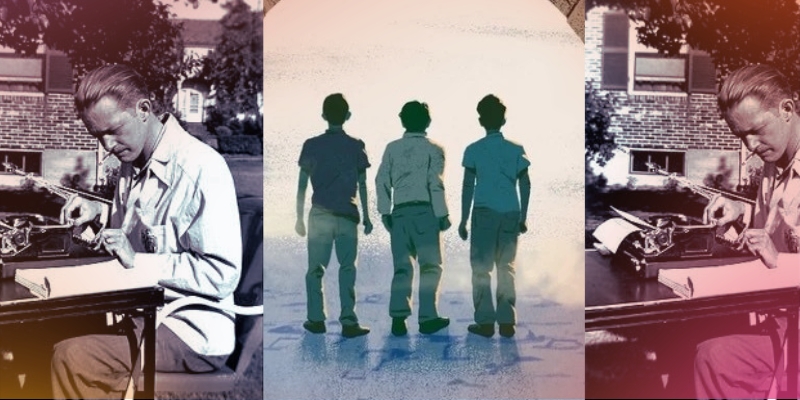
Robert Arthur, Jr. had had a long successful career writing for magazines and pulps, television and radio when he began writing for kids. He’d received three Edgar Awards for his radio work, which included co-creating and co-producing The Mysterious Traveler, with his writing partner David Kogan. He worked in Hollywood as a story editor on Alfred Hitchcock Presents, producing Dark Destiny, and writing for Thriller, Goodyear Playhouse, and other series. He had been writing and editing anthologies for adults and children when the first Three Investigators novel was published in 1964.
Between 1964 and his death in 1969, Arthur wrote ten novels in the Three Investigators series, which to my mind is the greatest mystery series for kids ever written. Admittedly I know less about middle grade fiction today than I did as a kid, so there may be newer contenders for such a title that have appeared in the twenty-first Century.
There were greater individual books that I read when I was a child, but the Three Investigators were the first books that I loved. That inspired me to think about books and writing in a new way. They were the books that made me want to be a writer.
For better or worse, I am who I am today because of Robert Arthur.
The Hardy Boys and Nancy Drew are practically synonymous with kids mystery novels, but the characters and many of the stories are bland and boring. I can say this; I read and owned enough of them and kept reading them for years. Whether because I hoped they would get better, because I’m something a completist, or because I just wanted a mystery story even if it wasn’t very good, I can’t really say.
One day at the downtown library, I ran into my friend David Speyer. We were both with our mothers and younger brothers to pick up books and he introduced me to The Three Investigators. Better than the Hardy Boys, he said, or something to that effect.
The library had an incomplete run of the series, but they were the original hardcovers dating back to the 1960s and 1970s. The original book covers were striking, and stand out even today, the product of talented artists like Ed Vebell, Harry Kane, Jack Hearne, and Robert Adragna.
The children’s wing of the New Britain Public Library with its vaulted ceilings and large windows is even more impressive as an adult. More like a cathedral than most libraries, though it’s been rearranged and the card catalogues removed, and sadly those books, which were old and worn when I borrowed them, are gone.
*
But Why Were They So Good???
The writing was better.
Let’s just make that clear. The writing was heads and shoulders above most kids series. As an adult who doesn’t read children’s books, I felt that reading them today. They also felt real in a way that so many books targeted at kids did not. The main characters were individuals and not bland stand-ins. Which sounds absurd to write, but what distinguished Frank Hardy from Joe Hardy? Their age and hair color. Age and hair color qualified as personality in many kids books. Jupiter Jones, Pete Crenshaw and Bob Andrews were different.
I always identified with Jupiter Jones, which is egotistical, since he was the brains of the outfit, but how often were we supposed to identify with the chubby brainy kid? How often are we supposed to now? Not because they turn into a superhero or end up being the chosen one or go on a weight loss journey, but that’s just who they are and they’re the point of view character to whom we’re relating.
Looking back I think about the number of girls and women in literature we read when we were young who were described—or described themselves—as “plain” from Meg Murray to Jo March to Juana Maria to Fern. I struggle to think of many boys I read who were characterized in similar ways. I also identified with Jupiter because I was chubby, had skipped a grade, and wanted to have friends I solved mysteries with in a much cooler place than where I lived. I also liked Hawaiian shirts, which is what he wore in most of the book covers and illustrations. Who wouldn’t want to be Jupiter Jones?
I don’t know much about Arthur besides the brief biographical sketches that can be found on various fan sites, or on his daughter Elizabeth Arthur’s website, but he understood kids. In a way that I think a lot of people who wrote books for children have not always. Not only did they live outside of Los Angeles and solve mysteries together, but so many of the details of their lives feel like a wish fulfillment.
Jupiter lived with his Uncle Titus and Aunt Matilda– his parents, professional ballroom dancers, had died in a car crash– who ran a Salvage Yard. Not a junkyard, as was made clear. Jupiter and his friends were expected to lend a hand on occasion, but for the most part they had what is now called a “free range childhood.” Or as we called it when I grew up, childhood, where kids were mostly left to their own devices.
They didn’t just have a clubhouse; they had a secret clubhouse. “Headquarters” was an old mobile home in a corner of the Salvage Yard that the boys had piled junk around for years until everyone else had forgotten it was there. They had installed a series of entrances. The primary one being from the small workshop of Jupiter’s that sat next to the pile, that let them crawl into the mobile home.
Each entrance had not just its own unique way to access Headquarters, but its own name. There was a periscope that they could use to see what was happening in the salvage yard. There were entrances they set up around the yard so they could enter and exit without being seen.
Because of their age, which I always guessed was around twelve-thirteen, though I don’t recall it ever being mentioned explicitly, they got around on bicycles, occasionally asking Hans or Konrad, Bavarian brothers who worked at the Salvage Yard, for rides. Also Jupiter won a contest, the grand prize of which was the use of a vintage Rolls Royce with a driver, which meant that Worthington drove them around to various appointments and on strange adventures. Leaving them off a short distance from a haunted abandoned castle in an LA canyon was not his typical assignment. Something that Worthington enjoyed far more than he tried to show.
Rocky Beach is a working/middle class town located where Malibu is. The kind of fictional city one finds in lots of stories, close enough to a big city when convenient, but also distant enough when needed. I like to think that it’s on the Pacific Coast Highway, just North of Los Angeles, on the way to Santa Teresa.
*
I hadn’t read this book in literally decades, but I knew it in greater detail than books I’ve read in the past year. I knew it better than things I’ve written in the past year. Once I started reading, every beat, every plot point, was deeply familiar to me. The first book in the series, it introduced how Jupiter passed along messages to his friends in code. His brain working in a way that makes perfect sense, but has its own logic.
Having obtained the use of a Rolls Royce, and fixed a printing press which they use to produce business cards, Jupiter has a plan to establish the Three Investigators. They will solve a high-profile case. In this case, they will visit Alfred Hitchcock, who is currently looking for an authentic haunted house as a location for his next film, and find him such a location. At a young age I was, not knowing who Hitchcock was, it made perfect sense. As an adult who knows Hitchcock’s films, it made perfect sense.
After conniving their way into his office on the studio lot, Jupiter offers to find a suitable location in Los Angeles and prove it’s haunted. He already has one in mind, the titular castle. Here is something that I think is important and worth noting. None of them say, the supernatural does’t exist, ghosts are impossible. They solve seemingly impossible and supernatural cases, but the answers to the mysteries are always people. They’re people using tricks and deception and weaponizing superstition.
But the impossible is never dismissed out of hand. It is always possible, until proven otherwise. I had discovered Scooby-Doo by this point in my life, and so the ways that greedy criminals weaponized superstition, and a humanist debunking of it, was familiar to me. Though Arthur got there first.
Terror Castle was a mansion built in the canyons of Los Angeles by Stephen Terrill, a silent film star who died in a car crash. And ever since no one has been able to spend a night there. People become terrified and run away in fear. There’s a spooky mist that appears. The organ plays spontaneously. Over the course of the book, the three debunk and explain all this, and discover why.
Each of Arthur’s other books had their own approach and a different kind of mystery. In Skeleton Island, they follow Pete’s father who’s working on the East coast on a film shoot and discover pirate treasure, and the remains of a more recent bank robbery. The Silver Spider is a Ruritanian romance.
The Stuttering Parrot involves a stolen parrot, which is connected to a number of birds each trained to repeat one part of a riddle. A mummy that whispers and a missing cat. There’s the connection between a museum robbery and gnomes appearing in an elderly woman’s yard at night. Often immigrants and newcomers are blamed for problems, and often they end up helping the three to find a solution.
*
Arthur died in 1969 , by which time he had recruited Dennis Lynds to continue the series, who ultimately wrote thirteen books under the pseudonym William Arden. Mary Virginia Carey, under the pen name M.V. Carey, wrote fifteen books, the most of anyone. Two other books were written by Kin Platt (under the name Nick West) and three more by Marc Brandel.
At a certain point the books stopped being “introduced” by Alfred Hitchcock, and instead the first book featured a fictional director named Reginald Clarke, and then by the fictional mystery writer Hector Sebastian. After originally being published in hardcover, they became paperbacks. There was a complicated legal situation involving Arthur’s will and the copyrights. I don’t want to make it sound like everything went downhill after Arthur died, though I do enjoy his books best.
Robert Adragna became the series’ cover artist with #29 and was hired to paint new covers for the older books as they were issued in paperback. Some are variations on the original design, some were good, and some missed the mark. I think his covers to Terror Castle and Skeleton Island are superior to the originals, and to the later covers created by other artists. I think that both utilized the sensibilities that he brought to his western and science fiction artwork, incorporating landscape and weren’t just great images but great settings. What you want a good book cover to do.
There were ultimately 43 books published, along with some choose your own adventure– I’m sorry, “Find Your Fate” mysteries– before the series ended in 1987. As with most series, the last few weren’t as good as the earlier ones.
*
The German Films
The Three Investigators were immensely successful in Germany. I don’t know why. Germans love westerns, too, and I’ve never read a good explanation as to why that’s the case either. It does’t really matter, except that there were multiple books published in German that continued the series, radio plays adapting the novels, and the unpublished novel by M.V. Carey that she wrote to be the forty-fourth book in the series was translated into German and published there.
Earlier this century, a German production company made two movies that were shot in South Africa, 2007’s The Three Investigators and The Secret of Skeleton Island and 2009’s The Three Investigators and the Secret of Terror Castle. They’re available to watch on Tubi. Despite using book titles, they were not faithful adaptations. Despite their flaws, they captured some of the tone and spirit of the books. Which I think is all that one can hope for. There are aspects of the books, the first one particular, that date it to the 1960s so it’s hard to replicate unless done as a period piece.
In the first film, and more so in the second film, much is made of Jupiter’s existential trauma of his parents dying of unknown causes and how he cannot leave any mystery unknown. The fact that both films involve Victor Hugenay, who readers will remember from the second book, The Stuttering Parrot, and we learn in the second film that Jupiter’s parents were spies didn’t bother me because they weren’t faithful to the books, they bothered me because they were bad ideas.
The first one is a much better film, and I think fans could enjoy despite its flaws. It entertained me, at least. The opening scene, though awkward and over the top, made me smile when Jupiter presents their business card, the camera zooming in on what for readers is a familiar looking design. “We investigate anything.”
The opening credits were well-done. I can quibble over the depiction of Headquarters—in the films, the trailer is not covered in junk, but is just a trailer in the corner of the salvage yard—but looking at the eclectic makeup of their equipment and how they access it, sliding through a repurposed vent and popping out of a chair, I caught myself grinning.
The character of Chris in the book is gender-swapped into a girl who both Pete and Bob have a crush on, though she has a sweet moment with Jupiter as they bond over dead parents as she teaches him to correctly pronounce Xhosa. While flirting with a girl is very un-Jupiter Jones behavior, this is how it would happen.
Whatever my other issues with the plot, the Skeleton Island film had a scene where Jupiter figured out a key clue, which he explained after everyone else stopped screaming:
JUPITER: I knew I had heard that sound before. And then it came to me. It was a baboon cry.
Jupiter strokes his chin.
JUPITER (CONT’D): Quite a sophisticated sound.
As written, and as delivered, it was a perfect Jupiter Jones line.
*
Rereading Them Today
Rereading the books so many years later I smiled at the familiarity. The comfort of them. As I said, it’s been decades since I picked them up, but I knew the plot of Terror Castle and details from Green Ghost and Silver Spider so intimately. Today the books and the setting bring to mind so many other things.
I lived in Los Angeles for years and remember driving through and hiking in those canyons. The large houses on the hilltops and the communities of people who lived in the wooded valleys, which felt like a world apart from the sprawling city on either side. Driving out to Malibu (home of another great American detective, Jim Rockford), whether to visit the beach or the Getty Villa or just escape the city, it felt very close and very far away from LA. Though Malibu does not have a salvage yard as far as I know, there is a vast network of used clothing shops, secondhand bookstores, and vintage stores across the Southland where so many of us used to shop, which then and now stands in contrast to the conspicuous consumption found everywhere.
I am reminded of old movies and actors, the illicit and scandalous stories of old Hollywood. The superstition and woo-woo you come across everyday in Los Angeles. Living near Hollywood where Topanga Canyon meets the ocean, the boys would have grown up immersed in that.
California today is a very different from the one that Arthur wrote about, having been transformed by decades of fires and earthquakes, developers and migration, but I think he understood and captured something about the heart of the place in these books. It might be as subtle as the lessons of tolerance in the books, where immigrants and outsiders are scapegoated for problems caused by others and when given the opportunity demonstrated their character and talent, but it’s there.
There is a reason why I loved these books. In life, hopefully at least once, you will discover a book. It was written by someone you will never meet, about a time and place you will never know, but it will feel like it was written for you. That’s what these books were for me. What surprised me, rereading them as an adult so many years later, was that they still are.
***