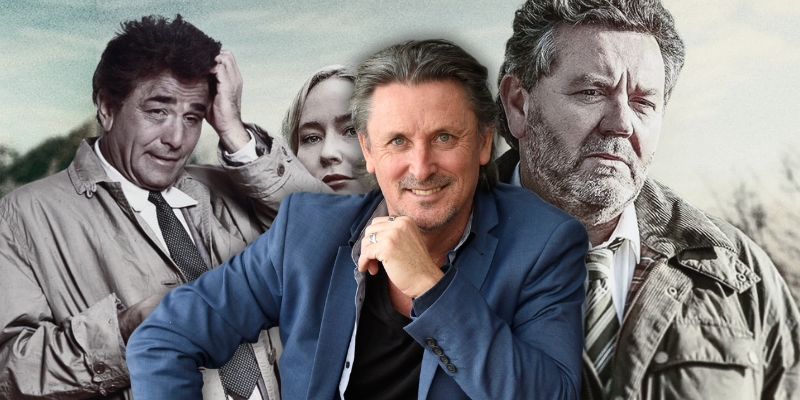
Tim Balme is recognizable to many for his acting roles, which range from the series The Almighty Johnsons to starring in Peter Jackson’s classic film Braindead. Years ago the New Zealand-based Balme transitioned to being writer and producer, working on shows like 800 Words, The Sounds, and Under the Vines, but he is best known for creating The Brokenwood Mysteries, the twelfth season of which launches today on Acorn.
Set on the North Island of New Zealand, the series features three detectives led by Detective Senior Sergeant Mike Shepherd, but what distinguishes the series is how it combines comedy and drama, managing to be both laugh out loud funny and absurd in the same episode it can be dark and heartbreaking. It has a soundscape of alt-country musicians from New Zealand including Tami Nielson, and Mel Parsons, which give the show a unique sound and mood.
It also features many supporting characters, some of whom recur regularly, and one of the joys of the series are the appearances of Frodo, the relationship between Reverend Greene and Dr. Plummer, Ray Neilson’s new business ventures, checking in on Neil Bloom and Trudy Neilson, and encountering new members of the Oades family.
As a longtime viewer, I have my opinions about characters and episodes. But what’s been interesting is that Balme continues to write and co-write multiple episodes each season, and that the past few seasons have featured some of the show’s very best episodes. Including last season’s finale, “An Oades to Christmas,” which one of the best and one of the funniest. (Though American viewers who watch on PBS are a few seasons behind). Balme and I spoke recently over zoom about not watching mysteries, the influence of Columbo, and building a whānau.
This interview has been lightly edited.
*
Alex Dueben: In preparing for this conversation and reading other interviews you’ve done, I was surprised to learn that you’re not a mystery fan.
Tim Balme: It’s not that I’m not a fan. It just wasn’t what I was watching at the time that I ended up creating the show. I created the show almost by accident. I’ve seen in other places that possibly the reason that it’s had some success because it’s been created by someone that didn’t understand the genre. [laughs] Maybe?
It’s not that I’m not a fan, it just wasn’t something I was overly engaged with. I’ve been working on it now for twelve years and I don’t watch other murder mysteries because the safest way I can protect myself is to not have been influenced by anybody else. If I end up telling a story that’s the same as someone else, that could happen, but it would be a complete coincidence. As opposed to, that went into my brain and ticked around and came back out three years later and I thought it was an original idea. It’s become a very conscious decision.
AD: I understand that. You are writing in a genre with rules, but it does feel like over time you’re telling this soap opera about a weird town where at least one person is killed every episode.
TB: That’s right. No one seems to mention that. Soap opera is an interesting term. We’ve often been compared to Midsomer Murders, in that there’s no swearing, there’s no sex. Weirdly enough, there’s no violence, really. The violence is implicit or after the fact or on the cut.
The difference we have is that we return people. We’ve created a village of locals that can come through an episode. It depends whether I think we need them or not. I don’t want to truck everybody through every episode for the sake of it. I think that would be tedious for them as actors and for the audience. I like to keep it unpredictable as to whether you’re going to see so-and-so in an episode or not.
I’m maintaining a whānau, if you like. That’s the New Zealand Māori word for family. The whānau of Brokenwood is a wider group of people that live in a region. In real life, they pass through. They could be walking outside the bank as our story about the bank happens. That’s just real life. I think that’s been one of our successes is incorporating a whānau as an incidental part of the bigger stories.
AD: If people watch a random episode involving Jools Fahey or the Oades family, they stand alone, but if you’ve watched the series and have watched the characters over time, it means something different.
TB: Correct. Jools is a really good example of that. She’s one of my favorite characters. She’s danced through five or six episodes now, I’ve lost count. She’ll return at some point. She’s living in the wider hinterland of Brokenwood somewhere, up to something, and we’ll find out about that when it’s time to bring her back into the foreground.
The Oades, too. The Oades family are a gift that keeps on giving. They’re like spice. You wouldn’t want an episode with them every week. Unless you made a spinoff series about the Oades family, which I’ve always thought would probably be sustainable. But it might be a case of just too much all the time. [laughs]
AD: It might be too much all the time. [laughs] When you’re creating all these characters, are you often thinking in terms of this would be a good character to come back? Or sometimes is it just the actor and seeing how people respond to them?
TB: It’s very much the actor. Often I’m creating these characters with an actor in mind, because New Zealand is a relatively small pool of actors. I’m pretty familiar with most of them, or certainly those in my demographic between forty and seventy.
I’ll often create a character with someone in mind. Or if I create one without someone in mind and the actor turns up and they just knock it out of the park, then I’ll go, great, let’s bring this person back and do something different with them. Conversely, it can work the other way as well. But typically it’s, let’s see what the actor does. When they light my fire, they’ll be coming back.
More so than what the audience think. Obviously there’s a lag between what we film and when the audience hits it. Although the feedback these days is almost instant with social media, which we keep an eye on.
I’m more influenced by the way that the actors are working more so than what the audience are thinking. I think it’s a dangerous territory when you start writing to the audience’s feedback, because I think that’s a trap. Some people are more vocal than other people. And of the percentage that are doing it, there are some that are particularly vocal.
If I start steering the ship towards their wants and desires, I think we hit the rocks pretty quick. Particularly because often people say they want things that they don’t really want. They don’t really want Mike and Gina to get together. Honestly, if I did that, you would kill me. You would hate me for the rest of your life. So by all means, fantasize about it, but it ain’t gonna happen.
AD: Now I say this as an American who has not visited New Zealand—yet—but there is something about the show that feels very specific to New Zealand. Even if I couldn’t always point out what that is. It feels like that was kind of part of the DNA from the beginning, a show about/for New Zealand.
TB: You’re absolutely right, Alex. When I was tasked with creating the show, the only audience I had in mind was my local audience. I didn’t expect it to translate across the globe as it has. All I cared about was making a show that people here would relate to and recognize—with the budget that we had, which was very modest. By being very specific to my audience with a universal genre, I created Brokenwood.
Now it just so happened it was this zeitgeisty moment, where the world was looking around for shows like these that had a point of difference, because they’d had a lot of UK shows and American shows. We just happened to pop up and people went, wow, that’s different, and engaged with it, and engaged with my location and cultural specifics. For some reason, they found they could enjoy it—and embraced it.
We hit the world at the same time as Acorn was expanding their platform for shows like ours for American audiences. So yeah, it comes from a completely culturally specific point. If I’d been tasked with, can you make a show that Americans might like, we wouldn’t be having this conversation. I would have failed.
AD: Related to that idea of specificity and universality, music is such an important part of the show. How much does music play a role in how you think and how you work as a writer?
TB: I’ve always been a huge aficionado of contemporary music my whole life. I’m the classic guy that used to play in bands at high school and university, and then decided to focus on the acting side of things and let that go, but I always had a great appreciation for it.
When I was creating Mike Shepard, I wanted to give him a musical interest. My original plan was that he was an opera lover. I wrote that in the first draft and someone wisely pointed out to me that, you know, Inspector Morse likes opera, so we can’t do that. I, of course, didn’t know this because I’d never seen Inspector Morse.
So I was umming and ahhing about jazz and blues, and luckily I landed on country because that has been a gift that keeps on giving. His passion for country music, to be honest, initially it was a point of derision from people around him saying, you like country music?! Which we did initially, but we’ve moved on from that to where it’s just part of his world and we tap that every now and then. But it became integral to our soundscape of each episode. I didn’t know it at the time, but country music in New Zealand, we have an alt country subculture of our own, which I wasn’t really aware of, to be honest. No sooner had we locked onto that and started looking around, we realized it was a really fast evolving genre here. From a budget point of view, we could only afford to license New Zealand music. Because of that, we ended up getting some really interesting music and artists like Tami Neilsen and Delaney Davidson and Barry Saunders. The guys that we started off with, twelve years later are very established artists around the world. We’ve introduced them on a larger scale to a wider audience as well. It’s been really symbiotic.
AD: Similar to the show and mysteries, it’s very specific, but also universal.
TB: I grew up on The Band, Bob Dylan, that sort of Americana country, as opposed to country and Western. What we call alt country has an innate darkness to it. There’s a dark edge to all country, fair enough. Country music, as we’ve joked about in the past, is about people falling down a coal mine and dying or their dog gets shot or something like that. It’s dark, even if it has some very positive melodies.
There’s that lovely contrast that’s built into a country song. That works really well in the stories that we tell.
AD: I think so. And like the show, it’s very much about this combination of tones. Because the show can be laugh out loud funny, but it can also get very dark.
TB: I think that’s been the key to the show, too. When I engage a new writer, I will always remind them of that, because the comedic elements that have permeated through the show, they stand out to people. A new writer will come in thinking it’s a comedy, and it’s not a comedy, it’s a drama. The comedy is character-driven.
The moment we start writing comedy, or the actors start playing comedy, the show dies. I have to say, you’re writing a drama. People get killed here. And when people get killed, that’s serious.
We have to acknowledge that’s a serious thing. There’s always a serious reason that someone felt they needed to kill someone else. If you can honor that from an emotional truth, then you can have fun with other things, and black comedy can emerge.
But that emotional truth has to be the thing that typically when someone confesses, or they’re charged, or however the murder is resolved from a story point of view, I’m always looking for the pathos moment. I want us to either feel doubly sorry for the victim, or actually a little bit sorry for the person that didn’t really mean to do it, but they did do it. There should be a lot of pathos in that moment.
All the fun and games that might have occurred in the previous eighty-five minutes, with the Odes family, or Jools, or whoever, that’s all well and good. But bring the emotional truth at the end, and that feels like it was worth spending 90 minutes on the story.
AD: As you were saying that, I kept thinking of the episode “Brokenwood: The Musical,” which I know you wrote, and which I think is one of the best of the series.
TB: Oh, thank you.
AD: That’s an episode where you cover a lot of ground and without being meta, make points about how Māori culture often gets treated, trying to appeal to Americans, lots of little things that were funny and pointed, but it also had a climax that was truly heartbreaking.
TB: It kicks you in the gut. You’re right. Thank you for acknowledging that. That’s a really good example of an episode that does all those things at once. It was a little bit divisive, that episode. Some people thought it was too silly. Some people just hate musicals, so they were never going to have a good time. But I think it’s a good story. Those characters are so narcissistic, and they can be driven to do these terrible things, and then people snap and have to deal with it. That to me is a good murderer-victim kind of balance.
AD: Sometimes you feel really horrible about the victim, and sometimes you feel really horrible for the murderer.
TB: What’s the last episode you’ve seen? You haven’t seen season twelve, obviously, because that hasn’t come out. Season eleven? “An Oades to Christmas?”
AD: Yes, I’ve seen all of season eleven and that episode, which I know you wrote, was a great episode, and also one of the funniest in the series. When you come off a more comedic like that, are you thinking about the new season and how to approach it in a different way?
TB: We are coming off that. I can tell you that episode one of season twelve is about an alien convention that comes to Brokenwood. The Oades are nowhere to be seen. Life carries on. Another day in Brokenwood. Did an alien come and kill someone on the golf course? Let’s figure that out. I look back on each season and go, what was the motivations around the murders, and were they getting too similar at some point?
I might go, we’re not having any longstanding revenge stories, or something like that. We need to keep it mixed up. So I might put a few caveats on it when people are pitching me stories.
I typically write three of the episodes each year, and have three other writers write the others. This season that I’m starting now, I’ve actually engaged two new writers. Just to keep things moving and new. It helps the actors, I think, and me. Just keeps us on our toes.
It’s more work for me, though, when I’m using a new writer, because I have to kind of teach them the DNA of the show. Everyone comes into the show going, I love Brokenwood, I can write one. Then they realize that they’re a little more tricky than you think. There’s a few tricks of the trade, which to me are just intuitive now, but I have to share that with them and support them through it, but that’s my job. And I do like getting fresh takes on it.
AD: One of the writers who started in recent years is Tania Klouwens, who is the costume designer for the show. Did she just pitch you an idea?
TB: More than that! We had just come out of COVID. I was in my office and this thud landed on my desk, which was a script that she’d written during COVID. I looked at it. I went, oh, no, I think I know what that is. It’s a script, and you’re not a writer. This could be really awkward. [laughs] I actually sat there going, please go back in time and don’t put that on my desk. I read it. And to be fair– she’d be very open about this– she had no idea what she was doing. She didn’t have a script writing software. She just figured out how to paginate on Word.
AD: She was just hitting tab a lot?
TB: Yeah. I’m going, oh my god, because I know how long that would have taken. But—but!—there was a good murder mystery story there. I didn’t know, but she was a murder mystery aficionado. She knows every Agatha Christie ever written. She’s actually far, far more schooled in the genre than I am, and I could recognize that in the script. Even though the script was problematic, I could go, we can work together and I can teach you how to make this a proper script.
That was The Mexican Day of the Dead episode. She learned incredibly quickly, and took feedback incredibly well, and that’s a really good episode. Then she wrote another episode the next year, which is the seance episode, which is one of the greats. She really was a fast learner, and a great team player, and a passionate person, about, obviously the show, but also the genre. She’s become a most valuable player.
She’s got another script this year, in season twelve, which is about spies, and is writing a new episode for this season that we’re working on now. I won’t say what it’s about, but it looks like a goodie. We do actually have a policy, which is no unsolicited ideas, but when someone walks into your office, and drops it on your desk, there’s nowhere to go. But fortunately, there was a happy ending.
AD: Are we ever going to see a Chalmers-centric episode?
TB: Absolutely. I was going to do one this year, but I had to defer it to next season, so season fourteen. It’s time for him to be landing the plane on occasion. I want to do a very Māori-specific story that he can lead out. I just have to find the right Māori co-writer. I haven’t managed to sort that out this year, so I’ll do it next year.
AD: One of the joys of the show, and you seem to enjoy this, is Mike as this rumpled, Columbo-esque detective.
TB: Columbo was my only point of reference I had, when we started putting it together. He was the detective I remembered as a kid watching on TV in the 70s, with my dad. I had a vague memory of him, and then I went back and watched some of those episodes on DVD, when I was engaging in this idea. Mike Shepherd is an homage to Columbo.
It’s interesting when you watch Columbo now, I’d forgotten this, but you knew who did it right at the beginning. You see them do it, and then the whole journey is the joy is Columbo getting his man, or woman. Obviously, we don’t do that. In a way, it’s not really a murder mystery, it’s a detective show.
That was the way they set it up, and it was very, very successful. Although if you do watch a lot of Columbo, by the time they got towards the end, man, they were starting to believe their own jokes. It gets a little bit too much, I have to say.
AD: It’s true. And Mike is part of that tradition. A character who others mock as old school and low tech—and still listens to cassette tapes—but he pieces things together.
TB: He’s got an iPhone now. That’s about it. I’m still very wedded to that idea that he can figure it out without the help of DNA and running it through the CSI machine. We have a complete polar opposite in that we have to just tell a story without all those bells and whistles. For me, that’s more interesting as a writer anyway.
Really, Mike’s great skill is memory, because people tell different versions of the same event. Or the same person can tell different versions of the same event, and that’s what detectives are skilled at doing, sorting out the lies.
What’s so great about the way that we tell our stories, is that people freely lie to the police all the time. Either because they feel like they have to, to cover up something else, or they don’t want to admit to what they’ve done. Really, Brokenwood is just a series about people lying to the police, and the police trying to figure out what the truth is. [laughs]
***