When I’m asked to speak about interesting research for my novels, one of the items I frequently share is the story of J.H. Barnstead. I find it incredibly fascinating that a standard forensic practice still used today originated here, in a small city in Nova Scotia, in the early twentieth century.
John Henry Barnstead developed a method of cataloging personal effects during the Titanic tragedy, but I first learned of him when I was conducting research for my first historical fiction, When the World Fell Silent, set during the Halifax Explosion of 1917. When a relief vessel collided with a munitions ship in the harbor, the resulting explosion leveled a whole section of the city. That disaster that claimed nearly 2,000 lives and left 9,000 more wounded. It was the largest man-made explosion on the planet until Hiroshima and the atom bomb.
At that time, Barnstead’s Method was employed by his son, Arthur, who was appointed Chief Mortuary Officer the day after the explosion. The more I researched, the more I realized this is not the only point of intersection between the explosion and the Titanic disaster, and like most authors I know, my “plot bunny” generator was up and running.
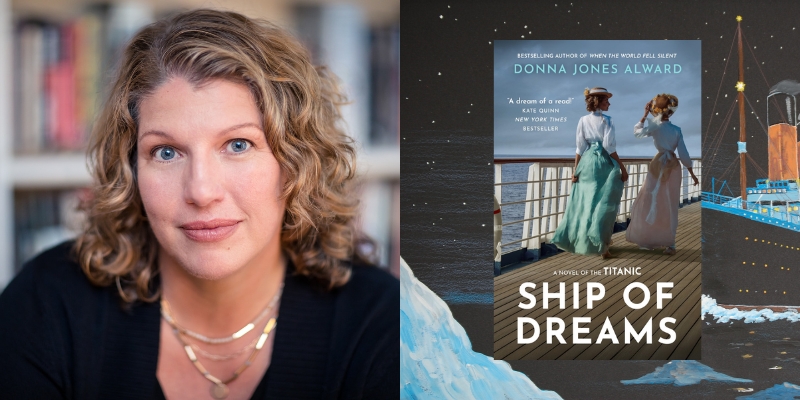
Beyond the forensic method, I learned so much about the Titanic that I knew it had to be the historical backdrop for my second novel, Ship of Dreams, giving me a chance to dig even deeper into Halifax history. Digging deeper meant learning more about how a single man revolutionized forensic identification and documentation.
So who was J.H. Barnstead, and how did he get involved in the most famous nautical disaster in history?
John Henry Barnstead worked with his father as a tanner in Halifax, Nova Scotia. Working with leather was the family trade, and in addition to being a successful leather merchant, John’s father, Charles, owned a large tannery under the title of Chas Barnstead and Sons that operated in the late 1800s. As a tanner, Barnstead was no stranger to death. I would expect, however, that he would find human remains a completely different sort of challenge to both heart and soul.
By the time John was in his forties, the large tannery was gone, and John became a barrister, taking on the role of Justice of the Peace and then Registrar for Vital Statistics in the province. It was this title that led him to be intimately involved in the Titanic disaster.
It went beyond his duty of signing the death certificates, upon which he issued a single cause of death: accidental drowning (even though exposure was the cause of several deaths). John, going as J.H. Barnstead, also devised an entire system of cataloging not just personal effects but physical evidence of the bodies, and doing so in a way that treated remains with respect.
When the world learned of the sinking, actions were immediately taken to send vessels to the area to retrieve any bodies. The main ship contracted out of Halifax, the closest major port, was the Mackay-Bennett, a cable ship owned by the Commercial Cable Company, and it set sail on April 17th, with coffins and ice on board. Its crew recovered three hundred and six of the three hundred and twenty-eight bodies that were found.
While Barnstead did not himself sail aboard the Mackay-Bennett, he was in contact with all ships involved in the search, including the Minia, the Montmagny, and the Algerine. The method he devised was applied to those passengers who were recovered.
What steps were included in the Barnstead Method? First, a number was assigned to the body. Everything—absolutely everything—was then attached to that number. Personal effects were removed and cataloged, and placed in a canvas mortuary bag bearing the victim’s number. Meticulous records were kept regarding the appearance of the body: clothing, height, approximate age; any marks or apparent injuries. A photo was taken to aid with identification
. The comprehensive and thorough documentation meant that even if a body was buried at sea, they could still be identified after the fact. Care was taken to treat the victims with respect and dignity.
Once the ships docked in Halifax, most of the bodies were taken to the Mayflower Curling Club and were prepared for burial as well as made available for viewing by families. A select few—high profile victims—rested at Snow’s Mortuary on Argyle Street.
Even now, as DNA is widely used for identification, the Barnstead Method remains a cornerstone of modern forensics. In fact, in 1992, his detailed records helped identify twelve more Titanic victims, and his method has been used in mining disasters and in casualty identification in the 9/11 attacks.
As I researched the Halifax connection to the Titanic sinking for Ship of Dreams, I visited Fairview Lawn Cemetery where most of the victims are buried. The numbers assigned to the victims upon recovery are carved on each stone.
For some, it is the only identification they have.
***