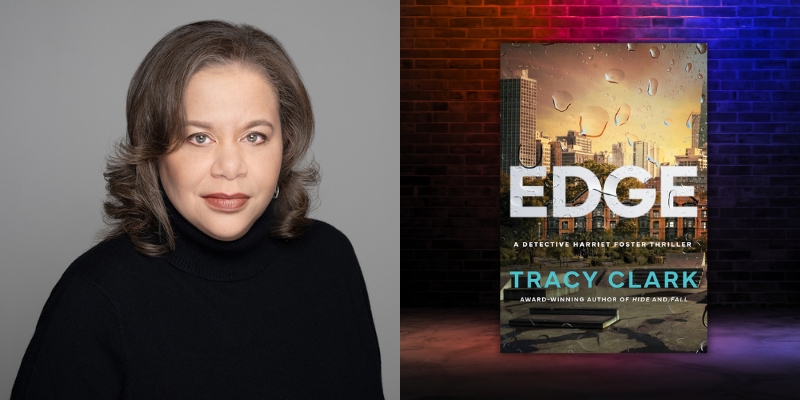
Writers are always looking for ways to up the tension in their stories. Higher stakes are always better stakes; more conflict works better than less conflict. I thought about all of this while I was building Det. Harriet Foster, my complicated, highly flawed, multilayered cop.
First, I made her female, then African American, then I plopped her down in the middle of the Chicago Police Department. Second, I took everything away from her, a son, a marriage, her longtime partner, the yin to her yang. Third, with all that to deal with, I gave her the worst possible partner I could think of, and then on top of that I gave her the worst possible case to solve.
Man, I was cooking with grease. If Harriet were real, the woman would probably strangle me with her bare hands.
But now I’ve got Harriet in a good spot, right? She’s got somewhere to go.
Stakes. Tension. Conflict. Gotta have it.
I’m not a cop. I don’t even play one on TV. So, with Harriet set, I wanted a better understanding of the challenges she might face as a Black female homicide detective in the Chicago Police Department. I needed to add some realism to the fiction.
I had a feeling it couldn’t be easy being a Black female police detective in a meat-and-potatoes town where a hitchhiking ghost bums rides along Archer Avenue and we sprinkle just a dab of corruption on top of every deep-dish pizza. In fact, I kind of knew it wouldn’t. I know female cops. I’ve seen the stress, heard the stories.
Going back to that tension thing, I needed Harriet to have it coming from all sides, and so I dug in looking for things to confound and prick at her. I packed my laptop and Twizzlers and, figuratively, set off down the rabbit hole.
There are between 11,500 and 11,700 (give or take) sworn officers in the Chicago Police Department, about 1,000 (give or take) of those are detectives like Harriet. Twenty-five percent of those are female. Blacks make up twenty-one percent of that number. Good. Harriet’s outnumbered. Sweet.
The Chicago Police Department (or any law enforcement agency) wasn’t set up for folks like Harriet. Established in 1835 and primarily staffed by those of Irish descent (men) from the late nineteenth century to the early twentieth, CPD didn’t swear in it’s first female officer until 1891, their first female patrol officer until 1913, and then female beat officers, as we know them today, didn’t get in those sweaty patrol cars, without restrictions as to their duties, until 1974!
Good. Harriet’s department was not set up for her. Double sweet.
So, Harriet’s a woman in a department not set up for her, leaving her open to all the male-chauvinist horsepucky almost every working woman in the known universe has to endure on an almost daily basis, and I show it. I could have left it there, but then again, I couldn’t have and have the character ring true.
It’s not only Harriet’s gender that makes her an outsider in the old boy’s club, it’s her race, and it’s not just a problem the department may have with it, but a problem her own community has with her being who she is, coming from where she comes from, and working for a department with a dubious reputation for over policing and running roughshod over neighborhoods of color.
Gender/Race. Department. Community. The three-legged stool on which Det. Harriet Foster sits.
In Hide, the first book of the series, I introduce this three-legged stool. I mentioned earlier giving her the worst possible partner? I did. I gave her an old-school, nasty, dismissive, misogynist bigot who doesn’t think women made good cops, let alone Black women.
I wrote the guy so unfavorably, in fact, that even I hated him. I thought I’d gone too far, so I checked with some female cops. I described Lonergan and asked if he was too much. Nope, they said (all of them). You nailed it. I worked with a guy just like that. Yikes, I said.
At the crime scene in Hide, where we first meet Harriet, the partner, the distasteful Lonergan, sees the scene quite differently than she sees it. They find the body of a young white woman but also find an unconscious young Black man not far from it, under suspicious circumstances.
Lonergan immediately sees suspect. Black guy. Close to the vic. Boom. Case closed. Meet ya at the cop bar. Harriet doesn’t jump to that conclusion. To her, Black doesn’t immediately mean suspect, having a Black face doesn’t immediately mark you as being a criminal.
As looky-loos watch from outside the crime scene tape, there are jeers from a few folks who look like Harriet and they admonish her for getting to this particular crime scene with all due haste, when the response from CPD is much slower on the South Side of town where they live.
When the suspect, that unconscious young man, is charged, his parents jump to his defense and look to Harriet as the enemy, the turncoat, trying to railroad their son into a prison cell. Harriet is CPD, not one of them. In their eyes, she is no different than Lonergan. She is suspect, a potential traitor who works for The Man and against her own people.
The community is not quite sure what side Harriet is on. Lonergan isn’t sure, either. Only Harriet is sure. She works for the truth, she honors her oath, she protects those who need it.
The department, though quite changed from 1891, 1913 and 1974, still has Lonergans in it. Again, yikes. So the road I envisioned Harriet having to walk, is the same road many real female cops and cops of color are walking right now. The world is complicated. We have not come to terms with race or gender in this country.
Just three years ago, here in Chicago, someone hung a noose at the construction site of the Obama Presidential Center. Three years ago. If you’re writing crime fiction, if you’re holding that mirror up to society, then you have to accept the reflection and do something with it, or else what’re you writing about?
Whether it’s conflict a writer imagines or conflict a writer holds that mirror up to, it all works to flesh characters out and add depth to your stories. Who is Harriet loyal to? The law? The department to whom she swore an oath? To her own code of ethics? To the community that she knows, and is a part of, and understands? As she’s faced with the likes of Lonergan and others who wear the same badge and take the same risks to life and limb, who’s she thinking about?
To Serve and Protect. It’s written on the side of every CPD patrol car. Serve who? Protect who? From what? Harriet certainly has not turned a blind eye to how police have historically served her underserved community. She works with Lonergan and knows full well Lonergan is no lone wolf. Yet she is charged with following the leads, closing the cases, following the law. What if the law is wrong? What if it’s Harriet standing in the gap between a rush to judgment and an innocent young man?
She has been walking in her Black skin for forty-three years and knows it only takes one bad traffic stop, one bigoted encounter for her to go from cop to victim.Harriet can’t ignore history. She didn’t just wake up Black this morning. She has been walking in her Black skin for forty-three years and knows it only takes one bad traffic stop, one bigoted encounter for her to go from cop to victim. I’m thinking about all of this as I write her because not to think about it would be preposterous and untruthful.
The three-legged stool on which Harriet sits sometimes gets really hot.
She walks a tightrope I put there for her, but that tightrope is far from taut. It wobbles, it has some give in it, and Harriet has to figure out how to walk it without falling. That’s Harriet’s struggle. Harriet is a cop on the outside of every closed door. Accepted, and not accepted. Wanted, not wanted. In the club or barred from it. A traitor here, an interloper there. A question mark.
Back to those stats as I was crawling around in that rabbit hole. Asian Americans only make up three percent of the CPD. Enter Det. Vera Li, Harriet’s second partner. My mirror’s always up.
***