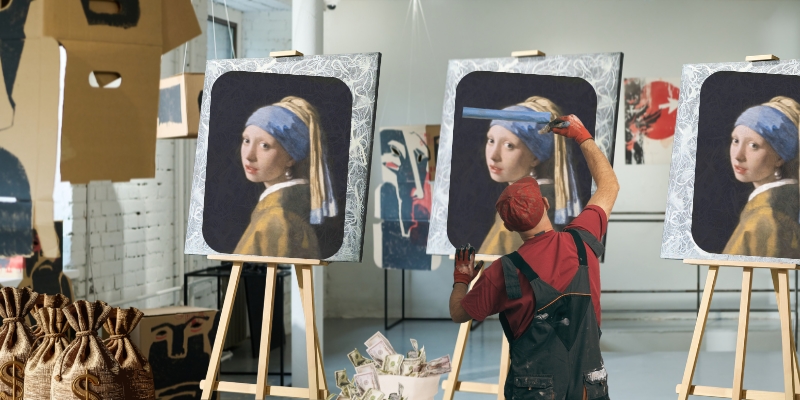
My forthcoming novel Lucien tells the story of two students at Harvard, an artist and an imposter, who become mixed-up in a scheme to sell forgeries of impressionist works. The inspiration for the novel came from a long-standing fascination with stories of imposters and illusionists—characters who slip between identities, not to deceive for its own sake, but to find a shape in which they can live, to gain access to worlds otherwise beyond reach.
In order to write Lucien, it was necessary to read countless books on forgers and conmen—on trauma and personality disorders—on imposters and fantasists. During my research, I immersed myself in a world of deception and illusion and encountered some mesmerizing characters—ranging from evil sociopaths to those on the more benign end of the spectrum.
Here are five books that illuminate that world with particular brilliance.
*

Mark Seal, The Man in the Rockefeller Suit
A fascinating account of the chilling story of Christian Gerhartsreiter, a true-life Tom Ripley and one of the core inspirations behind my character Lucien Orsini-Conti.
Gerhartsreiter arrived in the United States as an obscure and penniless German exchange student and, over the course of decades, reinvented himself through a succession of fabricated identities—first as a British aristocrat, and later as a supposed heir to the Rockefeller fortune.
Eventually convicted of kidnapping and murder, Gerhartsreiter managed to con his way to the upper echelons of the Manhattan social elite. As “Clark Rockefeller,” he gained admission to the Lotos Club, whose past members include Mark Twain, Andrew Carnegie and William Randolph Hearst, and married a senior partner at McKinsey.
A strange, eccentric man, “Clark Rockefeller” had an Upper East Side apartment filled with fake Pollocks and Rothkos and would occasionally offer friends private tours of Rockefeller Center, claiming to possess a mythical “master key.” His story unraveled after his wife filed for divorce and “Rockefeller” abducted his daughter, triggering a nationwide manhunt. After his capture and arrest, police discovered his true identity and connected him to the double homicide of a young couple in Los Angeles (the son and daughter-in-law of his former landlord).
What makes The Man in the Rockefeller Suit so compelling, and so useful to me as a novelist, is Seal’s attention to the social machinery that enabled the fraud—to what it reveals about us. Gerhartsreiter got as far as he did because people wanted to believe in Clark Rockefeller. It made them feel good about themselves to have “an important friend”—a member of one of the “royal” families of America—and so they overlooked his oddities and eccentricities and all the little things that didn’t quite add up or make sense.
This is a phenomenon I encountered again and again with these stories of imposters, and is an idea I kept central to the plot and character dynamics in Lucien.

Laney Salisbury and Aly Sujo, Provenance: How a Con Man and a Forger Rewrote the History of Modern Art
I read a dozen or so books on art forgery as part of my research while writing Lucien, and this was one of my favorites. Salisbury and Sujo tell the story of John Drewe and John Myatt, whose partnership in the 1980s and 90s produced hundreds of fake modernist paintings that fooled Christie’s, Sotheby’s, and some of the world’s leading curators.
The pair made something of an odd-couple. John Myatt (whom I interviewed in the course of my research) a divorced single-father and part time art teacher living in the bucolic village of Wiltshire, helped support his two children by painting replicas of famous paintings he sold via mail as “authentic fakes.” His life changed inexorably when he met John Drewe, an unhinged, manipulative conman who drove around in a blue Bentley and claimed connections to British intelligence services.
What elevates this above a standard true-crime yarn is the portrait of Drewe himself: a fantasist of almost novelistic ambition, who didn’t just sell fakes but rewrote the historical record, inserting forged documents into the archives of the Victoria and Albert Museum and the Tate. He didn’t just deceive the art world; he corrupted its memory. Chilling and riveting in equal measure.

Jonathan Lopez, The Man Who Made Vermeers
Han van Meegeren is perhaps the most fascinating art forger in history: a mediocre Dutch painter who, stung by critical rejection, spent years perfecting a technique for faking Vermeer, then sold his masterwork to Hermann Göring during the Nazi occupation of the Netherlands. After the war, when he was charged with collaboration for selling a national treasure to the enemy, he revealed the truth—he had fooled Göring with a fake.
The authorities refused to believe him until he sensationally proved his story by painting a new Vermeer in his cell. Widely castigated as a traitor and pariah, the act transformed van Meegeren into a national hero, suddenly adored by the Dutch public for his cunning trickery of the Nazis.
Lopez’s biography is a nuanced, deeply researched account of a man whose story raises genuinely uncomfortable questions about authenticity, taste, and the nature of artistic value. If a forgery is indistinguishable from the real thing, what exactly is the crime?

Tom Wright, Bradley Hope, Billion Dollar Whale
The story of Jho Low and the looting of Malaysia’s sovereign wealth fund, 1MDB, is the con artist story of the Millennial era, and Wright and Hope tell it with the propulsive energy it deserves.
Although Jho Low became adept at navigating the opaque and secretive world of offshore banking, asset laundering and shell companies, his primary tool was not financial sophistication but social engineering and performance. Rather than attempt to fly under the radar Jho Low did the opposite and hid his crimes in plain sight. He threw parties. He gave extravagant gifts. He befriended Leo DiCaprio, Paris Hilton and Miranda Kerr (and paid them to associate with him). He commissioned a super yacht for $250m. He bankrolled the production of The Wolf of Wall Street. All with stolen funds.
His story is also one of institutional failure—from the failure of financial regulators to the complicity of banks like Goldman Sachs and Rothschild to the involvement of high-ranking political figures including Najib Razak, the sitting Prime Minister of Malaysia (now serving a twenty-year prison sentence for his culpability).
Wright and Hope’s account is meticulously researched and demonstrates a deep understanding of the international shadow-banking system, yet it unfolds with the pace and tension of a thriller.
Eric Hebborn, The Art Forger’s Handbook
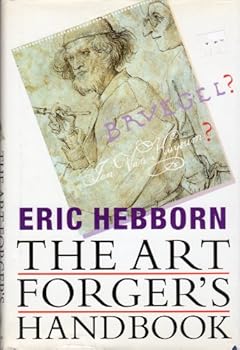
I’ll end with the most audacious entry on this list. Hebborn—one of the most gifted and prolific art forgers of the twentieth century, whose fakes hang in major museums to this day—wrote this book as a practical manual. This book was an invaluable part of my research for Lucien reading like a how-to guide for the technical aspects of art forgery.
Hebborn explains, with evident relish, how to age paper, mix period-appropriate pigments, and study the hand of Old Masters well enough to pass off new work as theirs. An extremely gifted young student who won a scholarship to the Royal Academy, Hebborn never achieved the professional success as a legitimate artist he considered himself due. The Art Forger’s Handbook and his memoir Drawn to Trouble were written as something of acts of revenge against the art establishment that rejected him.
Hebborn was murdered in Rome in 1996, in circumstances that were never fully explained.
***