In the first few months of 1948, the new Cold War began warming up.
A Soviet-backed coup in Czechoslovakia had led to the Communist Party taking total control in February, and Finland began implementing steps to appease and accommodate Soviet demands. A looming election in Italy threatened to see it go in the direction of Czechoslovakia.
In early March, General Omar Bradley, newly appointed as the Army chief of staff, summarized a widely held view to the Joint Chiefs of Staff: “For some time the international situation has been deteriorating. Recent events…give every indication that the situation will further deteriorate. There is no indication that the USSR will modify its aggressive efforts in the near future.”
In the middle of this rising sense of crisis, the military made a major push for the “custody”— the physical and legal possession—of the atomic bombs themselves.
They had been slowly and repeatedly pressing for this since their shock after Truman assigned all their atomic bombs to the Atomic Energy Commission the year before. Over the course of the year, they had, mainly through the Military Liaison Committee, pushed the AEC to provide solid reasons why the military should not be given atomic bombs.
___________________________________
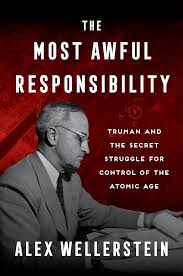
Excerpted from The Most Awful Responsibility, by Alex Wellerstein. Copyright 2025. Published by Harper. Reprinted with permission. All rights reserved.
___________________________________
The AEC’s offered reasons were primarily technical: Atomic bombs were still very tricky bits of technology, and the military had, at that time, very little training, experience, or even requisite facilities to take on such a role. The MLC, however, insisted that “the technical problems involved do not preclude the assignment of custodial responsibility to the Armed Forces,” and that, “without further delay, the Armed Forces should obtain custody of atomic weapons and be made responsible for their readiness in the case of emergency.”
This was itself rapidly echoed by the Joint Chiefs of Staff, who in a letter to Forrestal, who was now secretary of defense, argued that “neither prompt nor effective employment of such weapons can be assured unless the Military Establishment has responsibility for their custody and thus is afforded full opportunity for their preparation for use.”
Word of this made it to Truman. In a meeting with the AEC commissioners a week later, Truman related that he felt the military perhaps had a point, but he was not interested in hashing the matter out at that moment. He did emphasize, in a rueful tone of voice, his position on atomic bombs: “I certainly don’t want to have to use them again, ever.”
Truman didn’t make any decision or order. In the meantime, Operation Sandstone commenced, with three nuclear tests at Eniwetok Atoll in the Marshall Islands. These were the first tests of new atomic weapon designs since the Trinity test, analyzing the new composite core and “levitated” core technologies.
They were by all accounts a success, with one design yielding nearly twice the energy output as the Trinity bomb, and another doing fifty percent more than that. When Truman was given another report by the AEC commissioners in mid-May, he marveled at their description of the explosions and exclaimed that he wished he could have seen them himself.
After being briefed about what this meant for the stockpile—more powerful bombs, and in greater numbers—he rubbed the back of his neck with a certain weariness. “Why, that’s enough to wipe out a good part of the world,” he is recorded to have said. “If we could just have Stalin and his boys see one of these things, there wouldn’t be any question about another war.”
AEC Chairman David E. Lilienthal, who wrote of Truman’s reactions in his diary that evening, said that Truman was clearly “very troubled” by the nature of the improvements that were being made to the weapons. He related the following response from Truman after being formally asked to authorize the new tests:
Of course, I don’t like the idea of such things at all. I gave the order for the others [Hiroshima and Nagasaki], and I don’t want to have to do that again, ever. What I hope you will work hard at is the peaceful things about it, not the destructive. But until we are sure about peace, there’s nothing else to do.
The Truman that Lilienthal records, again and again, is a man who has no love of the atomic bomb, and no intention of using it. It is a Truman who absolutely seemed to express something like regret about the atomic bombings of Japan when he was out of the public eye, and to use his emotional feelings about the bomb as part of what was guiding his atomic policy going forward.
His mantra about having ordered the use of the weapons once and not wanting to do it again, “ever,” is telling, as is the fact that he repeatedly invoked it in the context of discussions about military control of the weapons and their further improvements. After Lilienthal reassured Truman that the AEC had no desire to use the weapons either, Truman responded enthusiastically: “That’s why I believe in a civilian Commission. I feel just like you do about it.”
The military, however, did not share the feeling.
On nearly the same day as Truman’s meeting with the AEC, the secretary of the Army, Kenneth Royall, sent a memo to the National Security Council on the “United States Policy on Atomic Warfare,” expressing the view that, sooner rather than later, there ought to be “a high level decision…as to the intention of the United States to employ atomic weapons in event of war.”
The military, he explained, had been operating under the assumption that atomic weapons would be used in the next war, but he believed “there is some doubt” that this was actually a “firm” government policy, and that “in some quarters” he understood that the idea was “being questioned particularly on the grounds of morality.” Furthermore, the question of who would order atomic weapons to be used, and by what channels such an order would go through, was still unclear.
Perhaps, Royall suggested, the Joint Chiefs of Staff could authorize the “employment” of atomic bombs themselves. Or perhaps that decision “might be reserved to the President or to some other agent of the government.” And beyond that, there was no official policy whatsoever about what circumstances might bring about the use of weapons, or against what kind of targets they might be used. Surely, he suggested, the U.S. should have an official policy “with respect to the initiation of atomic warfare.”
Since Truman had mandated on the day after the attack on Nagasaki, back in 1945, that no further atomic bombs be used, there had been no official clarification of any of Royall’s questions. The Atomic Energy Act of 1946 had reserved the president the right to transfer weapons to the military, but the custody issue was not exactly the same thing as the authorization issue, even it meant, in practice, that the military lacked access to atomic bombs as long as they lacked custody.
The omission in clarifying the basic question of what the U.S. policy was with respect to the use of atomic bombs, now almost three years after Hiroshima and Nagasaki, is somewhat stunning. It is not as if Truman were not thinking about the bomb during this time. But his thinking was rooted, at nearly every moment, in the idea that he absolutely did not want them to be used again. And so perhaps that is why he made no moves toward clarifying the circumstances under which they might be used—because he didn’t want to think about them.
The big showdown came a few weeks after the beginning of the Soviet blockade of Berlin, on July 21, 1948.
Secretary of Defense James Forrestal, Royall, several other top military representatives, and the AEC commissioners met with Truman at the White House. Speaking for the entire national military establishment, Forrestal presented a formal request for military custody of the entirety of the American atomic bomb stockpile. The argument came down to four points.
First, that having the bomb’s physical control split between the AEC and the military would negatively impact the ability of the United States to rapidly use the weapons if it needed to, and expose the country to “unreasonable risk of mistake, confusion, and failure to act” in the event of a massive, surprise attack.
Second, that “those charged with the actual employment of a weapon in combat” must, axiomatically, have familiarity with the weapon before it is actually used, especially if it is to be used effectively in an emergency. “Such familiarity and confidence can only be acquired,” he argued, “by constant inspection and handling of the weapon itself.”
Third, if the military had atomic bombs, they could disperse them strategically so they could be delivered promptly “when and if such use is approved by the President.” Fourth, he argued that military experience with the weapons themselves would undoubtedly improve the research and development process involved in producing new weapon designs.
These conclusions, he emphasized, were supported unanimously by the Joint Chiefs of Staff, and the secretaries of the Army, Navy, and Air Force.
Forrestal must have thought that this was an impossible request to resist. However, he had plainly misjudged.
Lilienthal gave a detailed report in his diary that evening. Arriving at the meeting room, the group was greeted “rather solemnly” by Truman, who looked “worn and grim.” There was none of the normal banter. It was a large group. Forrestal had wanted Lilienthal to appear on his own, but Lilienthal had insisted on bringing the other AEC commissioners to back him up. Forrestal had brought his own military entourage as well.
The group arranged their chairs into a half circle, with Truman as its focus. Lilienthal sat directly in front of the president, with the rest of the AEC near him. Forrestal and the military men sat to the president’s left. The mood, Lilienthal recalled, was dark: “a kind of seriousness hung over it that wasn’t relieved a bit, needless to say, by the nature of the subject and the fact that even at the moment some terrible thing might be happening in Berlin that would put this group into the hands of forces that might sweep our desires and wishes away, while the tides of force took over.”
Forrestal had wanted Lilienthal to speak first and give the AEC position on custody. Lilienthal refused: It was the military who wanted to change the status quo, after all, so they should have to make their position first. Forrestal’s deputy began reading a dense letter at Truman— to Truman’s great annoyance. When the deputy wanted to read accompanying materials, Truman snapped: “I can read.”
Following this, Lilienthal stated the AEC’s position to Truman plainly and directly. The issue of custody, he put forward, was not only about the narrow technical positions that they had been expressing for years, about the military’s lack of experience with this new, and possibly quite perilous, weapon. It was a matter of national policy and principle, and ultimately one that would be decided by Truman, who was, Lilienthal added with not a little flattery, perhaps the one person who had thought about the true meaning of the atomic bomb and the policies to try to constrain it “more than any other living man.”
What could the AEC, or the military, tell Truman, of all people, about questions of broad atomic policy? It would be, he quipped, “like trying to teach grandmother how to spin.”
Truman chuckled audibly; Lilienthal’s tactic was working.
Lilienthal wound up with a brief recap of the same arguments: The AEC alone had the expertise to safely handle atomic bombs at this point, and more generally, this was a fundamental question of civilian versus military control. It would be up to Truman to decide what to do.
The military’s rebuttal was, in Lilienthal’s mind, “simply beyond belief,” given the gravity of the times and the obvious disinclination of Truman toward their position. Instead of reacting to anything specific Lilienthal had said, the secretary of the Air Force, Stuart Symington, related a visit he had recently made to Los Alamos, attempting to compare the atomic bomb to more mundane commercial items. Lilienthal recorded Symington as saying:
Mr. President, it is just like having some goods you manufactured, well, when the salesmen go out on the road with it, they learn about the troubles the customer is griping about, and that way you make it better. . . . I talked to some scientists at Los Alamos, and one fellow, I forgot his name, he said he didn’t believe the law permitted the military to have the bomb, and I don’t believe he thought we ought to use it anyway.
Lilienthal’s diary account of Truman’s reply is worth repeating in its entirety:
The President was giving this line of irrelevant talk a very fishy eye; at this point he said, poker-face, “I don’t either. I don’t think we ought to use this thing unless we absolutely have to. It is a terrible thing to order the use of something that” (here he looked down at his desk, rather reflectively) “that is so terribly destructive, destructive beyond anything we have ever had. You have got to understand that this isn’t a military weapon.” (I shall never forget this particular expression.) “It is used to wipe out women and children and unarmed people, and not for military uses. So we have got to treat this differently from rifles and cannon and ordinary things like that.”
Symington continued to flounder, until Forrestal himself cut him off and tried to cut back in. It was to no avail. Royall, looking “glummer and glummer” during this obvious descent, finally whined: “We have been spending ninety-eight percent of all the money for atomic energy for weapons. Now if we aren’t going to use them, that doesn’t make any sense.”
Lilienthal felt that no further reply on his part was needed, secure in his feeling that if Truman hadn’t trusted these men with the bomb before, nothing they were saying now, or exhibiting through their “eager beaver” attitude to have nukes, would be reassuring to him at all. Truman said he would come to a decision soon, but then ended the meeting with a chiding remark: “This is no time to be juggling an atom bomb around.”
It was, Lilienthal judged, “one of the most important meetings I have ever attended.”
In two days’ time, Truman told his cabinet that he had made the decision to reject Forrestal’s position. For now, custody was settled: Once again, Truman had refused to give the military the bomb.
In the National Security Council’s efforts to resolve the “basic” issues that Royall had pushed them on regarding use of the bomb, they eventually came up with a “United States Policy on Atomic Warfare.” The general thrust of the report was that while the use of an atomic bomb was “a decision of highest policy,” they might someday need to be used in war and planning should reflect that.
The official American stance had to be thus, it argued, because if the Soviets were given “the slightest reason” to believe that the U.S. might not use the bomb, even the “suggestion of such a consideration, magnified into a doubt,” then it might provoke the very Soviet aggression that the US was trying to avert.
And while the military would be in charge of planning for atomic war, including considering the “type and character of targets” attacked, the paper argued that such weapons required “blending a political with a military responsibility” in order to make sure that such a war would advance “fundamental and lasting” goals of the United States.
Ultimately, after all the back-and-forth about the question of use authority, the report concluded that “the decision as to the employment of atomic weapons in the event of war is to be made by the Chief Executive when he considers such decision to be required.”
Hence, it would be up to the president. The top-secret final report, designated NSC-30, was given tacit approval by Truman in September 1948 and became the first official document to enshrine the presidential sole authority for the use of nuclear weapons that had followed, implicitly, since Truman had ordered the military to stop dropping atomic bombs after Nagasaki.
The timing was significant. The Berlin blockade was ongoing. The Soviets were reportedly flying their own planes in the air corridor that the U.S. aircraft were using to keep West Berlin free.
At a meeting with military leaders a few days later, Truman was briefed on plans to add facilities for storing atomic bombs in the United Kingdom, which would allow for a saving of ten days in the use of the weapons in the case of an emergency. Truman told the group that “he prayed that he would never have to make such a decision, but that if it became necessary, no one need have a misgiving but what he would do so.”
Later that day, James Webb, director of Truman’s Bureau of the Budget, visited Lilienthal to warn him that “anything could happen.” He reported that Truman was “being pushed hard by Forrestal to decide that atomic bombs will be used,” but that he was, so far, thankfully not getting much traction. “The President has always been optimistic about peace,” Webb reported, “but he is blue now, mighty blue.”
***
Excerpted from The Most Awful Responsibility, by Alex Wellerstein. Copyright 2025. Published by Harper. Reprinted with permission. All rights reserved.