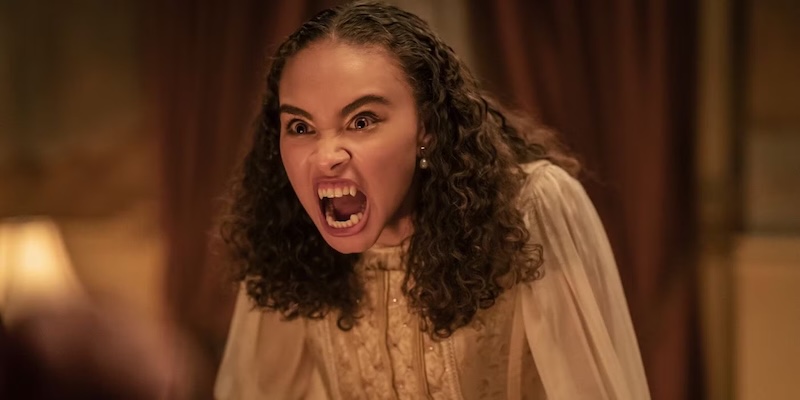
I still remember when I first felt like the threat of vampires was real. Back when I was a kid in elementary school, the thought of a pale, bloodthirsty creature lurking outside my bedroom window seemed entirely plausible and terrifying. My older brother had a book on mythological creatures, and he told me all about the rules that vampires must follow.
I remember peeking out the window to the alleyway outside of my bedroom and frowning at the shadows moving across the ground. My brother convinced me that a vampire would show up and ask to be let in. I was only safe as long as I didn’t invite the creature inside. My fear back then is hard to believe now, given my love for horror and the monsters it contains.
Monsters have always been used to explore the darker parts of reality in fiction. When I was younger, I could only see them as vehicles to deliver fear; it wasn’t until I got older and fell in love with the horror genre that I realized they could say so much more.
From vampires representing dark desires and unspoken fears, to Frankenstein’s monster representing the dangers of ambition, and zombies being stand-ins for bigoted stereotypes about certain races, monsters have existed as warnings in storytelling forever. As time went on and society progressed, so did many people’s ideals, so stereotypes and caricatures became outdated. But what happens when the monsters are the protagonists with a message that shouldn’t be ignored?
Memory itself can become a monster. In the case of vampires, for the low price of a little blood, you can drown in the history you forgot to mourn, or you can resurrect stories that deserve to be remembered and felt. That’s exactly what I intended to do with my own books, This Ravenous Fate and Our Vicious Descent. Black vampires act as a vehicle to explore centuries of lost history and create a space where haunting and healing can occur simultaneously.
Reaperhood is my version of vampirism in This Ravenous Fate, which is my young adult historical fantasy novel set in Jazz Age Harlem. I wanted people to come to my book with a fresh idea of the vampire mythos in their minds so that they wouldn’t have any pre-existing assumptions that impacted their reading experience.
I landed on the term ‘reapers’ because I considered the creatures in my book to be manifestations of death, or death incarnate–as that is how they are seen by the humans in the TRF world. There’s this sense that the weight of history accumulated due to their immortality is a heavy burden. The longer a reaper lives without giving in to their monstrous urges, the more they leave behind their humanity.
Reapers are vampires steeped in Black history and the horrors that history contains. The act of turning into a reaper is violent and traumatic and usually against the will of the newly reaper-turned human.
For my main character, Layla, in This Ravenous Fate, her transformation violently changes her body and everyone’s perception of her. Her innocence is gone in an instant and she is no longer seen as a young girl worthy of protection, but rather a dangerous monster. Reapers, just like many young Black girls, are denied their childhoods and forced into roles that see them with more burdens and responsibilities.
I’ve always been fascinated with the human side of monstrosity and in This Ravenous Fate, there’s a clear divide between humans and reapers when it comes to their morals, but in terms of their actions, both are violent groups at times–one more at will than the other. Vampires are immortal creatures that must contend with the loss of their humanity for a long time and in This Ravenous Fate, I wanted to dig deeper into that topic, focusing more specifically on Black girlhood and womanhood.
The first reaper was created in the United States as a consequence of unethical medical tests performed on enslaved Africans, the first reaper being a woman and a mother. Reaperhood is a reflection of the white man’s claim to the enslaved person’s body and the possessive undertones of such a fact are more pronounced in the case of Black women, who while enslaved, did not have control over any part of their bodies, including its most natural functions.
The exploitation of Black women and their sexualities sets their experiences apart from the Black man’s experience in the U.S., culminating in a unique form of oppression known as misogynoir. As a Black woman, it was important for me to explore the Black women’s experience in the United States, hence both of my main characters in This Ravenous Fate being eighteen-year-old Black girls on the cusp of adulthood.
One character, Layla, is denied her girlhood by being turned into a reaper, while the other character, Elise, is denied her girlhood by being forced to grow up and take on the major responsibility of being heir to her father’s reaper-hunting business. Both girls face womanhood with a warped sense of autonomy. With expectations on Black women to endure, there is little room for them to be allowed to have any other type of emotion that is essential for their wellbeing.
These standards narrow the image of Black women, limiting the various Black identities that may be accepted by society. A limited perception of Black women does not allow for a regard of every part of Black womanhood, thus refuting respectful representation.
Writing both characters’ perspectives gave me the opportunity to connect with parts of myself and my history that I had not been taught to care for before, as well as heal that younger Black girl in me who never saw herself represented in the stories she loved. This haunting, paranormal story became an act of catharsis for me and reapers, a tool to facilitate discovery and growth.
While defining the vampires in my book, all I could think about was how I would get people with the traditional pale vampire appearance assumed in their heads to think of something that was essentially the exact opposite. Reaperhood in This Ravenous Fate represents the different types of control the Black body is under, relating to the existing vampire mythos regarding sexuality and womanhood–particularly the way sexuality can be seen or used as a weapon and a threat when wielded by women.
In Sheridan Le Fanu’s Carmilla, the vampire Carmilla represents the threat of lesbianism, and attempts to depict the dangers of women being attracted to other women. Mary in Ryan Coogler’s Sinners is seen using her relationship and sexuality to get closer to Stack in order to turn him into a vampire. Both examples of vampirism turn women’s sexuality into a weapon and a threat that weakens those who engage with them.
In This Ravenous Fate, however, Layla and Elise are connected through their sexuality despite their best efforts not to be and it’s the development of their relationship that actually heals them, rather than hurts them. Instead of them condemning and demonizing their feelings, as many Black women are taught to do, Layla and Elise find comfort in their emotional authenticity.
It was my intention to work against this notion that Black women’s sexuality has always been shaped by exterior forces and shaped by harmful stereotypes. From the hypersexual Jezebel caricature to the desexualized Mammy caricature, Black women often must fight against these distorted views of their own sexuality.
In This Ravenous Fate the main characters are comfortable and confident in their sexuality to live authentically. At no point in This Ravenous Fate are my characters made to question their identity or truth because of their attraction to women and Layla being a vampire does not distort her sexuality or relationship to her lesbianism, either. They find power and strength in their love for each other.
Still, both girls must deal with the ways in which their bodies are regulated both unofficially and officially as not only women, but also Black women as social boundaries shaped over time by years of history continue to regulate the Black existence. When cracking open the vampire mythos with centuries of Black history that had been ignored and flattened, nuance became my best friend.
Vampires are immortal creatures with years to their souls and bodies. They are vessels of history, forever remembering everything done to them and everything they have lived through. While brainstorming the main ideas behind This Ravenous Fate, the concept of immortality and the inherent power behind being made of history was a thought that kept coming back to me.
I was always interested in vampires specifically because they are monsters that everyone is meant to be afraid of, but in general, they look so human. The only thing that sets the main vampire mythos apart from humanity is their thirst for blood, their inability to touch sunlight, and their immortality. It made me think about the thin line between their differences and how just the slightest divergences can have people petrified to approach.
In creating my own vampire mythos for This Ravenous Fate, I asked myself the question “what if you could see anti-Blackness spreading like a disease?” Because I had encountered so many people who insisted that racism and anti-Blackness were no longer actual problems in our world, I had this desire to prove that the very real problems I and other people in my community faced did exist.
The Harlem Renaissance ended up being the perfect backdrop for my blood-soaked tale of history and the love that endures between Black girls due to the cultural explosion that took place during this time period and created a powerful expression of African American identity. Reapers being the monsters hidden in the shadows of the Roaring Twenties felt like the perfect metaphor for lingering effects of anti-Blackness so many people in power tried to deny existed. Vampires made the most sense when deciding on a ‘monster’ for This Ravenous Fate because they are still so utterly human, just changed against their will.
I loved wrestling with the question of what truly makes someone a monster and what it is like to have so much history behind one’s identity, even if they don’t want it, or didn’t ask for it. Because for me, as a Black woman, I will always be attached to Black history, no matter how far into the future I continue to exist. Our bodies have been large components of building the past, present, and the future.
The reapers in This Ravenous Fate are representative of how bigotry, oppression, and general prejudice impacts people and their communities. And how wounds of the past may heal over time, but scars will remain to forever remind their wearer and onlookers of their history.
Though I was once a child afraid of the dark and what resided in it, I am now a lover of the unsettling stillness and flicker of shadows. I have learned that the monsters in some stories are not the ones causing true harm.
As a young child, anything monstrous seems dangerous, but as an adult, I recognize the nuances behind the darkness. Black vampires that reclaim traditional mythos to be more inclusive of marginalized identities demonstrate how the horrors of history can heal even when haunting contemporary narratives.
While more romanticized vampires seen in a lot of western media today tend to be associated with lust and pleasure and invitations to limitless freedoms, Black vampires remain rooted in history. Despite many attempts to keep it buried, Black history is impossible to ignore and destroy. Black vampires make Black history even more monstrous–they are living memories that make forgetting impossible.
***