Featured image: Netflix
To be honest, I’ve been afraid of writing this review. I was so deeply moved by Wake Up Dead Man, the new film from Rian Johnson (and the third in his Benoit Blanc trilogy), so much that I became (uncharacteristically) nervous to try to discuss it; amid all the praise and devoted close-readings that I felt sure would meet the film upon its release, I wanted my thoughts, my contribution, to really mean something. That’s the trouble when something means something to you; you want to mean something to it, in return.
It’s a funny feeling, because, as scared as I’ve been to try to write about it, I’ve also been champing at the bit to do so; I’ve felt like I could write a whole dissertation on the film. Wake Up Dead Man, which is not only directed by Johnson but also written and produced by him, is a dialectic omnibus of ideas about many things: the mystery genre, contemporary politics, the role of social media in culture, the place of religion in our lives, contradictions in the practice of Catholicism, hypocrisy, misogyny, demagoguery, greed, faith, anger, and redemption. It’s also a bonafide locked-room mystery. And all of its components—its questions, its conclusions, its references—fit together dazzlingly.
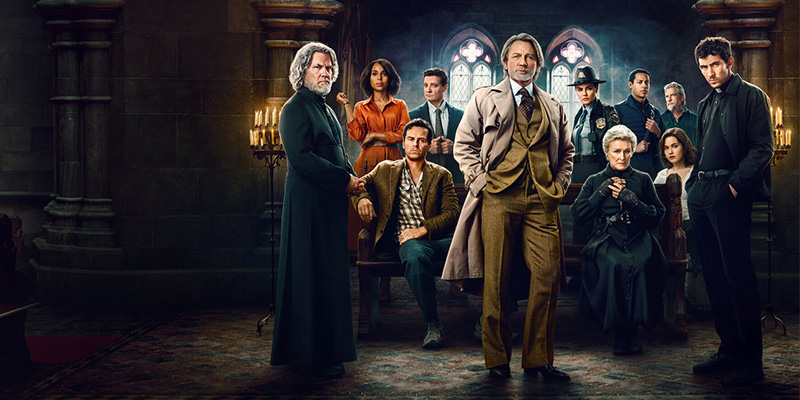
The story follows a young priest, Father Jud (Josh O’Connor), who is transferred to a new parish in upstate New York, whose sole clergyman is a bellicose, territorial demagogue named Monsignor Wicks (an extraordinary and terrifying Josh Brolin). The parish is small, with its own complicated lore (involving vengeful priests, wayward daughters, missing fortunes, and a strange family connection to it all). Plus, there are a handful of devoted regulars who have little interest in a new ministerial voice. There’s Martha Delacroix (Glenn Close), who manages the parish, the parish’s lawyer, Vera Draven (Kerry Washington) and her alt-right wannabe influencer son Cy (Daryl McCormack), a woman-hating, recently divorced doctor, Nat Sharpe (Jeremy Renner), a proudly anti-woke sci-fi writer (Andrew Scott), a tuned-out groundskeeper named Samson Holt (Thomas Hayden Church), and a young disabled woman desperate for a miracle, Simone Vivane (Cailee Spaeny).
Father Jud has difficulty integrating with the tight-knit worshipers, and even greater difficulty dealing with the combative and unpleasant Monsignor. And then Monsignor Wicks dies, mysteriously, while standing in a small caddy off the altar during a mass. He is stabbed to death, but this is impossible. The walls of this little alcove are made of stone. There is only one entrance. And because it’s off the altar in the church, no one can go in or out without being seen. It seems that Father Jud, who rushes in to check on the crumbled priest, is guilty. Otherwise, it’s an impossible crime, a total mystery. It might even seem to be part of a miracle.
And so, this is where famed detective Benoit Blanc (Daniel Craig) comes in.
It’s wonderful to see Blanc again. He is, as usual, a thoughtful, affable inquisitor–the only man who can solve the puzzle at hand. But as with the two previous films, Glass Onion (2022) and Knives Out (2019), this isn’t Blanc’s story. Johnson has frequently discussed his passion for Golden Age mystery novels, and in particular, the locked-room mysteries of John Dickson Carr, and his three Benoit Blanc films are clever interventions into this canon. Somewhat like Carr’s detective, Dr. Gideon Fell, the Benoit Blanc movies aren’t really about Blanc the way that Agatha Christie’s Poirot novels are about Poirot, or G.K. Chesterton’s Father Brown stories are about Father Brown, or Dorothy L. Sayers’s Peter Wimsey novels are about Peter Wimsey, or the Ellery Queen stories are about Ellery Queen. In other words, he’s a main character, but he’s not our protagonist. This is Father Jud’s story; he is its heart, even more than Glass Onion‘s heart belonged to the Brand sisters’ (Janelle Monae), possibly even more than Knives Out‘s heart belonged to Marta (Ana de Armas).
We’ve understood so far that Benoit Blanc’s purpose in these films is not simply to “solve” a mystery, but also offer support to genuinely good people who have been railroaded by powerful figures who don’t give a damn about them. He exonerates them from wrongful accusations, helps them find answers and closure and healing, and works with them to restore communities and instill meaning into the lives of the people who have forgotten this. In a way, Blanc becomes Father Jud’s priest; and with this, Wake Up Dead Man illuminates that this is what Blanc has been doing, all along: listening to and caring about even the humblest or most marginalized people, treating everyone as valuable, and helping to unburden those in need.
Father Jud is a former boxer, called to a life of faith and ministry but wrestling with guilt and anger, feelings that occasionally manifest in the form of a perfectly-executed right hook into the face of a deserving scumbag. He is, we can see clearly from the beginning, a good man, a man who doesn’t want to be governed by anger or lose himself in any way. A beautiful visual reminder of his divaricated and unconventional journey is his Roman Collar only half-covering a faded neck tattoo. O’Connor is a remarkable, sensitive actor, and his performance as a young priest who genuinely wants to do good is nothing short of transcendent, a perfect anchor for a film that, for all its insightful theming about faith (I’ll get to that), is also profound for its emphasis on the humanistic.
Johnson reminds us, never more than in Wake Up Dead Man, that the whodunnit IS by its very nature political.Wake Up Dead Man is more of a Golden Age mystery than the previous two installments (really, each of these three movies is based on its own entirely different “kind” of mystery tradition). This movie is a locked-room mystery, the kind perfected by Carr in his many novels. Wake Up Dead Man is partially a fan-letter to Carr, including that it literally uses Carr’s breakdown (from Chapter 17 of The Three Coffins) of the different ways that a locked-room murder might actually be committed. Blanc references the book (seems to have Chapter 17 memorized), and gives a copy to the local police officer on the case (Mila Kunis). Such overt tribute to this ur-text of “impossible crime”-solving is one of the most charming things about the movie, but it also helps bring some of the film’s themes into clearer focus.
In many whodunnits, especially from this illustrious period, the dead body at the center of the case is a puzzle to solve, more than a person who has died. In this way, some Golden Age detective mysteries have been referred to as slightly sociopathic in their blithe separation of “death” from “murder.” The Benoit Blanc films, and particularly Wake Up Dead Man, have something to say about this. While they certainly emphasize the humanity of the recently deceased person at the crux of the mystery, they also invert the common Golden Age narrative dynamic I just referenced. In Johnson’s canon, the dead body isn’t the puzzle—everyone is a puzzle. That’s, actually, what makes everyone human, dead or not. (This is why the detective and the priest turn out to do the same kind of work.)
These films, and particularly Wake Up Dead Man, are curious about how and why people do what they do. Human beings are mysterious, equally as unknowable to one another as God is to the human being. This particular curiosity, long baked into this franchise, comes alive fervently in Wake Up Dead Man, and helps slip this particular formula into an atmosphere concerned with faith and God.
The only person who really has any questions about God is Father Jud; and his questions aren’t actually about the existence of a higher power. They’re about faith in people, in his parishioners, in his clerical superior Msgr. Wicks, who has long embraced xenophobic, misogynistic, and hateful ways of thinking, ideas that he promotes during his fiery sermons. He is a demagogue, a soapbox orator for the complete wrong things. Father Jud is confused and worried about how to take back the reins of an incorrect and dangerous version of the Catholicism that he loves. (This is a bit like Ralph Fiennes’s Cardinal Lawrence in last year’s Conclave.) He wants to chip away at the poisonous barnacles that have attached themselves to his religion, distill essential messages of love and community and goodness out from it.
I’ve heard a lot of people discuss how Wake Up Dead Man uses the mystery genre to get at the theme of “mystery of faith,” and that’s fair, but I think both things are also at work on something else, together. I think the film is about truth even more than it is about faith.
Stay with me for a moment. In our postmodern age, it seems like everyone is trying to “do something with” the mystery—use the cliches of the genre to make a larger satire or criticism. Numerous films, as of late, have brought coteries of mysterious strangers to isolated spaces and produced a dead body, prompting investigations into powerful puppetmasters. The Menu, Blink Twice, Opus…. the list continues.
Keep staying with me! Considering how Johnson’s films purposefully, overtly play with classic mystery conceits, I’m always struck by how current they are. These are not timeless mysteries, but ones firmly rooted in their political moments. Knives Out was set during the first Trump presidency, Glass Onion, at the tail end of the pandemic, Wake Up Dead Man during Trump’s second term. Johnson’s films flirt with social commentary (there’s a scene early on in Wake Up Dead Man that goes hardcore on very specific references), but this direction always proves to be a red herring; his films ultimately (and wisely) swerve away from straight-up criticism into more eternal themes, allowing the initial juxtaposition of the time/place with classical motifs to say everything he needs about the contemporary world.
Or, to put it more simply: unlike many of his peers who take a stab at cinematic whodunnits, Johnson’s films do not try to add additional meaning to the mystery to bring them up-to-speed politically; he reminds us, never more than in Wake Up Dead Man, that the whodunnit IS by its very nature political. Why? Because it is concerned with the Truth, above all else (capital T). And in every political environment, from the Golden Age through today’s second coming of Donald Trump, “truth” is a wildly politicized and often obfuscated thing, and it’s common for “religion” to become twisted to offer credence to these manipulations and appropriations. Remember, Donald Trump is hailed by many of his followers as a Jesus-like figure; so is Monsignor Wicks. But this isn’t a reference to today’s culture so much as an acknowledgement of how today’s culture falls into predictable, perennial formulas.
This is why I think Wake Up Dead Man is Johnson’s deepest meditation on the whodunnit, thus far. This is a film where the concept of truth is claimed by so many: by nefarious, power-hungry troublemakers, by uptight religious weirdos, by cynical and bitter and opportunistic individuals. This is a film that represents how people yearn so much for the truth that they will do stupid or dangerous or naive or horrible things to uncover it. This is also a film about people who absolutely don’t care about the truth, and will manipulate the appearance of truth for personal gain.
The search for the truth, through the muck of so many promised and false truths, is the work of the detective in the whodunnit, just as much as it is the work of the priest in his holy work. It is also the job of every person in a society, and it is very easy to become distracted along the way. The best scene in the film, and the one that exemplifies this the most, is a scene in which Blanc and Father Jud are searching the Monsignor’s office for a clue that might unearth a secret fortune, when Father Jud winds up on the phone with a customer service worker (the great Bridget Everett) who is having a hard time. The young priest pauses, and leaves behind his almost Looney Tunes-esque raid of the office, to be there for her… to go be her priest. They talk on the phone for hours, and he listens, genuinely, and comforts her. This is the Truth that the film holds at its center: that regardless of all material or emotional trappings, the purpose of being human is to support one another. The purpose of being human is the same thing as the purpose of reaching out to God: to be a good person, and to do the right thing. And the purpose of being a priest is to prioritize these things above all else.
It’s also a nice note how the figures who provide literal answers that help get at the truth are not clerics or politicians or lawyers or (cough) influencers… but mystery novelists. The solution to the case at hand lies in a John Dickson Carr novel; with this, not only does Johnson help dismiss the common notion that mystery novels are fluff or frivolous, but in general, he also reminds audiences that reading literature helps us understand, predict, and even prevent real-life events, like the promotion of mistruths on a wide scale. Literature can help us see through the promises of False Messiahs.
Amid all of this wise postulating, Wake Up Dead Man doesn’t take itself too seriously. It’s a remarkably funny film, with numerous moments that take the piss out of the more staid or stodgy interpretations of Catholicism, or ritual in general. The obligatory Noah Segan cameo is hilarious, but in general, Johnson assembles a tremendous cast to bring his complicated film to life. Besides O’Connor and Craig, who are responsible for the film’s deepest moments and biggest laughs, Glenn Close and Josh Brolin are the cast’s standouts, both making the most of their characters’ scary and ridiculous aspects. Personally I think Glenn Close should win her Oscar for playing the solemn Martha. I also think that Johnson should win Best Adapted Screenplay; in a career of dizzying, impressive scripts, Wake Up Dead Man, I think, his best.
The film, which is completing a week-long run in theaters, is launching on Netflix today. (I maintain that this is a film that should have at least a 45-day theatrical run, but Netflix doesn’t listen to me.) I beg you to watch it, and watch it again if you’ve already seen it. One of the best moments in the film is when Blanc sums up his initial attitude about the case: “This was dressed as a miracle. It’s just a murder. And I solve murders.” It’s a great line, but by the end of it, the film will have flipped it on its head. Wake Up Dead Man is dressed as a murder, but it’s also a miracle. And that, my brothers and sisters, is the truth.