tk
Story/Mood: This atmospheric silent film, whose title means “The Witch,” is unlike any other movie I’ve seen. Frankenstein director Guillermo del Toro describes it as “the filmic equivalent of a hellish engraving by Bruegel or a painting by Bosch.”
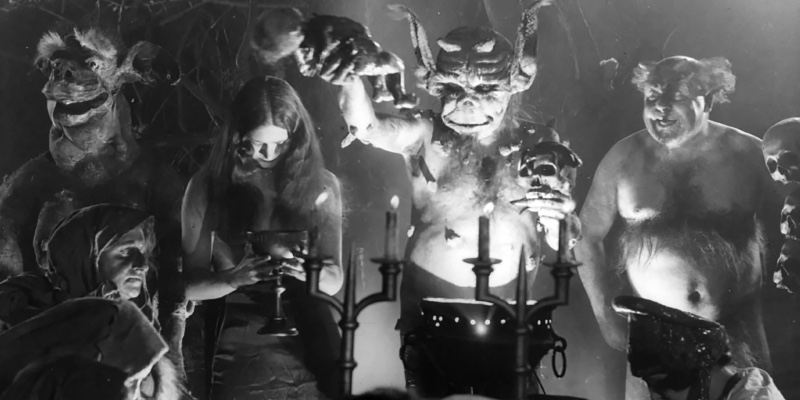
Häxan combines documentary and fantasy to create an immersive “film essay” that explores everything from the mythology of witchcraft, to the torture and trial of witches, and witches’ sabbaths where the participants kiss the devil’s ass. It culminates in musings about whether poor older women who would be helped by charitable organizations today (today being 1922), or women diagnosed as “hysterics,” might have been marked as witches in the past.
The Look: Gorgeously filmed in black-and-white, with some sequences tinted in deep blue or blood red, Häxan opens with a title card that reads: “Let us look into the history of mysticism and try to explain the mysterious chapter known as the Witch.” The first of the film’s seven sections takes the form of a cinematic lecture about cosmology and ancient beliefs about heaven, hell, and supernatural forces—illustrated with drawings, photographs, and old-style museum-y models, as well as images that are partially animated. This is the magic of early film at its finest—film as a novelty, as pictures that move. The movie then shifts to dramatic re-enactment:
“Through the imagination,” the title card says, “we now journey to the underground home of a witch in the year of our Lord 1488.” That’s when things start to get even weirder as fact blends with fantasy. We get stories about graverobbers, a poor beggar woman who is wrongfully accused of witchcraft, witch trials, lustful priests and nuns visited by Satan, instruments of torture, and witches flying on their broomsticks through the night.
Crew: Benjamin Christensen, Häxan’s Danish writer and director, also plays the devil in this film, lasciviously wiggling his tongue as he bursts into the frame. His goal, he explained, was to “throw light on the psychological causes of these witch trials by demonstrating their connections with certain abnormalities of the human psyche, abnormalities which have existed throughout history and still exist in our midst.”
Also, Christensen wanted to understand “whether a film is able to hold the public’s interest without mass effects, without sentimentality, without suspense, without heroes and heroines—in short, without all those things on which a good film is otherwise constructed.”
Where to watch: The Criterion Channel as well as other streaming services. I watched Häxan on the big screen with a packed crowd at the Museum of the Moving Image in Astoria, NY. The film had long been lingering in my drawer as a DVD (yes, from way back when!). Seeing it on the big screen with live piano and a fully engaged audience as part of the museum’s Halloween line-up was a great way to appreciate the stunning visuals and the strangeness for the first time.
Other notes: 105 minutes, black and white. The Criterion version features music from the 1922 Danish premiere. In his essay, “Häxan, The Real Unreal,” film scholar Chris Fujiwara says that censors in several countries, including Germany, France, and the United States—“objected to the movie’s numerous scenes of torture, sex, nudity, and anticlericalism, and only after undergoing extensive reediting could it be publicly shown in those markets.”
Some companion pieces if you’re interested in the subject (and I know there’s a lot out there, so these are just two): Robert Eggers’s The Witch (2015), in which the filmmaker treats witches as part of a belief system and therefore real; and Rivka Galchen’s 2021 novel, Everyone Knows Your Mother is a Witch—set in Germany in the 17th century, about the witch trial of the famous astronomer, Johannes Keppler’s mother.