What if . . .
Haven’t we all asked ourselves that question during our lives? What if we hadn’t taken the paths we chose—college, jobs, partners? What would our lives have been like? How would our choices have shaped us differently? Robert Frost’s poem The Road Not Taken resonates with all of us. Two roads, which to choose? I doubt anyone can say they haven’t wondered “what if” at least once during their lifetime.
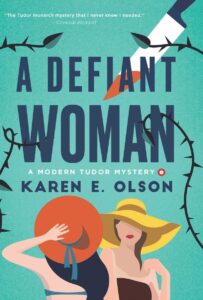
This question became the cornerstone for me while writing A Defiant Woman, the second of my modern retellings of the Tudor wives—because in it, I ask: What if Henry VIII’s second wife was not killed by her husband? What if Anne Boleyn was able to choose her own fate and managed to escape, disappear and survive?
I’ve played fast and loose with the history—although I’ve been careful to stay true to some facts and keep the wives’ personalities intact— as I’ve taken the Tudors and placed them in modern-day settings. But by reimagining Anne’s fate—by posing a “what if”—I know I’m taking a risk.
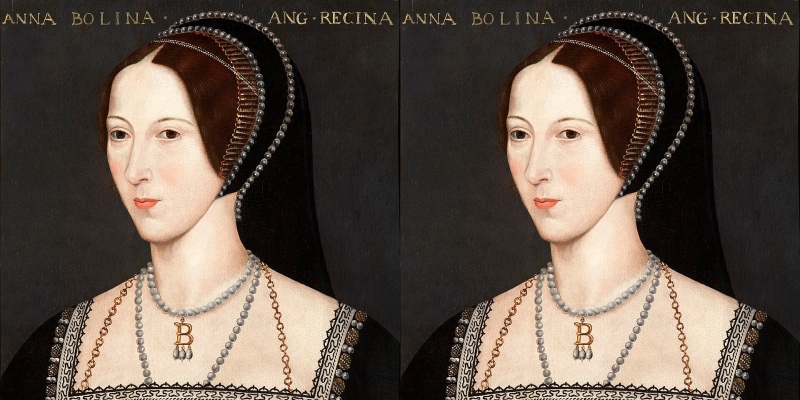
Anne is very possibly the most popular of all of Henry VIII’s wives. There are social media pages and groups devoted to her, where people share their speculations about her life, pregnancies, marriage, and death. Some proudly say they have done genealogy tests and have learned that they are descended from the Boleyns. There are photographs of women and girls who have chosen to be Anne for costume and Halloween parties, attired in period dresses, French hoods, and that famous “B” pearl necklace. Some gruesomely use red lipstick to draw a line across their necks, to indicate her fate on the block.
I have been reading about Anne and the other wives for decades, but the number of books about Anne outnumbers the others.
What is it about Anne Boleyn that is so intriguing?
Her execution by her husband tops the list. It is so horrifying that Henry, who had loved her so much—as indicated by his surviving letters to her—could do such a thing. He waited seven long years for her as he struggled to divorce the tenacious Catherine of Aragon. They had three idyllic years of marriage, during which Anne was coronated as queen—only two other wives, Catherine of Aragon and Jane Seymour, also had that honor—and Elizabeth I was born.
Anne’s inability to carry another pregnancy to term—and the lack of a male heir—soured Henry toward this woman who’d once captured his heart.
But it wasn’t only about how she didn’t give him a son.
Anne ultimately was accused and convicted of treason—on trumped up charges of adultery. Five men—one of them her brother—were executed along with her. But all of the accusations were fabricated and orchestrated by Henry’s righthand man, Thomas Cromwell, who was threatened by Anne’s influence on Henry about the dissolution of the country’s monasteries. Anne wanted the money and treasures to benefit the poor. Cromwell wanted them to benefit the king. Henry was easily swayed in the end.
The beautiful and bewitching Anne Boleyn, highly educated, deeply religious, opinionated, strong-willed, and a little bit too sure of herself, was taken down.
But, what if?
The epigraph I chose for my book is a quote by Margaret of Austria: “Changes in fortune make a woman stronger.”
My Anne—Nan—escapes her volatile and violent husband and takes refuge in a small town in France, where she sheds her former self and recreates herself. She has a son.
She has not been executed or murdered. Rather, she has survived—and quite well, although with some guilt and regrets because she left her young daughter behind—and that is where my story begins. Anne is the one who is wondering “what if.”
***