
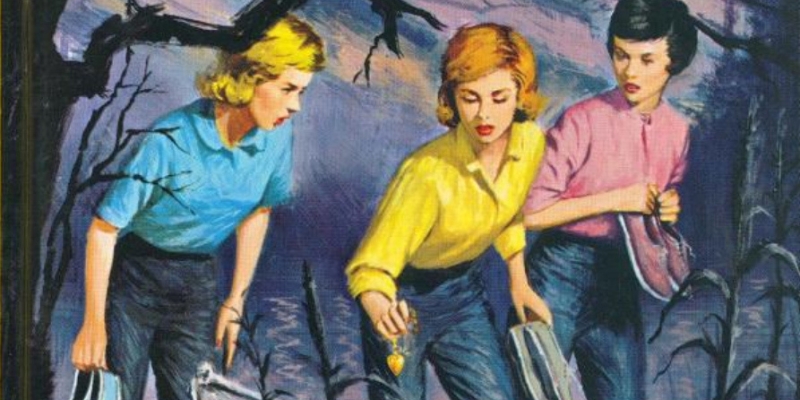
“What kid detective stories did you grow up on?”
This was one of the most common questions I received in 2023 around the release of my debut novel, Charlotte Illes Is Not A Detective, about a retired kid detective in her 20s who gets thrown back into mystery-solving. Kid detective books were what inspired Charlotte Illes, as well as her two best friends, Lucy and Gabe. Because one thing that ties child detectives together—besides a level of precociousness that’s charming on paper but would probably be a nightmare in real life—is that they all have friends.
Nancy Drew, of course, has cousins Bess and George, who bring their contributions to the solving of mysteries without threatening Nancy’s title as The Sleuth. And then there’s good ol’ Ned, who’s been called everything from
Nancy’s special friend” to “Nancy’s boyfriend” to “that pest who keeps whining about Nancy working on mysteries instead of hanging out with him” (that one was twelve-year-old me, not Carolyn Keene).
Encyclopedia Brown has Sally Kimball, who was ranked one of the most iconic detective sidekicks by CrimeReads’ Olivia Rutigliano (#1 can be easily guessed; the good doctor will be making an appearance). On top of being Encyclopedia’s friend and bodyguard, Sally also occasionally solves mysteries before the brainy titular sleuth.
Now, despite being told by multiple people that I do not have “only child energy” (I have theatre kid energy, it’s different), I am an only child. And I know many would not call their siblings their friends. But when I say that Detectives Should Have Friends and I Get Sad When They Don’t, I’m saying I like it when detectives have some kind of companionship, whether it be a friend, romantic partner, professional partner, sibling, roommate, neighbor, grandma, or talking dog.
I’ll be honest; I don’t remember a ton about Frank and Joe Hardy (Boys). Their Wikipedia page says they don’t have many differing characteristics besides their looks and slightly varied levels of patience. But they do have each other. And when you live in a crime-ridden small town like Bayport, a friend is just the thing you need. And maybe extra locks on your doors.
(Honorable mention to Frank and Joe’s rotating cast of friends, including the timelessly-named Chet Morton and Biff Hooper.)
The Alden siblings—and their dog, Watch (non-speaking)—are the poster children for a lack of adult supervision, their first book being more of a survivalist story before they pivoted to amateur sleuthing. Gertrude Chandler Warner once wrote to a fan, “Perhaps you know that the original Boxcar Children raised a storm of protest from librarians who thought the children were having too good a time without any parental control! That is exactly why children like it!”
Maybe this is why friendship is such a large aspect of kid detective fiction. The subgenre thrives on a lack of adult presence, oftentimes when an adult would make the situation much safer (though less exciting). Having friends present makes stories targeted to children a little less frightening—at least, until the nail-biting climactic moment when the sleuth finds themself alone with the killer. Or the baseball card thief. Depending on if you’re in Bayport or Idaville.
Adult detectives are different. An adult on their own isn’t usually as inherently nerve-wracking as a child on their own, especially if that adult is an able-bodied, straight, cishet white man. But still, there’s a comfort in an adult detective having friends. The reason for this varies by detective, and by their friends.
When developing my post-time loop mystery, Out of the Loop, I knew that twenty-eight-year-old Amie Teller could very easily be alone in life. It would have made the two years she spent in a time loop even more lonely than such an experience would already be.
But time loops are scary enough, not to mention when there’s a murder thrown in. So I gave her David, Amie’s friend and neighbor, who interrupts Amie’s spiraling thoughts with a voice of reason. I also gave her Ziya, Amie’s ex-girlfriend, who assists with the sleuthing as the two try to navigate their new relationship as friends. Just friends. Nothing more.
After a childhood filled with kid detectives, my first forays into the world of adult detectives were during my tweenage years, one of which was incited by the release of the adaptation that changed the fabric of Tumblr forever: BBC’s Sherlock.
(Did you guess that #1 detective sidekick earlier? If you said the Tenth Doctor in the Doctor Who episode “The Unicorn and the Wasp,” you’d be…incorrect. But what a pull, I’m impressed!)
Friend, biographer, roommate. Like the great Sally Kimball, Dr. John Watson wears multiple hats. Of course, as Holmes and Watson have many iterations, there are many ways to analyze their friendship.
But I think the most interesting aspect of the relationship between Holmes and Watson is that in every universe, Sherlock Holmes, though already a successful consulting detective by the time they meet, does not exist in fiction until the two become friends. ((The night before I submitted this, I stumbled across a trailer for an upcoming TV series called Young Sherlock. Oy.)
I really can’t say I’d be interested in reading about Holmes sitting alone in his apartment, playing his violin before silently heading off to pursue a new line of thinking that we the audience aren’t privy to due to a lack of Watson. Or, even worse, getting access to the thoughts of Sherlock Holmes (translation for the Tumblr trash: visiting his mind palace) and having to stumble through complicated lines of thinking that he has no reason to simplify for a less intelligent audience.
Sherlock Holmes is better with John Watson, largely because, in my opinion, he’d be insufferable for a reader to be alone with. The same, I think, can be said about Agatha Christie’s Hercule Poirot, though I think Dame Agatha would disagree. She reportedly thought Poirot was “insufferable” as he was, even with friends like Captain Hastings and Ariadne Oliver.
But as an author spends the most time alone with their detective and whatever’s going on in their little gray cells, I think Agatha Christie’s view of Poirot is indicative of how we as readers would feel if we too were left alone with him for an extended time.
Not all adult detectives are Holmeses or Poiri. Like Out of the Loop’s Amie Teller, some adult detectives benefit from having friends for purposes other than reader sanity.
Richard Osmand’s Thursday Murder Club, the reason why my mother is always telling me to “write more older people,” features four amateur sleuths, neighbors at the same retirement home, who bring their own skills to the table and support one another as friends. Rian Johnson’s Knives Out films each feature a different “friend” to detective Benoit Blanc. Those characters not only help with the investigation, but are the beating hearts of each story.
Maybe I’m just soft. After all, I couldn’t leave Amie to face a time loop without a friend to lean on, and I certainly wasn’t going to send her after a murderer alone. The world is scary enough even for those of us not tracking down killers. So when a detective is a lone wolf without even a talking dog to bounce ideas off of, I get sad. Sorry, Raymond Chandler. I tried.
***