Growing up, I wasn’t really a horror fan. I read a few Goosebumps books as a kid, but overall horror books and movies scared me too much to pursue the genre when I was young. It wasn’t until my adult life that I started to appreciate horror stories, and a lot of that appreciation stemmed from real life experiences I had as an adult that scared me. I’m not talking ghost encounters or other paranormal events, but rather, difficult or traumatic moments that happened in my life. These experiences made me realize how the horror genre isn’t always just stories meant to frighten you, but that it can be a powerful place to confront traumas and fears. Horror stories give people a place to explore themselves, process emotions, and even gain validation of their experiences in a way that feels safe and controlled, and this is what I found myself doing as I wrote and fell in love with the genre of horror.
In my very early twenties, I found myself running to the neighbor’s house of my then-boyfriend (now husband) after other neighbors screamed in the street asking if anyone knew CPR. I worked at a school then, and I’d taken a certification class, but I’d never imagined I’d find myself needing to perform CPR on anything more than a plastic dummy. Still, I rushed over, young and scared, to find one of the neighbors surrounded by family and passed out on the floor of his house. They’d only told me he collapsed, so I started compressions, feeling wholly underqualified and like a child thrust into a situation with too little knowledge. I pressed on his chest until my arms ached while alternating trying to breathe for him and not understanding why the air seemed to inflate his stomach instead of his lungs. It wasn’t until after the paramedics came and took over that the family explained he’d been choking and I realized what had really happened. The paramedics cleared his airway and took him away, heart still beating but, in the end, he didn’t survive, and that experience shaped me for a long time.
That man’s funeral was the first one I remember going to, and I was overcome with guilt when his family thanked me for trying to save their family member—because to me, trying hadn’t been enough. They’d still lost someone they loved.
For years, I found myself dealing with that guilt and the trauma of that situation. I found myself hating just looking at that neighbor’s house because of the memories it reminded me of, found myself replaying that day over and over in my head, and thinking of all the things I might have been able to do differently. If I’d only known he’d been choking first. If I’d gotten there sooner (the reality that I ran there as soon as I was asked didn’t matter). If, if, if…
I probably should have talked to a professional back then. But I was young and therapy was expensive and I didn’t always see all the ways in which that day left an impact on me. Slowly, I got back to my life, knowing that day had changed me but not realizing quite how much. I understood and realized that I had a new paranoia about choking and at my next CPR recertification class I left and cried alone in a bathroom before coming back. But in general, my day-to-day went on and so did I.
It wasn’t until years later, when I started watching Buffy for the first time (yes, I was very late to the Buffy craze) that I realized how deeply that experience still affected and shaped me. There’s an episode where Buffy finds her mom on the couch, no longer alive. Whoever directed that episode has dealt with trauma, you can’t convince me otherwise. The sensory details in that scene felt too real: the way the paramedics voices muffled, the ringing silence that faded in and out, the visual focus on a random part of the body or on something completely unrelated like the way the sunbeams caught in the window. That scene triggered something in me while watching it and made me realize how deeply my experience with the neighbor still affected me. I didn’t even finish watching that scene. I had a panic attack and had to get up and leave. I’ve never watched that episode again. And yet, I can still remember, a little too vividly, too emotionally, the parts I did watch, and sometimes my own memories become superimposed alongside that scene.
But it wasn’t just that experience with the neighbor that changed me. In my early thirties as a mom to an infant and toddler, I received a cancer diagnosis. I had lots of doctor appointments where I was learning more information than I wanted, I went through surgery and radiation therapy where I had to be isolated away from my husband and babies for over a week. It wasn’t the first time thyroid cancer had reared its head into my life. My mom was diagnosed when I was a young teen and went through similar treatments and has been, overall, doing well since. But my thyroid cancer was—lucky me—an unusually rare one, with few doctors who even had experience with it. It made the situation more terrifying when I was already confronting my own mortality for the first time, all while trying to raise two little ones. Even now, I still deal with constant and lifelong appointments and check-ups where I have to confront my fear of recurrence. (Thankfully, there have been no signs of that so far.) But it’s another experience that has fundamentally changed me.
While my experiences feel unique to me, I know they’re not. At some point, I think everyone deals with some sort of trauma or has to face fears they might not have even known existed. Or at other times, we’re exposed to traumatic events indirectly and they still affect us. When I was in my twenties, an intruder came into my mom’s house and held her, two of my sisters, and my niece hostage while he hid from the police. I didn’t even live at home at the time (a home that was in a very safe suburban area that no one would have expected this to happen in), yet I found myself changing the way I looked at the safety of my own house and checking the locks often.
I’m not sure anyone goes through life without some scars. And mine had become avoidance and lingering anxiety from these situations. They clung to me like shadows. Sometimes they’d trail almost silently behind me. Sometimes the light shone too brightly on them to dismiss their existence. And I think that’s what ultimately drew me to horror.
The ways in which our brains and bodies store trauma can be intricate and varying, and for me, I’d find myself hyper-focusing on those memories and the way those experiences changed me. I became overly paranoid about choking, particularly with my children. I have to mute commercials or scenes in shows about cancer and cancer treatments—less often now than I used to at least. And for years, I double and triple checked the locks in my house. But I also understand that memories are tricky, maybe particularly the ones we find traumatic. Memories can melt and morph into something different from our real lived experiences, but they can feel just as real as the actual events that happened, and I think understanding the way my memories were, at times, overtaking me or rewriting themselves, drew me to the horror genre and to writing unreliable narrators.
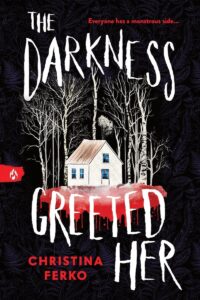
In my debut YA horror, THE DARKNESS GREETED HER, I plucked tiny pieces of my own history and gently placed them into this book, more than in anything else I’ve ever written. Penny’s intrusive thoughts are more demanding and dangerous than what I’ve experienced but the core feelings are there. Harper deals with performing CPR on someone who doesn’t survive, similar to my own experience. Emma deals with a home intrusion. And Kylie has to face her mom’s cancer diagnosis. My debut is heavy and it has content warnings for a reason, but I found that facing these experiences within my writing helped me heal a lot from them—not as a magical cure, but as a safe place to explore and confront those feelings and fears. Friends, family, and other support certainly helped as well, but finding a safe way to explore those traumas through the lens of horror was a cathartic and healing experience for me. I personally believe that’s why people are sometimes drawn to the horror genre and why there’s a surge of popularity happening within this genre at the same time that caring for mental health is becoming more accepted and common. Horror isn’t just about gore and jump scares and the adrenaline of fear. Horror can be a place to confront the things that terrify us in a safe and controlled way, and there’s deep healing that can be found within that.
***