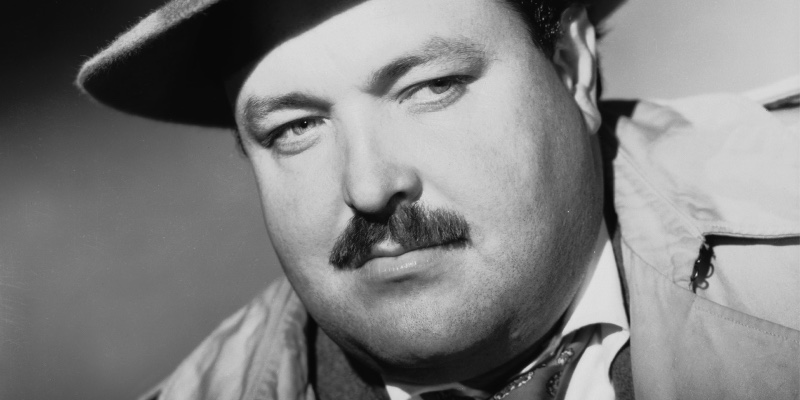
Film noir lovers know William Conrad from his hard-edged and menacing roles in vintage black-and-white films. Most people know him from 1970s and 1980s TV cop shows like “Cannon” and “Jake and the Fatman.”
But even those who know the lower-profile aspects of his career as a narrator of rule-breaking cartoons or the radio voice of Sheriff Matt Dillon on “Gunsmoke” in its pre-TV incarnation might not know his other behind-the-scenes role as a film director of surprisingly weird and effective thrillers like “Two on a Guillotine.”
Conrad was a man of many talents, most of them oversized, like his screen presence.
And while it’s handy to talk about Conrad’s “three” careers, he actually had more than three. You could play a one-man game of “Six Degrees of Separation” with Conrad and nearly everyone else in show business over a 50-year period that ranged from the heyday of radio to directing films starring ‘60s teen idols and directing a “Batman” guest villain to the peak of TV detectives with a side quest to cartoons that were second in their enduring appeal only to classic Looney Tunes.
Conrad was a lot and that is not a weight joke.
A killer role
Conrad first gained attention for his appearances in classic films. Sometimes he was a cop or bartender, sometimes he was a scary character made even scarier by his cold-blooded demeanor.
For 1946’s “The Killers” – based on an Ernest Hemingway story from 1927 – Conrad was listed last among the names in the opening credits even though his is the first face we get a clear look at as he and a partner walk out of the darkness, behatted and wearing trenchcoats. The two look like bad news and that’s quickly confirmed. (His fellow killer is played by veteran character actor Charles McGraw, who’s also wonderful.)
They go to a diner and immediately project an aura of menace. Conrad is frightening as he argues with the counterman about what’s on the menu. His eyes are dead as can be as he intimidates the counterman.
“The town’s full of bright boys,” the killers agree.
It’s a great scene, full of dire, softly spoken threats and the repetition of “bright boy.” as the killers call everyone. Conrad, in his second film role and his first credit, is the focus of the film until Burt Lancaster, in his film debut, is introduced as Swede, a washed-up boxer.
Conrad disappears from the film for an hour before he shows up again, and in a story full of threatening, boastful and blustering tough guys, his quiet, intimidating presence is again electrifying.
Conrad had a juicier role in “Cry Danger,” released in 1951 and starring Dick Powell and Rhonda Fleming. Conrad plays a bookie. Louie Castro, who complicates Powell’s life. Conrad oozes disreputable in every scene and also takes a number of beatings. It’s a very satisfying role for Conrad fans.
Conrad essayed a variety of roles in his film career, but one of the most offbeat is in Jack Webb’s “-30-“ a classic newspaper drama from 1959. (The title refers to the dashes and numerals vintage reporters and editors would type or scrawl at the end of a story to note that there were no further paragraphs or pages.) Conrad is funny this time but still intimidating as a big-city newspaper second-in-command editor whose gruff voice and demeanor keep the staff on their toes.
Conrad found other, offbeat uses for his talent and especially his commanding voice.
Meanwhile, in Dodge City and Frostbite Falls …
As someone with a powerful voice, Conrad found himself in demand as a narrator and voiceover actor.
In some quarters, he’s still remembered as the star of the original, radio show version of “Gunsmoke,” with 480 episodes airing from 1952 to 1961. Conrad played Marshal Matt Dillon, bringing the law to lawless Dodge City, Kansas after the Civil War. The series was the audio-only version of the live-action “Gunsmoke,” starring James Arness, debuting in 1955 and running for 20 seasons. (So yes, it’s the case that for six years, both Conrad and Arness were playing the same character, one on radio and the other on TV.)
It’s likely that Conrad was too heavy to play Dillon on TV – at least as judged by network executives – but to listen to those radio plays now is to hear how remarkably adult and noir they are. Conrad certainly imbued the show’s lighter moments with a bit of humor, but in the episodes available online, Conrad’s performance is sometimes heated but always dry and wry.
“I’d us a shotgun if I were you,” he counsels Chester, his deputy. “It’s more effective when there’s a mob to be dealt with.” Pop culture historians note that “Gunsmoke,” on radio and TV, broke from the Western precedent of telling stories aimed at young fans. The writing and Conrad’s powerful delivery set it apart from singing cowboys.
Conrad was inducted in the Radio Hall of Fame in 1997, three years after his death, a well-deserved honor.
While his voice was perfect for narrating the noir TV drama “The Fugitive” from 1963 to 1967, there’s little in Conrad’s career to tip us to the lunacy of his narration of creator/producer Jay Ward’s “Rocky and Bullwinkle” cartoons and sister show “Dudley Do-Right.” Conrad’s narration is breathless and urgent and loose in the shows, which began in 1959. At times, Conrad – credited as “Bill Conrad” – is downright goofy.
It was a lighthearted mood that was not repeated in Conrad’s turns as a film director in just a few years.
Three thrillers on a guillotine
“But what I really want to do is direct.” How many Hollywood actors uttered that phrase over the decades? How often was it a desire that seemed likely to be confined to episodes of “The Love Boat”?
But William Conrad killed it from the director’s chair as part of a fascinating phase of his career.
And three – count ‘em – three films he directed were released in a single year, 1965. In quick succession, Conrad directed and studios released “Two on a Guillotine,” “My Blood Runs Cold” and “Brainstorm.” And it’s possible there’s never been as offbeat a big-screen trifecta directed by one director in a single year.
They’re all a little off-kilter and – apparently intentionally – reminiscent of the work of William Castle, the famed producer who wanted to be known as the equal of director Alfred Hitchcock. As if in imitation of Hitchcock and Castle (who made a notable cameo in his production “Rosemary’s Baby”) Conrad appears in a cameo in “Guillotine,” posing happily and patting his belly in front of a funhouse mirror.
“Guillotine” gave Conrad the opportunity, working from a script co-written by veteran mystery author Henry Slesar, to do a little bit of everything. He directs not only young heartthrobs Dean Jones and Connie Stevens but Cesar Romero, the Latin film idol who went on to play the Joker on the “Batman” series. Here Romero plays “Duke” Duquesne, a 1940s stage magician known for his frightening visual tricks, like running a sword through his wife (Stevens) and operating a guillotine on stage.
In 1965, Duquesne dies – always a showman, he’s buried in a coffin with windows – and his estranged daughter (also played by Stevens) can win his estate if she can spend seven nights in his haunted mansion, a gothic castle in the Los Angeles hills complete with skeletons on wires, secret passages, an ominous rabbit with its own whimsical theme and heads rolling down stairs. It’s wild and Conrad encouraged Romero to chew all the scenery as he swanned around in a tux and cape.
“Brainstorm” definitely feels like Conrad is channeling Castle channeling Hitchcock. The film stars Jeffrey Hunter – here billed as “Jeff” and leading a surprising number of actors who would also later have roles in “Star Trek” – as a man who saves a suicidal woman (Anne Francis) and has an affair with her, despite her husband (Dana Andrews) being his boss.
The film has a few twists – exactly who has the mental disorder here? – and its flashy but grim tone is nothing like the weird cotton candy of “Two on a Guillotine.” It feels very much like Hitchcock’s “Vertigo.”
“My Blood Runs Cold” is maybe the most Hollywood-esque of the three thrillers Conrad directed that were released in 1965. Teen idols Joey Heatherton and Troy Donahue star in a thriller about a man (Donahue) who insists that he is reincarnated and Heatherton is his lost love reborn. The leads are beautiful blondes and Conrad’s film – which opens with a quote from Lord Byron – features crashing waves and some twists and turns before settling for a “chase up a tower and fall to death” climax that seems right out of many 1960s and 1970s TV cop shows.
King of 70s crime TV
It’s well known that the 1970s was a time of unusual detectives on TV. There was the sniper-shot cop in a wheelchair (“Ironside”), the blind detective (“Longstreet”), the old detective (“Barnaby Jones”) and others. But it’s possible the most notable was “Cannon,” a Quinn Martin production that aired 1971-1976 and starred Conrad as an overweight detective.
By the point “Cannon” aired, Conrad seemed suited to the rigors of a weekly TV series. He played Frank Cannon, a retired police detective who was tough but accustomed to life’s finer things, especially food, drink and women. He was in all ways but his physicality a typical TV detective of the time, not unlike Mike Connors’ “Mannix,” which had debuted in 1967. He even had a car phone like Joe Mannix.
Despite seeming winded at times after a foot chase, Cannon was always able to take care of a suspect, sometimes with gunplay, usually with a chop to the neck, sometimes with a bear hug (he overcame bad guy Leslie Nielsen in that manner in an episode) and sometimes by bouncing them with his girth.
“Cannon” continues to hold a pop culture presence, with episodes still airing overnight on cable along with “Barnaby Jones,” which was spun off from “Cannon.”
Conrad was the spinoff king, as we’ll see.
“Jake and the Fatman,” which aired for five seasons beginning in 1987, was an attempt to reignite Conrad’s success in “Cannon.” In the series, he played prosecutor J.L. “Fatman” McCabe, an aging but gruff crimebuster riding herd over younger, more energetic investigators like popular TV action star Joe Penny. McCabe was not as reclusive and sedentary as Nero Wolfe, a classic detective fiction character created by Rex Stout and played by Conrad in a 1981 drama series.
But Cannon, born in 1920, was 67 and not in top health when “Jake and the Fatman” began in 1987, so it made sense for McCabe to have counterparts to Wolfe’s Archie Goodwin. These younger, brasher operatives did the legwork.
In the episode “Who’s Sorry Now” – all of the episodes are titled after classic songs – McCabe is taken hostage by a revenge-seeking criminal. Because of the actor’s age and physical condition, most of his scenes are of him tied to a chair, bitterly complaining to the kidnapper about, among other exchanges, missing a meal of Mu Shoo Pork. When he does get physical, it’s mostly rolling around in the office chair he’s tied to.
That’s in contrast to the physicality of “Cannon,” which regularly featured Conrad’s character strong-arming bad guys.
I couldn’t write about “Jake and the Fatman” without noting its status as a series that was both spun-off (kinda) and launched a spin-off. An early episode of “Matlock,” the lawyer series starring Andy Griffith, featured Conrad as J.L. McShane, the prosecutor who squared off against Matlock from across the courtroom. Conrad made such an impression that producers decided to create “Jake and the Fatman” for him, although his name was changed from McShane to McCabe. His “Jake” co-star Penny was also in the “Matlock” episode, but in another role.
And “Jake and the Fatman” spun off its own spin off. In its fourth season, Dick Van Dyke guest-starred as a crime-solving doctor named Mark Sloan. Van Dyke won his own series, “Diagnosis: Murder,” with that back-door pilot.
Conrad looms large in the history of TV and film for “Cannon” if for nothing else. But he was truly a show-business Renaissance man.