A few days later, I was on a plane again, headed to a tech conference in Silicon Valley. There I met Roomy for a Thai lunch in Palo Alto.
I don’t remember if we talked about Kronos or Hilton, but I’m sure we talked about edge, which got me thinking about the trades. Roomy wanted me to see her house in Atherton. I had some time to kill, so I agreed, and off we drove to the enclave of the ultra-wealthy, where castles of the kings and queens of tech lay.
The gates at 168 Isabella Avenue opened to a $13 million estate she’d bought in 2000, a figure she mentioned twice before we even parked. What she didn’t mention was the $5 million loan she’d taken after the tech crash or the $60,000 a month it cost just to keep the lights on. Like much in Roomy’s world, it was all show, punctuated by name drops about neighbors like Larry Ellison and Yahoo’s Carol Bartz.
Inside, Roomy introduced me to her husband, Sakhawat. Far from the “deadbeat” she’d described, he was educated, seemingly successful, and attentive to their adopted daughter, though far less kind to the maid, Vilma, whose breaks he monitored with unsettling precision. I’d later learn she worked nearly ninety hours a week for $250 and would eventually sue them. The house was dotted with carefully arranged silk scarves and designer handbags, a curated display meant to signal wealth. I’ve learned that people who try that hard to show you how rich they are usually aren’t.
Roomy’s command center occupied the guesthouse behind the pool. She had at least four landline phones on her desk. Her work ethic was undeniable, a perpetual motion machine of schemes and connections, fingers dancing across those phone lines like a switchboard operator from a black-and-white movie.
What I now realize was the house wasn’t a testament to Roomy’s success—it was a warning sign. Her mansion was built on information that wasn’t hers to sell, then remortgaged when her own bets went down the toilet. But I didn’t see it for what it was. Instead, like the dinner guests at her lavish parties, I was blinded by the opulence.
It was at one of those parties, just a few days later, where my next illegal trade was born. The first day I was back in the office I received an IM from Roomy. She wanted to talk on the phone. When I called, she dove right in. She’d hosted one of her parties over the weekend where she met a young woman fresh out of college who worked at a company called Market Street Partners. Market Street was in the business of crafting quarterly earnings press releases for public companies.
One of their clients? Google. The woman told Roomy that she had information on Google’s upcoming second-quarter earnings report, set to release on July 19.
Sedley was betting large on Google; it was my favorite position.
“If you want in on this, Tom,” she said, lowering her voice, “you have to pay. Fifteen thousand.”
“I told you I wasn’t going to do that anymore.”
“Well, that’s up to you,” she said. Her tone was no longer a Mata Hari whisper. “The information costs one hundred thousand dollars. She’s not giving it away. Your end is fifteen thousand.”
“Let me get back to you,” I said. I hung up the phone and immediately IM’d Gautham. I didn’t even hesitate. What happened to all my I’m-never-doing-this-again resolve? But it was Google, for God’s sake. And what if Roomy’s new source was wrong? This wasn’t Deep Shah—it was a junior employee at some PR firm. Was she really sitting on God-tier earnings intel, or was she just some overworked intern who overheard the wrong conversation while ordering lunch?
“Call me,” I wrote in the IM to Gautham.
“My source wants fifteen thousand dollars for some Google earnings info,” I said to Gautham. “If it’s legit, can your guy handle it?”
The mysterious Z was also known in edge circles as “Octopussy” because his tentacles reached so many sources.
“Of course,” Gautham replied without hesitation.
And, just like that, I was back into it. My moral compass, already com-promised, recalibrated once more to accept what I was doing. Each time, the justification came easier. Each time, the guilt faded faster.
The source’s claim was that Google was going to miss Wall Street’s estimates by three cents. The Street was expecting $3.59 per share, but they were going to report $3.56. If she was right, the information was monumental—Google had a quarterly winning streak like Cal Ripken’s consecutive games played. I could sidestep a huge loss for our fund.
I convinced Evan to dump our shares, fed him some line about concerns over expenses, and braced for earnings day. When the numbers hit—$3.56, exactly as Roomy’s source predicted—I wasn’t even surprised. Google stock tanked seven percent after hours.
On the first Monday morning in August, a headline crossed the Bloomberg terminal that should have stopped me in my tracks. An article from the Financial Times appeared titled: “Boom Time for Suspicious Trades.” It detailed how nearly sixty percent of companies acquired by private equity in the past twelve months had unexplained spikes in share prices before the news broke—compared to just fourteen percent of deals back in 2003.
If ever there was a massive, blinking neon warning sign, this was it. But instead of seeing it as a cautionary tale, I brushed it off as just more proof of the “everyone’s doing it” rationalization that seemed to fuel Wall Street’s collective denial. I didn’t even pause to consider that the SEC might be noticing the same trends and gearing up for a crackdown.
Although I didn’t know the psychological term at the time, I was also assuaging the guilt that had started to build through what’s called, “moral licensing.” It’s the idea that if you do something good, you earn credit to do something bad. I was volunteering at St. Paul’s, where I’d gone through RCIA, once or twice a month. I went to Mass every Sunday, wrote checks to charities. It created this internal moral scoreboard. I’d think I’m a good guy, I help people. I’m not hurting anyone.
So, when I made a trade on edge, and would feel a trickle of guilt, I would tell myself, “This isn’t me; this is just something I do once in a while.” That disconnect is important. It let me sleep at night.
By the time I met Gautham later that morning at Grand Central—at what had quietly become our regular hand-off table—the absurdity of my life had fully set in. He slid the envelope across like we’d done this a hun-dred times, as if passing the salt. I stuffed it into my laptop bag, attempting to exude the nonchalance of someone who definitely wasn’t carrying a small fortune in illicit cash.
At LaGuardia Airport, the envelope sat in my laptop bag, taunting me. I moved through the crowds, the fluorescent lights making the ter-minal feel like an interrogation room. I was headed to a conference in Silicon Valley, carrying cash Roomy had convinced me to bring. But now I wasn’t sure how I’d get it on the plane. What if TSA searched my bag? What then?
I ducked into a men’s room and locked myself in a stall, leaned against the cold metal door, and stared at the bag. I unzipped the bag, pulled out the envelope, and stared at the cash inside. Fifteen thousand dollars. Crisp bills, neatly stacked. This is insane. This is absolutely insane.
My hands shook as I started shoving the cash into my shirt. I stuffed it down the front, the back, tucking it into my waistband until I could feel the weight pressing against my body. The crisp edges of the bills scratched against my skin. I rolled more of the bills and tucked them into my socks, pressing them down until they felt secure. When I finally stood up, the cash shifted with every move I made.
I left the stall and avoided looking at myself in the mirror. My mouth was dry, and my hands felt slick with sweat, gripping the handle of my bag like it was the only thing keeping me grounded, and got on line.
When my turn came at the checkpoint, I slid my laptop bag and carry-on onto the belt. My pulse thudded as I stepped through the metal detector. It wasn’t even one of today’s full-body scanners, but that didn’t matter. One suspicious glance and I felt like I might crack.
“Nothing in your pockets, sir?” The TSA agent’s voice sliced through my thoughts, sudden and sharp.
For a moment I couldn’t catch my breath. The cash wasn’t in my pockets—technically, I wasn’t lying.
“No,” I said, barely audible.
Her eyes lingered. Heat rose in my face, my heartbeat loud in my ears. Then she waved me through. I stepped into the metal detector, holding my breath. No alarms. No lights. No call to step aside. I grabbed my bags and walked toward the restrooms, forcing myself not to look back.
Once inside another stall, I locked the door and collapsed against it, my legs shaking. My hands fumbled to pull the cash from my shirt and socks, the bills slightly crumpled from the ordeal. I shoved them back into the envelope and stuffed it deep into my laptop bag, zipping it shut with a shaking hand. I leaned forward, resting my head against the stall door, and took a deep breath.
The relief didn’t last. Leaving the restroom, I spotted two TSA agents near the gate, casually checking bags. They weren’t rushing; just thorough, but my heart dropped. I told myself it was routine, nothing unusual. Still, the thought hit hard: They’re here for me. They know. They must have seen something.
As my group was called to board, I tried to keep my head down, blend-ing into the crowd. My bag felt like it weighed a thousand pounds, the cash inside burning a hole through the fabric. I moved forward, every step feel-ing like I was walking into an execution.
“Sir,” one of the agents called out. “We need to check your bag.”
The agent unzipped my bag with methodical precision, flipping through the contents: my laptop, the envelope of cash. My chest felt like it was about to collapse under the pressure. She paused, her fingers resting on the envelope. I braced myself, my mind scrambling for an explanation. Vegas. Poker. Say something normal, Tom. Don’t let them see you panic.
She looked up at me, then exchanged a glance with her colleague. “Have a nice flight, sir,” she said, her tone uninterested, zipping the bag closed and handing it back to me.
It took me a second to process what had just happened. I gripped the bag and walked toward the boarding gate. When I finally sank into my seat on the plane, the adrenaline drained from my body all at once, leaving me trembling.
I’m going to fucking kill Roomy, I thought. And I’m never doing this again. But deep down, I knew the truth.
I arrived at my hotel in Sunnyvale feeling drained, like I’d just survived a near-death experience. The next morning, I met Roomy at Marvell Semiconductor for the start of the Silicon Valley bus tour. She was her usual self, completely oblivious to the fact that I had spent the previous day smuggling cash across the country like some low-budget criminal.
When I handed her the FedEx envelope, I didn’t hold back. “Here,” I said, shoving it into her hands. “And don’t ever, ever call me with any edge information again. I’m out. I’m done. In fact, I’m not even sure I want to stay in touch with you.”
She rolled her eyes like I was being dramatic. “Tom, settle down,” she said, like I’d just complained about a bad cup of coffee.
I ignored her for the rest of the tour that day. As the bus moved from one company to another, I sat there, stewing in my own frustration.
I saw her as I was leaving.
“I just can’t do this anymore,” I said, my voice flat, drained. “Yeah, okay,” she said with a wry smirk.
My resolve lasted until September.
“Z has another one,” Gautham said on the phone, his tone way too casual for what he was about to drop. “3Com. It’s going to be acquired later this month by a private equity firm for over $5 a share. The stock’s in the mid-$3 s. It’s an easy fifty percent premium.”
3Com. A company so mediocre that even hearing its name made me cringe. “Are you serious?” I said, already feeling the familiar tension creeping in.
“Dead serious,” Gautham replied. “This is solid. Z’s all over it.” At first, I held my ground. “Not interested,” I said.
But who was I kidding? Of course I was interested.
I played hard-to-get, but as the days went by, and Gautham didn’t let up, I caved. I bought my 0.9 percent position. I didn’t even bother passing the tip to Roomy. This one was mine.
Sure enough, on September 28, 3Com announced it had agreed to be acquired for $5.30 per share—a 44 percent premium. Just like Z said. No cash payoffs. No cloak-and-dagger nonsense. It was almost disturbingly easy.
I was at a conference on the West Coast when the news broke. I woke up early that morning to find an email from Evan with the press release attached. As I read it, I wasn’t sure if the feeling I had was excitement or dread. Evan didn’t say much, just a simple “Nice trade.” But it was enough to make me pause. He has to know. He has to fucking know what I’m doing. So why doesn’t he say anything?
Later that day, Gautham called. “Did you see the news?” he asked, though he already knew I had. “Z owned a massive chunk of it. Made millions.”
“How many lives does this guy have before he gets caught?” I muttered. While these illegal trades consumed my thoughts, they were just a fraction of my actual life. The real impact was on my relationships—especially with Sue.
The night I returned from the conference, Sue and I had dinner together. Lehman had just reported its first quarterly loss in five years.
“I don’t know why I’m underwriting anymore,” she said. “Even the deals that don’t make sense end up getting approved.” She paused. “It feels like the only thing that matters is closing, not whether the numbers hold up.” I nodded, unable to meet her gaze. Sue had an unwavering moral compass. I told myself I was protecting her by keeping her in the dark. In reality, however, I couldn’t bear to see her disappointment if she found out what I was doing.
Each secret trade built another invisible wall between us. While I crossed lines at work, Sue anchored our life with dinner together, Sunday Mass, walks around Hell’s Kitchen. These routines became my tether to the person I still wanted to be, even as I betrayed that ideal daily.
The honesty of our marriage stood in stark contrast to my secret life, making the deception all the more painful. With each passing week, I was two different men: the husband Sue thought she knew, and the analyst I had become.
By then, Sedley was riding an incredible wave of success. We were closing in on $100 million in assets under management, a milestone that would solidify us as a serious player in the hedge fund world.
But with that success came the realization that we couldn’t continue operating like a scrappy boutique fund. Crossing the $100 million threshold meant something significant: we’d have to register with the SEC. It was a whole new level of scrutiny. Our books would need to be in perfect order, and every move we made would be subject to oversight.
We needed a Chief Financial Officer, which was mandated by the SEC, someone who could manage the complexities of our rapidly growing firm. But what he didn’t know when he accepted the job was that, in addition to his CFO duties, he’d also be taking on the title of Chief Compliance Officer.
The irony wasn’t lost on me. Here we were, bringing on a compliance officer after everything—the insider trading, the cash handoffs, the edge trades. It felt like hiring a firefighter to stand guard over a house that you already burned to the ground.
Meanwhile, the financial world was abuzz with excitement about what was shaping up to be one of the biggest internet IPOs in history. Alibaba.com, the Chinese e-commerce giant, had filed to go public in Hong Kong. The scale of the deal was unprecedented. This was the kind of IPO that could define a fund’s year. Hedge funds from around the globe were clamoring for a piece of it, and only the biggest players had a shot.
Morgan Stanley, our prime broker, was the lead banker on the deal. Naturally, I called up our equity sales rep and told him Sedley wanted to put in for an allocation of shares.
His laugh was immediate and loud. “Tom, are you serious?” he asked, incredulous. “This is Alibaba.com. The largest internet IPO since Google. Do you really think Sedley is going to get an allocation? Any shares coming into 101 Park are going straight to Tiger Global and Tiger Asia. That’s just how this works.”
I didn’t back down. “I’ve got a relationship with the company,” I said, trying to sound more confident than I felt. Technically, it wasn’t a lie. Thanks to Xiao, and the weeks I spent preparing for the meeting in China, I thought we were at least memorable. I’d positioned Sedley as a long-term investor, not just another fund looking for a quick trade.
“I’ll put in the request,” my Morgan rep said finally, though his tone made it clear he thought it was a waste of time. “But don’t hold your breath.” I knew the odds were long, but part of me thought we were in the game. A few days later, my phone rang. It was the Morgan rep, and his voice was different this time—less dismissive, more surprised.
“I don’t know how this happened,” he said, still sounding stunned, “but you got an allocation. Enough to make Alibaba two percent of your portfolio.” The allocation list read like a who’s who of hedge funds—and then, Sedley. “I’ve never seen anything like it,” the rep said. This wasn’t just a win; it was a game changer. Sedley was no longer an upstart clawing for relevance. We were at the table.
The IPO priced on November 6 in Hong Kong at HK$13.50 a share. I stayed up all night watching the opening trade. When the market opened, the stock took off. By day’s end, Alibaba closed at HK$39.50, up a hundred and ninety-two 192 percent—nearly tripling on its first day.
The insider tips, the paranoia, the stress—they’d consumed me, dragging me into a world I never should’ve entered.I stared at the screen, my exhaustion replaced by exhilaration. In a single day, that stock added nearly four percent of performance to our fund. It was our biggest win by far, dwarfing everything else we’d done, including the edge trades.
We were on track to finish the year up over thirty percent, and soon our assets would cross $100 million. The insider tips, the paranoia, the stress—those had added maybe one percent to our returns. Just one percent over seven months. And yet they’d consumed me, dragging me into a world I never should’ve entered.
That night, I told myself: This is it. No more edge trades. No more Roomy. No more Gautham or Z. You’ve proven you can win the right way. Stay focused on what matters.
As it turned out, I didn’t trade on edge again—not because of any newfound moral compass.
***
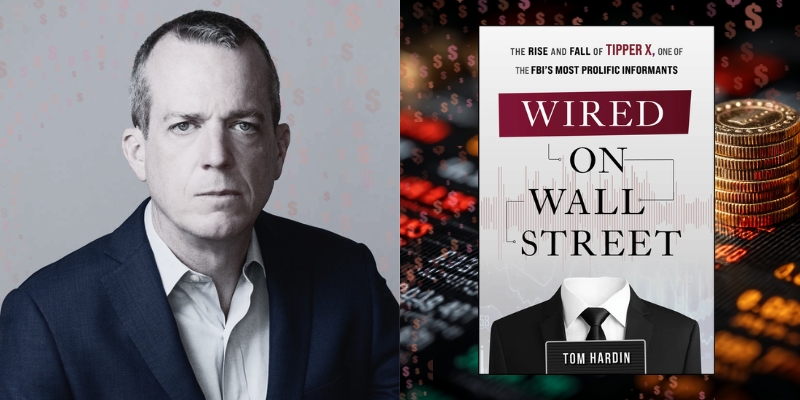
Excerpted with permission of the publisher John Wiley & Sons, Inc., from Wired on Wall Street: The Rise and Fall of TipperX, One of the FBI’s Most Prolific Informants Copyright © 2026 by Tom Hardin. This book is available at all bookstores, online booksellers and from the Wiley web site at www.wiley.com.