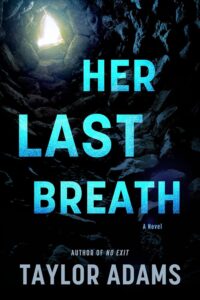
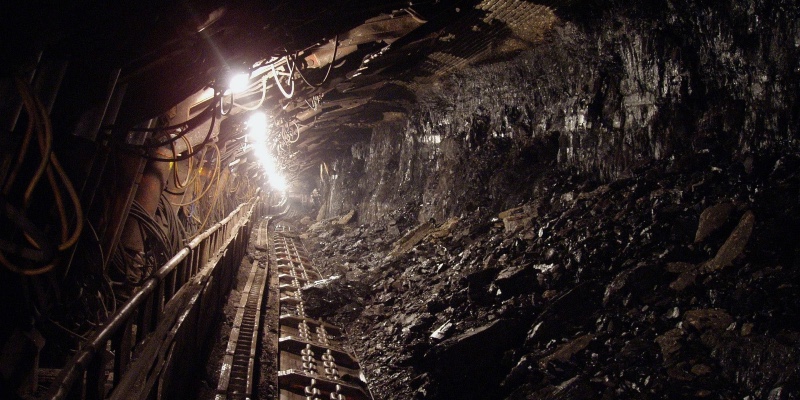
Whether it’s a snowed-in rest stop or an isolated beach house, I love trapping characters in confined spaces! So it’s actually surprising that it took me this long to realize a cave would be a heart-racing setting for a thriller. My new novel Her Last Breath follows two best friends, Tess and Allie, on a caving expedition as they quickly discover they’re not alone. Soon they’re fighting for their lives inside a narrow crawlspace deep underground. Caves touch on several primal fears but the biggest one, which I strove to nail from the very first page, was claustrophobia. I wanted to make the reader feel as physically trapped as the heroines.
*
It all started with a YouTube rabbit hole – one day I started watching helmet-cam videos filmed by cavers as they belly-crawled through tight underground passages. I became fascinated with caving and read about some harrowing real-life rescue stories. As I learned more and more, I remember finding myself subconsciously tensing up and holding my breath. With how sensory and immersive reading can be, I figured, if I could evoke those same feelings in a psychological thriller, it could make for an intense experience!
Of course, firsthand experience is the best inspiration of all. I’ve visited a few caves in the US and Iceland (all very safe and touristy) but I’d recently visited one in Mexico that was partially flooded. This really got my imagination running, because water adds an entirely new dimension to the danger. The idea of wriggling through a cramped crawlspace is already terrifying – but what if you’re underwater, too, without diving equipment? What if you’re forced to scoot on your back and breathe tiny pockets of air trapped in the ceiling? What if you realize you’re trapped in a dead end, with no way to turn around?
I’d planned to visit a few more caves to experience more sights and sounds, but since I’m also a work-from-home dad with a two-year-old, travel wasn’t always easy. However, my son has a collapsible tunnel toy that’s about two feet wide and eight feet long, and I crawled through it at least once or twice a day, imagining it was made of rock (and not fabric). I think fellow writers who are parents will agree – sometimes you have to get a bit creative with your research! And my son thought it was hilarious to watch, which was a plus.
*
To make the sensation of claustrophobia as real as possible, I focused on tactile details. Reading engages the senses and I wanted readers to feel the scrape of oppressive rock overhead, the grit in their teeth, and their own trapped breaths warming the air. There are so many subtle things to capture – the way your voice echoes differently in a confined space, the musty odors of ancient rock and moisture, the surprising workout on muscles you might not have used since the playground (or was that just me?). Every cave tour I’ve been on has always included a moment where the guide asks everyone to shut off their headlamps and stand silent. It’s fascinating to experience true darkness underground; without starlight or moonlight the blackness becomes a physical presence that’s in there with you. Your eyes might start to play tricks on you, too, as your brain isn’t used to repeatedly receiving the same visual information and begins to misfire. There’s something deeply unsettling to being someplace you don’t belong, that your body isn’t even adapted for, and with precisely-chosen sensory details I tried to make that feeling as tangible as possible.
(While I wrote this book, I often joked that if I made at least one reader throw up from anxiety, I’ll have done my job!)
*
Like any fear, claustrophobia is all about the buildup – it takes time to sink into the bones. I tend to start my thrillers fast but I knew that approach wouldn’t work for Her Last Breath. The cave is the story’s true villain and I needed to give it its due. So I paced the story carefully as Tess and Allie navigate their way down into those depths, building dread, dropping ominous clues, getting to know the colossal creature whose maw their exploring as we wait for it to inevitably snap shut. I introduced tiny, real-life details that will later become critically important – using a lighter to check oxygen levels, the dangers of tying a rope incorrectly, the horrifying possibility that you’ve wedged yourself so deeply that your body will never be recovered. By the time the story’s more flesh-and-blood villain introduces himself, Tess and Allie are already a hundred pages into their descent. As the danger escalates, the only way to flee is deeper down. By the climax they’re three hundred pages down and still descending, and I wanted the weight of those three hundred pages to feel as solid as the rock overhead. After all, if the heroines are three hundred hopeless pages down, the journey back to daylight must require another three hundred pages, right?
I built out the layout of the cave itself with similar care. Different parts of real-life caves are often given nicknames by cavers, and this was a great way to pace out the challenges (and horrors) faced by the characters. A cold, hands-on-knees crawl down a narrow tunnel? The Drainpipe. A bone-shattering vertical drop? The Chimney. And for Tess and Allie’s deepest circle of Hell, a suffocating labyrinth of cramped, ten-inch crawlspaces and dead ends flooded with ice-cold water – Worse Than Death. For this climactic nightmare I aimed to design the most hellacious physical experience I could imagine. Crawling through a shoulder-width space, how do you fit your body through a ninety-degree turn? How do you ration your air when the tunnel ahead is completely flooded? What will you do with your last breath?
*
Some of these scenes gave me claustrophobic chills as I wrote them – and if I’ve done my job correctly with research, sensory details, and careful pacing, readers will hopefully feel the same discomfort! Her Last Breath is in stores now and I’m so thrilled to see copies out there in people’s hands.
(And if it makes you throw up, please let me know – it’ll make my day.)