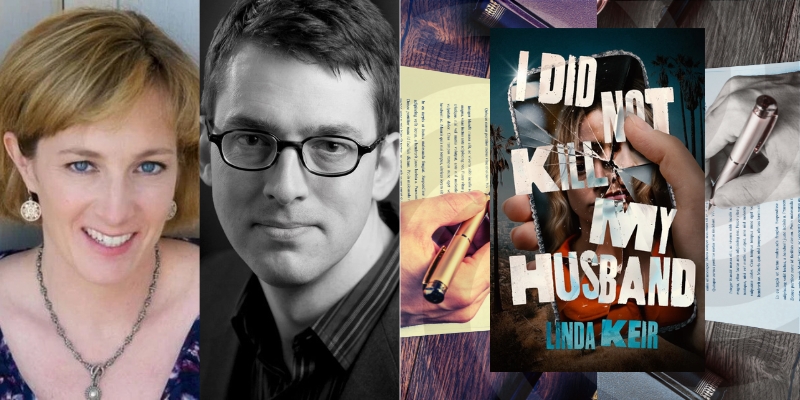
Most readers see writing as a process in which staring at blank pages, hand wringing, hair twirling, binge-eating, and emergency alcohol consumption are undertaken in lonely isolation. But they don’t have to be. While cowriting five novels, we have learned that the suffering—and the joy—can be shared.
We’ll be hitting the road soon to promote our most recent collaboration, a thriller called I Did Not Kill My Husband. And we know from experience that, at every appearance, we’ll be asked how we do it.
Here are our best answers to the most common questions.
*
How did you start writing together?
Our meet-cute as writers (we’re both happily married to other people and live in different cities) happened during cocktail hour at Love is Murder, a now-defunct Chicago mystery conference. We shared some laughs, connected on Facebook, and became official conference pals. When attending the same cons, we sat in on each other’s panels and talked writing with a growing group of mutual friends.
In 2011, we ran into each other in the book room at Bouchercon St. Louis. An agent friend joined our conversation and asked what we were working on.
Linda said she wanted to write a cautionary marital tale about the polyamorous lifestyle—AKA swinging—but was struggling with the tone, because she usually wrote dark comedy and felt this one should be serious. Keir said he was fascinated by the very same subject but had tried and failed to write it as comedy.
“You should write it together,” the agent told us. “A novel about swingers written by a male/female writing team would sell in a second.”
We were intrigued enough to consider the idea seriously. And after breaking the news to our spouses (none of us are swingers, and even an extramarital writing relationship needed mindful navigation) we decided to give it a try. Four years after we started outlining, after multiple rewrites and a few near misses with editors, we received an offer on our first book, The Swing of Things.
How do you develop ideas?
The Swing of Things was developed during endless brainstorming sessions that, for us, are the best part of the process. Linda came up with the seed for our second novel, Drowning with Others, while moving her son into his freshman dorm, which got her thinking about the pitfalls of sending even younger kids away to boarding school. Keir provided a personal story (a college girlfriend who dumped him for her poetry professor) that gave the project the spark it needed.
For our third joint venture, Keir, who was fascinated by Elizabeth Holmes and “Dirty” John Meehan, wanted to write about emotional grifters. When Linda’s friend told her a salacious story about a married man who went to unbelievable lengths to dupe his mistress into believing he was separated, The Three Mrs. Wrights began to take shape.
The pitch for our fourth novel, The Royal Game, came from Alloy Entertainment, who wanted a novel about a British prince who marries an American against the wishes of his family. And murder. As our developing “brand” appeared to be marriages in trouble, it fit perfectly.
How do you plot?
We both agreed we’d need a road map and spent seven months outlining that first book. We’ve followed the same process ever since, although we love to explore unexpected detours. And having learned to write together, subsequent outlines have taken us a lot less time.
One of the most enjoyable outlining processes occurred with The Royal Game, which took place in a five-person, virtual writers’ room that included the two of us, two brilliant story executives from Alloy Entertainment, and our amazing agent, Josh Getzler. Testing ideas with smart, experienced people is a lot more fun than it sounds. Once the outline was locked, we wrote with complete freedom.
Who writes what?
Keir tackles verbs and adjectives while Linda handles conjunctions, articles, and nouns.
Just kidding.
Actually, we divvy up the POV characters and go from there. In The Swing of Things, a husband-and-wife story, Keir wrote the husband while Linda wrote the wife, each of us allowing our characters to react to what their spouse was saying and doing. We’ve continued this practice, too, allowing Keir to prove his insistence that he can write women, too!
We also work to our strengths. Keir drafts quickly, while Linda’s process is more painstaking. Keir is able to lose himself in a scene, bringing it to life with vibrant details, while Linda is more of a story editor, always thinking about the big picture and the impact of each scene on the next.
And when life throws a curveball, we help each other out by stepping up to tackle specific tasks, whether it’s research, drafting, editing, or even admin stuff. While the word count isn’t necessarily divided fifty-fifty, the distribution of work evens out. It’s important to be compatible and also different: because we don’t have the exact same plusses and minuses, the sum is greater than the parts.
When we started, we naively believed cowriting would take half as much time as writing solo—and boy, were we wrong. While the science eludes us, it is just as much work.
How do you edit?
After we draft new chapters, we exchange them and edit each other’s work—and one strength we both share is the ability to accept hard truths. Keir writes clean, flowing copy, which Linda has been known to delete in broad swaths when she feels it will tighten the narrative. Keir’s line edits can be formidable, but he’s a former editor and they are on point.
Our multiple passes on each other’s work result in clean manuscripts with a consistent authorial voice (or so we’ve been told by our editors). This internal editing process is one of the best benefits of writing with a partner.
How do you handle disagreement?
We rarely disagree on the big subjects, but we handle our occasional disputes by being honest, keeping it simple, and respecting each other’s opinion. If we can’t come to agreement about a certain plot twist or line of dialogue, we leave it in the manuscript and let our editor decide. By that point, we’ve often forgotten the issue!
What kind of tools do you use?
We’re pretty old school. We plot and edit on the phone, write in MS Word, and store our files in shared Dropbox folders. Dropbox means we can work in the same files without worrying about losing data or overwriting each other’s work.
What are the financial ramifications?
This is probably the biggest drawback of co-authoring. Book advances don’t magically double when two writers are involved, and all money we earn is, of course, split in half—after our agent’s fifteen-percent commission is taken off the top.
But our partnership has benefited our solo careers in intangible ways and undoubtedly helped train us for the select ghostwriting and editing projects we take on individually.
What’s next for Linda Keir?
All our books fit into subgenres of crime fiction: The Swing of Things and The Three Mrs. Wrights are suspense, while Drowning with Others and The Royal Game are mysteries. Keir had been itching to write an out-and-out thriller, but it still caught him off guard when Linda pitched him: “The Fugitive—but a woman.”
A man-on-the-run story, this time featuring a woman falsely accused of murdering her husband and trying to prove her innocence, would be its own unique take on the classic film. Linda has had a growing fascination with the real-life consequences of “influencer” culture, and making our protagonist Cara Campbell an “ethical gold digger”—a potentially problematic Instagrammer with millions of followers—allowed us to explore this theme.
Together we explored how the chase would unfold in the world of smartphones and a world wide web of online sleuths and murderinos racing to find Cara before law enforcement. Would it even be possible for a modern-day fugitive to avoid capture with cameras everywhere and millions of eyes following her latest change of disguise?
With these key elements in place, Keir cooked up the character of Jordan Burke, sheriff of the California county where she escapes. A third-generation lawman in danger of losing his job to an outsider in a hotly contested election, he has an intensely personal reason to catch her.
I Did Not Kill My Husband couldn’t be more different from the book that got us started, but the excitement of bouncing ideas back and forth was just as fresh as the first time. And we think our years of experience make this our best book yet.
And we certainly enjoyed writing it together.
***

I Did Not Kill My Husband will be released March 3, 2026, by Blackstone Publishing.