

Crime and the city: Harbin, China
Our itinerant series explores the complex, censorship-combating mysteries of former Manchuria
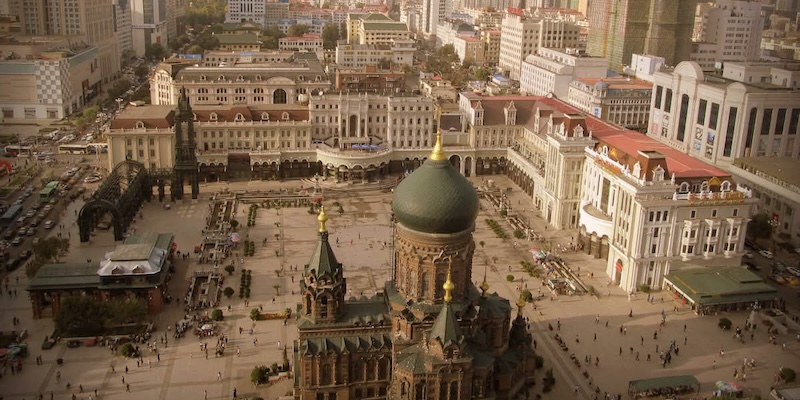
Harbin, capital of China’s Heilongjiang Province—what used to be known as Manchuria—China’s “Wild East.” It’s long been China’s most northerly and Russified city—train lines into Russia and for many decades run by the Russians to the warm-water port of Dalian and connecting to the Trans-Siberian Railway. And then, after 1917, a new Russian influx fleeing the Bolsheviks.
Even today, sitting up towards the border at the Amur River between China and Russia’s vast Far Eastern provinces, the city has onion dome Orthodox churches and synagogues with streets that would not look out of place Khabarovsk or Tomsk. But this is certainly Chinese territory now and so crime writing is, as we’ve seen in Crime and the City columns on Shanghai, Beijing and Chengdu subject to certain censorship and restrictions.
Yangsze Choo’s The Fox Wife (2024) is set up in Manchuria in 1908 where young woman is found frozen in the snow. Her death is clouded by rumors of fox spirits, believed to lure people into peril by transforming into beautiful women and men. Bao, a detective with a reputation for sniffing out the truth, is hired to uncover the dead woman’s identity. Since childhood, Bao has been intrigued by the fox gods, yet they’ve remained tantalizingly out of reach. Until, perhaps, now.
American Sinologist Scott Seligman’s true crime Murder in Manchuria (2023) is a brilliant evocation of the Soviet spies and fascists, adventurers and chancers who gathered in interwar Harbin, a city at once highly modern—trains, art deco hotels, American cars—yet with old world animosities that boil over into kidnapping, murder and espionage.
Semyon Kaspé, a young Jewish musician, is kidnapped, tortured, and ultimately murdered by disaffected, antisemitic White Russians, secretly acting on the orders of Japanese military overlords who covet his father’s wealth. When local authorities deliberately slow-walk the search for the kidnappers, a young French diplomat takes over and launches his own investigation. Amazing…. And it’s all true!
Novelist Mark Oulton fictionalizes this same period in Red Spy in Harbin 1: In the Making (2025). It’s 1935 Harbin, a city of spies, racketeers, and would-be revolutionaries. Chinese agent Chen Minghe is ordered to infiltrate the Russian émigré Fascist Party—led by Konstantin Rodzaevsky, a real-life White émigré whose vanity and erratic leadership belie his dangerous ambitions. 1937 dawns and full-scale war with Japan begins, Chen’s mission starts to unravel. Rodzaevsky’s affair with a planted mistress comes to light. The resulting scandal begins to unravel the operation.
Chen’s adventures in espionage continue in Red Spy in Harbin: Book 2: The Price of Survival (2026) but in this tale move to World War Two Japanese occupied Taiwan.
Another series with Harbin at its centre and in the same “nest of spies” interwar period is Tom Stickel’s Special District: Harbin: Drawing the Tiger’s Bones (2022). It’s 1929 A patrolman, Borya Melnikov, sits at the bottom ranks of Harbin’s Special District police force. A dismembered body. A raging Red Terror campaign. A brewing war with the Soviet Union….Borya is assigned to investigate the dismembered body of one the city’s foreign businessmen uncovered in the nearby Japanese zone.
Special District: Harbin: Book 2: The Tigers of East Mountain (2023) starts with the discovery of body of a local Jewish businessman in a Harbin back alley threatens to tip the city into mob violence… It’s 1932 and Borya Melnikov returns to police ranks after the Japanese take over Harbin and end Soviet control, only this time with the Judicial Police of the new state of Manchukuo (Japanese- occupied Manchuria).
And finally, Special District: Harbin: Book 3: Visiting the Tiger’s Den (2024). It’s 1935, and Borya Melnikov has risen to the rank of Senior Inspector on Harbin’s Judicial Police unit in Manchuria. But his position is becoming untenable as Manchukuo’s Japanese masters are increasingly intolerant of his independent style…and now this anonymous threat lands on his desk. It’s not in his nature to back down to threats, but it is only weeks before his wife returns to Harbin. He must quickly solve all four of his open investigations before she arrives or risk putting her into danger also.
Brian Klingborg’s City of Ice (2021) is more contemporary and has Harbin partially as a backdrop. In a remote Chinese town – where the theft of a few chickens counts as a major crime—a young woman is found brutally murdered…with her heart, lungs and liver removed.
Inspector Lu Fei, a weary cop who fled the city, suddenly finds himself under the intense scrutiny of the ruling party in Beijing. Determined to find her killer, Lu Fei must navigate a society where politics can be deadly, corruption is rife, and the powerful are untouchable. As evidence connects the case to a string of unsolved murders, Lu must decide what he will risk in search of justice….
There are more Lu Fei novels, mostly set in northern China, including Thief of Souls (2021), The Magistrate (2023) and Wild Prey (2022), which takes Lu Fei to Myanmar.
Caroline Petit has written several historical fictions set in China, usually southern China—Hong Kong and Macao. The Fat Man’s Daughter (2006) ranges too from Hong Kong up to Manchuria. In Hong Kong in 1937 orphan 19-year-old Leah Kolbe is approached by a Mr. Chang, who claims to have known her father and offers her a commission to go to Manchukuo to smuggle out Chinese Imperial treasures. She consents and, accompanied by her faithful amah and a Russian émigré woman in Chang’s pay, takes the train north.
And finally, a writer I’ve been trying to squeeze into Crime and the City for a long time, Japanese author Haruki Murakami. Not naturally a crime writer admittedly but his novel The Wind-Up Bird Chronicle (1994) counts I reckon. Toru Okada, an unemployed man living a quiet suburban life in Tokyo, watches his life unravel after his cat disappears, his wife Kumiko grows increasingly distant, and he starts receiving strange phone calls.
From there the story explores deep psychological trauma, historical violence (particularly Japan’s actions in World War Two in Manchuria), personal alienation, and the hidden depths of human memory. The Manchurian sections of the novel are extremely atmospheric and often harrowing, a stark, visceral departure from his usual dreamlike, whimsical magical realism.
It is a book partly about Japan’s war crimes in China, brutality and multi-generational trauma. A trauma, by the way, that still lingers over Heilongjiang Province and the city of Harbin.
***

Paul French
Paul French is a British author of books about modern Chinese history and contemporary Chinese society including Midnight in Peking and the 2018 release City of Devils.