
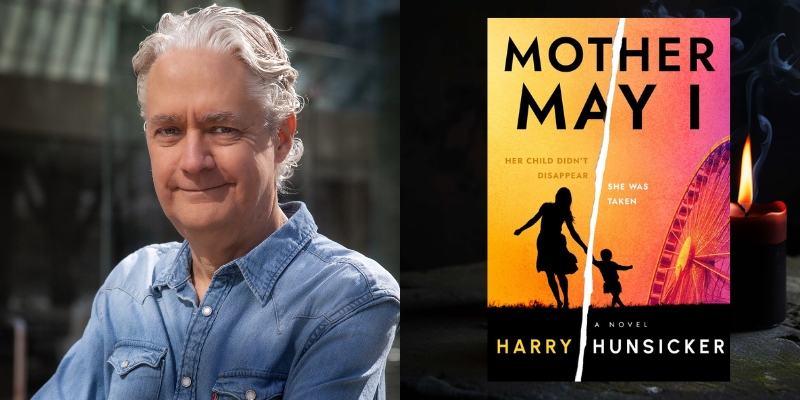
Harry Hunsicker on Transforming Grief into Conflict in Crime Fiction
The author of Mother May I explores the narrative tension of trauma and closure
Eleven years ago, within the span of a few months, my parents died suddenly, both from natural causes.
I was their only child, and we were a close-knit family, living only a few blocks apart. I didn’t truly understand grief until then. I didn’t comprehend the impact it could have on a person: the crushing depression, the devastating sense of loss, the need to do something—anything—to alleviate the turmoil and despondency, and yes, the anger.
In response to losing my mother and father, I started taking long walks, a habit that continues to this day. But what if my parents had been the victims of violence? What might I have done then?
I might not be sitting here right now, typing these words; that’s what.
In Dennis Lehane’s brilliant crime novel Mystic River, when Jimmy Marcus’s daughter is murdered, his grief takes a dangerous turn into a quest for vengeance. I don’t want to give away any spoilers, but Jimmy’s search for the killer causes him to make a series of terrible mistakes, compounding an already tragic situation. (Sean Penn won an Oscar for his portrayal of the anguished Jimmy Marcus in the film version.)
In both the book and the film, Marcus had been a criminal, someone used to operating outside the confines of the law, so his turn was understandable.
I’m not a criminal, but I can tell you that the irrationality that comes with grief makes pursuing relief in that manner completely believable. A character’s urge to act can become stronger than their ability to resist. Self-control disappears like a puff of smoke on a windy day, leading a person to attempt to right a wrong that, by definition, cannot be made right.
In Razorblade Tears by S. A. Cosby—another excellent crime novel—two fathers join forces to find the person who murdered their sons. The men’s grief is compounded by the fact that their sons were married to each other and both fathers are virulently homophobic.
In this instance, grief causes more than just action. It forces these two men to confront the way they treated their sons, opening wounds of regret and missed opportunities, a different level of sadness.
With their personal beliefs and the realization that they had failed their sons on some level, the fathers’ grief—much like Jimmy Marcus’s—again compels them to act. They have no choice in the matter. Their search for the killer cannot change what happened, but it provides the fathers a chance to stand beside their sons in death in a way they failed to do in life.
Grief never goes away. It shifts its shape and hides. It lies dormant, always there, an undercurrent in a person’s life.
Such is the case in I Did It for You by Amy Engel. In this thriller, Greer Dunning returns to the small town where her sister was murdered fourteen years earlier. Unlike in the other examples, justice was served in her sister’s killing: a man was arrested, prosecuted and later executed.
But when a similar murder occurs in the same town, Greer realizes that her sister’s killer may have had an accomplice. Whatever sense of closure she might have had is ripped away like sutures yanked from an unhealed wound.
The new killing opens the floodgates on Greer’s hidden grief, breaking through the carefully constructed walls around feelings she thought she’d long since sloughed off. The second murder and her return to her hometown compel Greer to embark on a search for another killer.
Again, grief drives the story—the character’s need for a final resolution regarding the violent death of a loved one. In this instance, that drive was merely postponed.
Psychologists like to talk about the hierarchy of needs—food, shelter, companionship, a sense of belonging, to name just a few. These are the elemental forces that drive us and inform the bedrock of our actions.
But where does grief fit in that hierarchy?
What happens when someone you love is taken from you? Where does that leave a person?
It leaves you with a sense of nothingness and rage, a hollow anger echoing inside, which in turn provides that most precious of elements in drama—conflict.
In fiction, conflict fuels the story.
With grief, the fuel becomes plentiful, a never-ending supply of forward momentum capable of propelling good stories to levels of greatness. (See the three examples above.)
But more than that, grief is part of the human condition, an emotion all of us are familiar with even if we haven’t yet experienced it firsthand.
Like love, grief is universal. So is the urge to respond to it.
That connection holds true in life as well as in the stories we create to make sense of the world around us.
***

Harry Hunsicker
Harry Hunsicker is the best-selling author of The Life and Death of Rose Doucette, along with numerous crime novels and short stories. His novels include Shadow Boys, The Devil's Country, The Contractors, and the Shamus Award-nominated Still River, among others. Hunsicker is a fourth-generation native of Dallas, Texas, where he currently resides with his wife, Alison.