In her new monthly column for CrimeReads, author and historian Radha Vatsal makes the case for why you should be watching new movies and shows from around the world and across the decades.
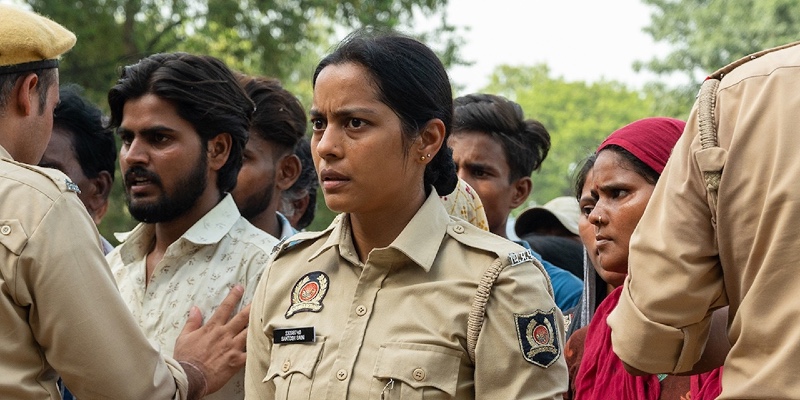
Cast: In this police procedural set in small-town India, policewoman Santosh (Shahana Goswami) investigates the rape and murder of a teenage Dalit girl. Goswami’s watchful, thoughtful performance, in which she rarely even smiles, drives the film. It’s matched only by Geeta (Sunita Rajwar), a senior female cop who is brought in to handle the case. Geeta takes Santosh under her wing, but it’s difficult to know what the opaque and quietly terrifying older woman’s motives are. Does she want to mentor Santosh, or to show her up? Is she attracted to her protegee? Some of all the above?
Story/Mood: The deliberately-paced story draws you in as you watch Santosh slowly come to terms with the corruption and brutality of the police and the indignity and cruelty heaped on the Dalits. Dead animals are thrown into the Dalit’s well, which is also where the young victim, Devika Pippal’s body is found. Once suspicion falls on a Muslim man who has been texting with Devika, you know that things aren’t going to end well for him. The final reveal came as a surprise (to me at least) and was utterly chilling. If you’re interested in a story about policing versus justice, tradition versus freedom, caste and religious tension, this movie is for you.
Crew: Sandhya Suri, the director, is a British-Indian documentary filmmaker. In an interview with the Hollywood Reporter, she says that she had initially planned the film as a documentary about violence against women and police corruption in India. But Suri says she dropped the project because what she learned was “just too horrific.” A shocking rape case in Delhi gave her a different angle—to focus on the female cops caught in between the public’s anger about violence against women, and their duty to defend the system even while feeling solidarity with the victims. She says:
“[W]hat I knew was I didn’t want to make a film about the good cop in the bad system. I wasn’t interested in that. I was interested in a very morally murky universe. That’s what felt truthful, and Santosh trying to find her own grey within that. So what is her grey? [That] was my question. And also the other question was, if she does cross the line, is there a way to come back?”
Memorable moment: There are several surprising moments in the film but one that stood out was when Geeta reaches her hand to Santosh’s face and pulls out the younger woman’s nose ring. It’s a small movement that lasts a few seconds, yet the two women’s relationship is so unpredictable, that I had no idea what Geeta was up to and whether or not her action was going to be violent.
I needed to check: Santosh becomes a policewoman when she’s appointed to the position on “compassionate grounds” after the death of her policeman husband. I had no idea whether this was really a thing and immediately rushed to look it up. It turns out that this provision does exist. For instance, this is from the Delhi police department: “The Commissioner of Police…is competent to appoint a dependent member of the family of a deceased police employee…in order to help the family of the deceased in overcoming the economic hardships that are occasioned by the bereavement.”
Where to watch: In the US, Santosh is streaming on AppleTV, Amazon, etc.
Other notes: The runtime is a solid 2 hours and eight minutes. In Hindi with English subtitles. Santosh premiered in the Un Certain Regard category at Cannes and was the UK’s entry for Best International Feature at the 2025 Oscars. The film has not been theatrically released in India due to cuts required by censors.