I always wanted a sister. Life gave me a brother, excellent in the way of Gen X older brothers. Which is to say, while he absolutely did shoot me in the butt with a BB gun, he would pound to flinders any other child who picked on me. He was both protector and menace, but never a perfect confidant and co-conspirator like my imagined sister.
I mean this literally. As a child, I invented a sister named Liz, braver than me, trustworthy, loyal, and loyal. I had a host of viperous aunts actively proving real-life sisters seldom live up to the hype, but my mother read to me a great deal. I sourced my pretend sister by pirating the best bits of the March and Ingalls girls and throwing in some Pippi.
Liz felt so real that sometimes she would take my place at dinner. My parents would kindly ask their imaginary third child all about her adventures (Liz was a roamer with magical abilities), while my brother rolled his eyes, but also threatened those who mocked me for keeping her past the age when imaginary friends are normal.
Part of my devotion to her stemmed from the vagaries of growing up in a military family. I have always kept a wide acquaintance, but my close friendships are few and hard won, built slow in layers of trust. As an army brat, we moved just when my best-friendships were flowering.
I remember having t tell Susan we were moving when I was only seven. We sat under her covered pool table, weeping, swearing endless fealty. Only Susan knew I had stolen a Zagnut bar from the corner store and that I liked a round faced boy named Todd.
Together, she and I had heard about the horrors of French-kissing from her cousin. Under this same pool table, we’d stuck our tongues out very far, closed our eyes, and after a hundred false starts, briefly mashed the drying, nubbled ends together. Then we collapsed, shrieking laughter, and made a solemn oath to never, ever do this repulsive thing with boys. A future without her was a wasteland, and it felt the same each time we moved.
I measure my childhood eras by those best friends: Susan. Angie. Yvonne. Jennifer. Tricia. Lydia, who has held the position from grad school to this day. Perhaps this is why I so often write about sisterhood, a thing that I have never experienced. I have written sisters who commit crimes for each other, or together, or hide each other’s worst decisions and know each other’s darkest secrets.
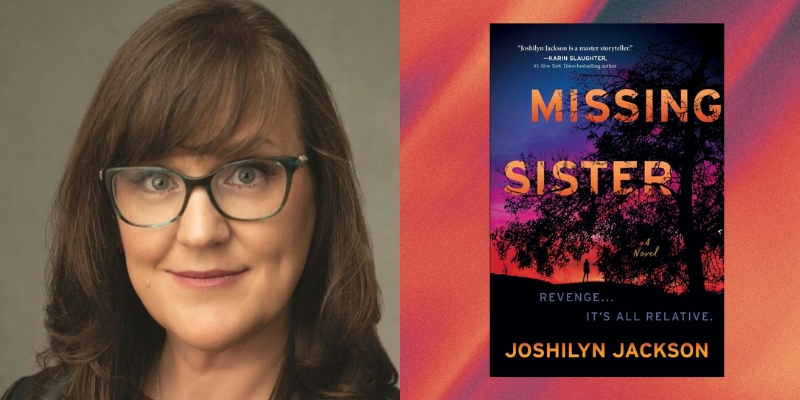
In Missing Sister, for the first time, I am writing about this gap I’ve always felt, an absence where a sister ought to be. Penny Albright had a twin, Yang to her Yin, a burning force that balanced her softer light. When Nicki became a casualty of the opioid epidemic, Penny burned her whole life down, quitting her job as a chef and ending her engagement. She went back to school to study Criminal Justice and then to the police academy, determined to become the kind of cop that might have made a difference when Nicki needed help.
When the novel opens five years later, she’s a rookie called to her first murder scene, where she recognizes the still-warm victim as one of the men she blames for Nicki’s decline and death. She leaves, distraught. Alone in the darkness, she finds Thalia Gray, a blood-soaked Fury who is, for a reason unfathomable to Penny, systematically avenging Nicki.
Penny ought to arrest her, but instead, she does the unthinkable. She lets Thalia go. From that moment on, she’s obsessed with finding out who Thalia is and what she was to Nicki. Thalia has her own gaps, and the heart of this book is the relationship they form. It is a darker, bloodier heart than any I would cultivate in real life, but it still beats true.
Looking at my other books in the light of this latest “sisterhood,” I realized how many of my “sister” pairs are actually cousins, or best friends, or step-sisters, or adopted sisters. Perhaps I have been doing more than writing into a lack that I have felt all my life.
Lydia, an only child, also wanted a sister, and we have filled that role for one another. When she was in the throws of a complicated pregnancy and a necessary move, I drove ten hours to Virginia, collected her, and kept her until her valiant husband got their earthly belongings toted across the country, settled into his new job, and got a house. When I had to have an awful surgery, she stayed with me and fed me and took care of my menagerie of beasts after Scott had to go back to work.
On September 11, I was feeding my baby in my cozy pear green kitchen when the news began to blare that a plane had crashed into one of the twin towers. I called Lydia, and we watched the second plane hit together. We stayed on the phone for most of that awful day, watching the news, often silent, but comforted by the breathing presence of the other.
Together we raised our children, weathered the loss of beloved parents, traveled and worked, celebrated victories and mourned sorrows, defended each other, and forgave each other for those rare, inevitable moments when we let each other down.
Perhaps this is what my stream of fictional sisters and near-sisters has been saying all along; a lack or loss or gap hurts, but that space means there is room for a connection; a chosen family can be better than what the random roll of the genetic dice might gift you. For Penny, who has found herself inside a thriller, this truth has a razor sharp edge.
The bond happens in a moment; Thalia says a single word to her, but it is the right word. Penny makes a leap of faith, aligning herself with a dangerous stranger who is doing every dark thing Penny dreamed of, but could never do.
***