As we drove up the long gravel driveway, I began to get cold feet, but I’d begged my mother to attend this birthday sleepover and didn’t want to chicken out. When we pulled up to the farmhouse, I noticed that there was only one lit window, the others dark and foreboding.
Nobody greeted me, but I crawled out of the car anyway, backpack slung over my shoulder. When the kitchen door opened, revealing my friends inside, my relief was instantaneous. They were huddled around a table, examining a five-card tarot spread.
Candle and cigarette smoke mingled, making the atmosphere both mysterious and inappropriate for eleven-year-olds. I was curious to say the least and quickly joined the assembled group, hanging on every word the psychic shared about my friends’ futures.
Everybody got a turn, and while mine didn’t produce any earth-shattering news, I still clung to the prophecies, hoping the bit about a new pet cat would come true. The psychic correctly read the room and did not predict catastrophes for a group of impressionable young girls.
I grew up in a rural, Southern town flush with folktales, superstitions, and ghost stories. We didn’t need campfires to try and scare each other.
But my interest in the uncanny is hardly unique. Bookstores have rows of books dedicated to the supernatural, Goodreads has countless lists, and Hailey Piper offers up ten noir/horror blends in this earlier CrimeReads article. You can find elements of clairvoyance—either fake or genuine—in stories dating back to the Epic of Gilgamesh circa eighteenth century BCE and continuing through today’s bestseller lists.
One of my favorite recent mystery novels is Ruth Ware’s The Death of Mrs. Westaway in which a young woman reads tarot on the Brighton Beach boardwalk to earn a living. I enjoyed the inclusion of a character who tells fortunes without any supernatural abilities, a more relatable (to me at least) version of this trope.
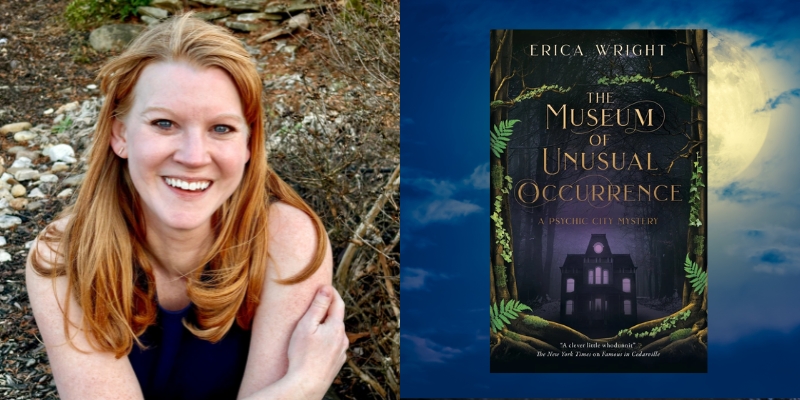
Research for my latest novels, including The Museum of Unusual Occurrence, included a tarot class. I bought a beautiful deck, the Wild Wood, but as much as I loved the illustrations, I couldn’t muster up any sixth sense. The teacher praised student after student, then kindly corrected my feeble attempts. I didn’t mind. My protagonist doesn’t have any special abilities either, although her neighbors proclaim to have them in spades.
The question is, why are we drawn to mysteries with clairvoyant characters? Even Arthur Conan Doyle—the creator of perhaps the most famously no-nonsense detective of all time—included supernatural angles in several stories (debunked, of course, by the end). Surprisingly, Doyle himself embraced Spiritualism and its trappings. He was known to host séances in his own home and fell out with his friend Houdini over the matter.
Partly the appeal of these books is akin to horror novels, rollercoasters, and haunted houses: it’s fun to be scared while objectively safe. We also find a camp quality, the same one on display during Halloween.
Every October, my neighborhood teems with skeletons, pumpkins, witches, and more. An entire street of enthusiasts try to one up each other, their yards covered in faux graveyards and their houses draped in spiders, obscured by machine-made fog. At one trick-or-treat stop, an elaborately dressed woman peers into a crystal ball. She hands out chocolate bars and prognostications.
I’d argue that there’s wish fulfillment, as well. Nearly half of all murder cases in the United States go unsolved. Mystery novels offer us a promise of better statistics. And imagine if genuine mediums were thrown into the mix, people who could call up the murdered and ask them to identify their murderers? A lot more guilty folks would find themselves behind bars.
There is something deeper about the appeal of the uncanny, though, something metaphysical. Spiritualism was founded on the belief that we could communicate with the dead and therefore prove an afterlife existed. It’s little wonder that this religion gained prominence after the Civil War when nearly everyone was mourning the loss of loved ones. People wanted comfort, and they sometimes sought it around a séance table.
When we read mysteries in general—from cozy to noir—aren’t we asking ourselves essential questions about mortality? Are we not, like poets, mining what it means to be alive and what it means to die?
Emily Dickinson famously characterized death as a gentleman in a carriage. Dylan Thomas exhorted us to rage against the inevitable end. Poet and mystery novelist Chris Abani asks, “And how is it that death can open up / an alleluia from the core of a man?” in his poem “White Egret.” And Kenneth Patchen gets right to the heart of the matter in “I Feel Drunk All the Time,” writing “You’re a bastard, Mr. Death.”
There’s usually a satisfying sense of closure when we read a mystery novel. The crime is solved, justice served, detectives at least temporarily resting on their laurels. But the best ones consider how the characters have been forever altered by both the violence and the choices they’ve made. Physical and emotional scars form, and we’d be well-advised to remember them.
The birthday sleepover did not end as grandly as it began. From too much cake or cigarette smoke, I soon found myself sick and vomiting in the front yard. I slept fitfully and was more than relieved to see my mom’s car creeping back up the driveway in the morning.
Nonetheless, I still get a thrill thinking of that dark, spooky kitchen more than three decades later. It felt vaguely illicit, as if we were testing our luck, rebelling against the laws of nature. (And yes, I did in fact get a new pet cat.)
When we begin a new book, there’s a similar leap of faith, a throwing of bones if you’ll indulge the metaphor. We hope to be lose ourselves in the story and perhaps learn something otherwise unknowable along the way.
***