
On wellness culture, horror fiction, and shifting the blame
"Horror has always understood that care can become control."
On a winter evening some years ago, in a tiny cottage in North Wales, a friend of a friend said something to me that has stuck to my brain like fungus. At some point that evening, my liver transplant came up—the fact of it, nothing more. She knew no part of my medical history or the reasons my liver failed.
“You know,” she said, waving her glass through the air. “If you’d have drank more water, you probably wouldn’t have needed your transplant. And if you’d walked more.”
I remember blinking for a moment, taken aback. I was drinking water as she said it, while she and my friend drank the better part of a bottle of wine.
She went on to tell me about a distant relative of hers who’d died of cirrhosis of the liver. Her tone was not one of grief. He needed to drink more water, she said with firm conviction. He needed to move more. She poured herself more wine.
I don’t think she was being cruel. I think she was reassuring herself. As if his death, from a disease he may have had no power to prevent, were a sort of punishment. As if my transplant were the consequence of my own bad decisions. If illness or disability happens because people make poor choices, then it’s possible to be careful enough to avoid them. She could be careful enough. The dead relative had failed a test she intended to pass, and so had I, and for the rest of the evening that made the world manageable.
This is wellness culture’s load-bearing wall, and the wall is old. In this culture, health has long stood as evidence of virtue, and illness as evidence of its absence. It is why the friends in the book of Job sit with a suffering man in silence for seven days, then spend the rest of the book explaining what he must have done to deserve it. It is in the Victorian asylum, where a woman’s breakdown was read as a verdict on her character rather than on the life she was living. Elaine Showalter’s The Female Malady traces 150 years of it. The language is softer now. Detox, discipline, intention, alignment. But the structure beneath it is the same. It does the same work it has always done. It is not a theory of medicine. It is a theory of blame.
It is not a theory of medicine. It is a theory of blame.
I was dying. I am not dying now. I am grateful every day, and I am still astonished by it. But a transplant is a trade, not a cure. Another transplant recipient told me, when I was struggling, that I had to accept I was a fifty per cent person now—that I couldn’t manage what a hundred per cent person could. He was right.
A person who is visibly, permanently ill becomes a surface that other people write prescriptions on. I have been told to do yoga. Gong baths. Meditation. Supplements, veganism, low-carb diets, Mediterranean diets, water fasting, seaweed wraps, enzyme peels. Reiki. The list is longer than this, funnier than this, and still growing. Every item on this ever-expanding list was offered by someone who meant well, and who had somehow decided that they were qualified to tell me what my body needed.
They are not prescriptions, though. A prescription can be declined. What’s actually being handed over is a promise—this will help you—and the promise comes with a condition attached, which is that you must receive it in the right spirit. You must be open. You must not be cynical. Think positive! You also must not have tried it already, and you certainly must not say that you tried it and it did nothing, because that is heard as a refusal to heal rather than a report on the outcome of the attempt.
So the thing being asked for is not really the yoga or the seaweed wraps. It’s your doubt. Hand it over, come to this with an open heart, and you may yet be restored. Keep hold of it and you have identified yourself as the obstacle to your own recovery, which is a tidy arrangement for everyone except the person holding the obstacle.
Please hear me when I say, people who live inside an illness know more about it than you can possibly know from the outside.
The horror genre is suited to the exploration of this pressure. Horror has always understood that care can become control. It has intimate knowledge of the sanatorium, the asylum, the house you enter for your own good. Getting out, well, that is a separate question. Horror knows that the person offering to restore you is also deciding what you will be restored into.
Think of the Overlook Hotel in The Shining, a place you cannot leave once the weather turns, where the staff are endlessly solicitous and the help never comes. Or Ira Levin’s Stepford, where the improvement actually does work. That is the horror of it. The women are delivered exactly what was promised: serene, radiant, agreeable, well. What they gave up to get there is the part nobody mentions in the brochure.
That is the mechanism I keep returning to. Not the failed cure, but the cure that succeeds on terms you never opted into. The ritual that asks for your clothes, your routines, your privacy, your scepticism. The healer whose authority cannot be questioned, because questioning is itself the symptom.
Horror is the only genre that takes the uneasy patient seriously. Everywhere else, the woman who says something here is wrong is anxious, difficult, non-compliant, ungrateful. In horror she is the one who is right, and the narrative proves it.
What drew me to write about a wellness retreat was the language. I had been noticing it for years: surrender, release, cleanse, let go, trust the process, do the work. It’s the vocabulary of devotion. Strip the eucalyptus from it and you are left with the grammar of initiation—give something up, submit to someone’s guidance, be remade as something new. Wellness borrowed its words from religion but never acknowledged the debt, which means the obedience came along too, carried quietly inside phrases that sound like kindness.
I went to the Uist islands in the winter of 2015 during Storm Desmond. Uist in winter feels like standing at the end of the world. There’s an eeriness to it, an almost-emptiness, but also this heady sense of something ancient sitting just beneath the surface. What stayed with me was the machair. It’s one of the rarest wildflower habitats on earth, a delicate skin of shell-sand lying directly on top of peat bog. Something fragile flowering over something darker and preserving.
The islands are not sinister. They are beautiful, and people live full lives there. But that winter, in a remote blackhouse, with winds gusting to seventy miles per hour, I felt the remoteness. I felt how cut off we were. The distance that makes a place restorative is the same distance that makes leaving difficult, and a retreat built on that distance holds a quiet power over anyone who arrives desperate enough to be helped.
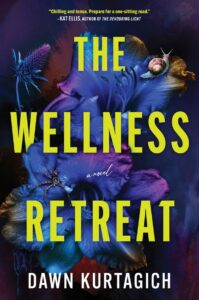
All of this went into the pot—the friend of my friend with the glass in her hand, the borrowed liturgy of the spa, the flowers growing over the bog, and the isolated blackhouse—and what came out, a decade later, was The Wellness Retreat.
The retreat in my novel promises restoration. What it asks for is surrender, and those are not the same transaction, though they are sold as one.
Here is the part I find hardest to write. I would give almost anything to be well. Not improved, not inspiring—well. That desire is the most exploitable thing about me, and every retreat, every protocol, every promise is built on the knowledge that people like me are carrying it.
That is what I wrote about. Not a woman too wise to want healing. A woman who wants it badly enough to pay—and a place older than the spa, which was never selling anything, and which takes her at her word.
What I need, meanwhile, is relief where relief is possible and support where it isn’t. Dignity. Company. To be believed about my own body. These are not consolation prizes for people who failed at getting better. They are the substance of care, and they remain available even when improvement does not.
Wellness, as it is sold, has no room for that. So I write horror instead.
***

Dawn Kurtagich
Dawn Kurtagich is the award-winning author of The Dead House, And the Trees Crept In, Teeth in the Mist, Blood on the Wind, and most recently, The Madness. She leaves her North Wales crypt after midnight during blood moons. The rest of the time she exists somewhere between mushrooms, maggots and mould. She is enjoying life with her new liver, Lucy, her husband, two black cats, and those moldy forest mushrooms we mentioned earlier.