

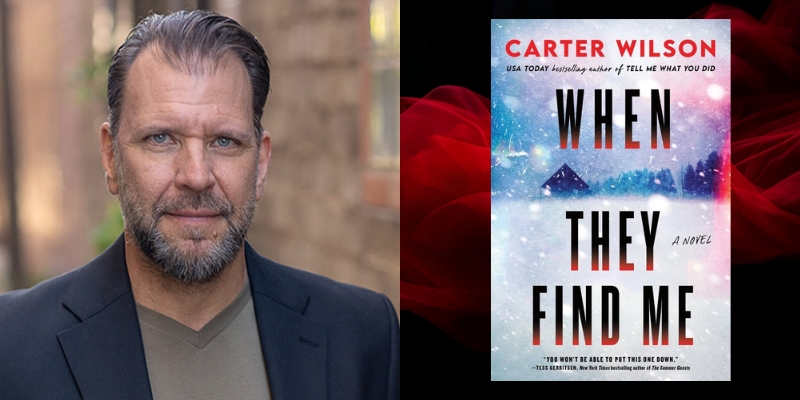
Carter Wilson on justice, manipulation, and why revenge thrillers are so satisfying
The author of When They Find Me explains the cathartic essence of a subgenre
I love a revenge thriller! Someone gets horribly wronged, the people who are supposed to help prove useless, and eventually the wronged person decides, screw it, I’ll handle this myself. Things often get bloody from there. Count me in.
We all love justice served when the systems supposed to deliver it have failed. How many of us have felt purely homicidal after getting lost in an insurance company’s endless phone menu? You’ve entered your policy number four times, explained your problem to three people, and been transferred to a department that may or may not exist. Meanwhile, a recording keeps assuring you that your call is important.
Important to whom? Certainly not whoever just disconnected me.
Sure, a bureaucratic phone tree isn’t (usually) justification for a killing spree. But that feeling of powerlessness is familiar. Someone else controls the outcome, and you can’t even get them on the goddamn phone. A revenge thriller transfers power from the system to the individual. The person who’s been ignored or screwed over gets to decide what happens next.
Finally, someone gets to do something.
I’ll readily admit there’s emotional manipulation involved. Give readers someone to care about and a good enough reason to want payback, and suddenly they’re willing to entertain all sorts of behavior. This works in David-versus-Goliath stories, too. Show me a corporation knowingly poisoning a town’s drinking water, and I’m probably going to be pretty flexible about what happens to its CEO in chapter thirty. This includes graphic limb removal.
Dexter takes this flexibility to impressive lengths. His code gives us permission to root for a serial killer. We know whom he’s targeting and why, and that’s enough to get us on board. Murder remains bad, of course. We’d just appreciate it if he could finish this particular one before anyone interrupts.
Victoria Helen Stone’s Jane Doe gives us a different kind of payback. Jane makes herself into the perfect girlfriend for a man she intends to destroy. He thinks he understands who she is, while the reader knows how badly he’s miscalculated. There’s something wonderful about watching a man remain so confident while getting everything so wrong. By all means, buddy, keep underestimating her.
But writing about revenge makes me consider what I’d actually do if something terrible happened to me or someone I loved. I get to explore those thoughts while sitting safely in a coffee shop with my laptop. Sometimes I don’t particularly like the answer. Sometimes I love it.
We have laws telling us what’s allowed. We have society telling us what’s acceptable. Then we have our own private understanding of good and evil, which may come with a few footnotes. Don’t hurt people. Don’t kill people. Unless, perhaps, those people are threatening your child.
That last one can do a lot of damage to an otherwise sound moral philosophy.
When I was writing When They Find Me, I never had trouble rooting for Annie Wolfe. She’s hiding with her twelve-year-old daughter, Coral, in a remote Colorado town, all because she took matters into her own hands four years ago and a couple thousand miles away. She knows her vengeance comes with a cost, and she’s waiting to be hunted down. She’s peppered her cabin with hidden weapons and built a safe room.
Then a father and his two adult children invade Annie’s house believing someone else lives there, and a historic blizzard traps everyone inside. This is bad news for Annie and Coral. It’s also an unfortunate development for the people who picked this particular cabin.
Annie will do anything to protect her daughter. I wasn’t sitting at my laptop wishing she’d consider a more measured response while armed strangers threatened them. I wanted her to have easy access to a pickaxe and a flamethrower. But Annie isn’t enjoying any of this. She just wants herself and her daughter to survive. Mostly, she just wants everyone to leave her the hell alone.
Her history with revenge is complicated, and I’ll leave the specifics for readers to discover. Annie believes in an eye for an eye. She has her own sense of proportion, and she isn’t interested in drawing out someone’s suffering. I understood her reasoning even as I wrote about the consequences.
Then there’s Coyote, the father leading the home invasion. He sees himself almost as an animal, acting according to instinct. In his belief system, nature doesn’t concern itself with good and evil. He isn’t waking up, stretching, and wondering how much bad shit he can squeeze in before lunch. He’s doing what comes to him naturally, and I had to take that posture seriously while writing him, even while I wanted Annie cave in his skull.
So there I was, drinking coffee and deciding who deserved to die. Maybe my favorite part of being a thriller writer.
I think revenge stories satisfy the part of us that’s tired of waiting for someone else to fix things. Writing them also makes me question how far I’d go once I stopped waiting. I can believe in the law and still find myself enthusiastically supporting a character who breaks it. Put my own family at risk, and who knows what I’d be willing to justify?
Fortunately, when I finish the book, the rules still apply. I have to behave like a reasonably civilized person. Which I fully intend to do.
Unless my insurance company transfers me one more fucking time.
***


Carter Wilson
Carter Wilson is the USA Today and Publishers Weekly bestselling author of eleven standalone psychological thrillers. His stories focus on ordinary people pushed into situations where survival and morality collide, and every decision has consequences. His 2025 novel Tell Me What You Did was a national monthly pick by Barnes & Noble, and his work has been optioned for film and television. He hosts the podcast Making It Up, where he has candid, unscripted conversations with fellow authors about what it actually takes to build a writing life. He also founded Unbound Writer, where he works closely with writers through coaching, immersive retreats, and live workshops. A sought-after speaker and moderator, Carter is known for conversations that feel honest, engaging, and a little unpredictable. He lives in Erie, Colorado and travels frequently to teach, interview, and speak. To learn more, please visit www.carterwilson.com