

Seeking Justice in Deep South Georgia
Corruption charges, a contested election, and an assassination. It all added up to a District Attorney's biggest case..
I had finished the third run-through of my closing argument, so I went down to the pond to see how John Petrey, my chief assistant district attorney, was doing with his portion.
I walked slowly and quietly so as not to disturb him. As I drew near, I caught sight of him standing on the dock, facing the water in his T-shirt, shorts, and Birkenstocks. Tall and slim, glasses perched on the end of his nose, hair a little disheveled, he was delivering a persuasive argument to what appeared to be an empty pond.
Across from the dock, though, I spotted the gray snout and black eyes of an alligator, the rest of the animal still and immersed in the water. The animal was watching him. Because the sun was shining from that direction, the light combined with Petrey’s terrible eyesight caused him not to see it.
That old gator was the most attentive juror he ever addressed.
* * *
We were two hundred miles from where the murder happened, living in a hunting lodge outside Albany, Georgia, preparing to close the biggest case I would ever try.
Eighteen months earlier, on December 15, 2000, during a cold and rainy night in Georgia, Derwin Brown, the sheriff-elect of DeKalb County (one of the largest metropolitan Atlanta counties), was ambushed and shot twelve times in his own driveway. The killing sent shockwaves through the Atlanta area and Georgia and was reported nationally and even internationally. The preceding summer, Brown defeated the incumbent sheriff in a highly contentious campaign that was focused on corruption allegations against the sitting sheriff. An investigative reporter for a local television station exposed shocking details of the corruption. Brown was three days from being sworn in. His family was inside the house waiting for him.
Derwin’s wife ordered a custom-tailored sheriff’s uniform for the swearing-in. She had hung it inside the storm door so it would be the first thing he saw when he entered the home.
At the morgue that night, I noticed his wedding ring had been flattened. A bullet had struck it. He had apparently been holding his hand up to defend himself.
As the district attorney, I had a policy that my team would show up any time an officer was killed in the line of duty, which is how I found myself alone with the bullet-ravaged body of Sheriff-elect Brown for a few minutes. I knew that if we found the killer(s), I would be the prosecutor.
* * *
The trial was not held in DeKalb County. There had been too much media coverage. The judge granted the defense request to move the trial.
The prosecution and the defense each got to suggest three cities. One of mine was Savannah. If I was going to spend eight weeks somewhere, I thought it would be nice to be near the ocean.
People who hear “change of venue” may think of it as a technicality, or as a strategy of defense attorneys to seek out a different jury pool. It should be neither. It occurs because a judge in the county where the crime occurred determines the people who live there are not impartial, and the case needs to be moved to another county to ensure justice is delivered.
When the order came in, I thought Petrey was playing a joke on me when he announced the case would be tried in Albany, the county seat of Dougherty County, in deep South Georgia. My hometown. I have three generations buried in that sandy soil below the gnat line in Georgia.
A few years before the trial, a hundred-year flood caused the Flint River to flood over the cemetery. The caskets were hermetically sealed, so when the flood water reached them they shot up out of the ground like missiles. Fred Mays, a GBI agent and one of the most important people on my prosecution team, once told me there were two things in this world he was afraid of: rattlesnakes and dead people. During that flood, Fred’s job was to take a motorboat out over the cemetery and lasso the caskets and bring them back.
My grandmother was buried in one of the caskets that floated down the Flint River. I always wondered if Fred was the one who returned her casket to the cemetery.
The trial was held in the county courthouse where I had been sworn in as a young lawyer, and where the state of Georgia once prosecuted Martin Luther King Jr. I watched Dr. King march down Slappey Drive when I was a boy. I stood on the sidewalk with Sarah, who cared for my sister and me, and I had no idea what I was looking at. I thought it was a parade.
Forty years later, I stood in that courtroom and quoted Dr. King to a jury.
* * *
The hunting lodge was the only place we could find in the Albany area to house our team of lawyers and investigators without interruption for two months. It had a cabin that looked like the one in the old Snuffy Smith cartoon. Seventeen miles outside town, it had a tin roof, a ladder up to a sleeping room with windows on every wall, and the pond. No phones. No television. Other small cabins were also on the grounds of the hunting lodge. This is what the biggest corruption and murder prosecution in the history of the state looked like from the inside. Lawyers in shorts, isolated from the outside world, arguing to the woods.
* * *
Months before, a lawyer who had worked in my office as an assistant district attorney came to my house.
He told me not to ask him any questions. He said he knew I did not carry a gun, but I needed to start carrying one, and I needed round-the-clock security.
I knew what he was signaling.
Lawyers are allowed to break client confidentiality when a life is in danger. My name was on a hit list.
The investigators in my office volunteered in shifts to be my bodyguards. These were men and women I had worked with for years. I had been to their weddings; I had celebrated the birth of their children. Some of them were my neighbors, close enough that I walked to their houses. They came every year to the office Christmas party I hosted at my home and enjoyed cheese balls and sugar cookies. And now they were willing to take a bullet to protect me.
* * *
In Georgia, as in almost all states, the district attorney is elected and answers only to the people he or she serves. (This is in contrast to the federal system, where the United States Attorneys are under the supervision of the Attorney General who serves at the pleasure of the President.) It was my decision, and my decision alone, whether to bring charges against those whom I believed were responsible for Brown’s assassination. After sharing the evidence with the most experienced lawyers on my staff and seeking their input, Tom Clegg, my chief trial assistant, said, “You are the boss. It’s your decision.” Attorney General Robert Jackson, who was later appointed to the U.S. Supreme Court, said in a speech in 1940, “The prosecutor has more control over life, liberty, and reputation than any other person in America.”
A fair question is why I decided to be the lead prosecutor on this case. First, I was a career prosecutor who had tried over 100 jury trials before being elected district attorney. In many district attorney offices, especially in urban areas, the district attorney is primarily an administrator and rarely goes to court. Some elected district attorneys have never tried a felony case, either as a prosecutor or defense attorney. The courtroom was my sandbox.
Second, the ultimate responsibility for a conviction or an acquittal would rest on my shoulders as the district attorney. I wanted to be in charge if I was to bear the responsibility for a win or a loss. Also, I had some of the best and most experienced trial lawyers in the country assisting me. I was not alone.
Finally, this case was critically important to the people I was elected to serve. A sheriff-elect was murdered before he could take the oath of office. The voters of one of the largest urban counties in the country had their vote taken away from them before the candidate of their choosing could serve. Our investigation revealed a pattern of corruption on a scale that none of us could have imagined before the murder.
***
As I put pen to paper to write the story of this case in A Rainy Night in Georgia (Prometheus/Simon & Schuster), I was struck by how the issues in this case remain relevant and timely today. The strength of our criminal justice system depends on having people who are committed to public service, integrity, and adherence to the rule of law.
* * *
Petrey gave his part of the closing argument to a jury of twelve. (It was a while before he learned about the juror with a snout.)
When the verdict came in, a reporter I had known for years, the one who had helped break this case in the first place, asked me what I was going to do next. I told him I was getting a six-pack, my Jimmy Buffett CDs, and my boom box, and I was going to the beach.
We chose Bermuda. My family appreciated being out of the public eye, on an island with some of the strictest firearms laws in the world.
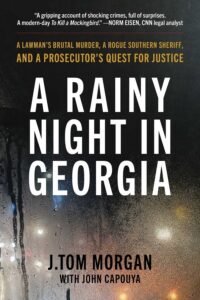

J. Tom Morgan
J.Tom Morgan served as the elected District Attorney of DeKalb County, GA, from 1992-2004. He was the first recipient from the United States to be awarded the Special Achievement Award from the International Association of Prosecutors in 2003. Prior to his time as DA, Morgan served as an Assistant District Attorney in DeKalb County for nine years and was the first prosecutor in Georgia--and one of the first in the nation--to specialize in the prosecution of crimes against children. As a nationally recognized expert on criminal justice, he has appeared on The Oprah Winfrey Show, The Today Show, CNN, Court TV, and 48 Hours, among others. Morgan has lectured to prosecutors and law enforcement officials in more than 30 states, Puerto Rico, and Europe, and served on the faculty of the National College of District Attorneys.