
Virginia Trench on psychological thrillers and the dark sides of motherhood
The author of Mr. Disappear uses suspense as postpartum therapy
There were ear-splitting screams. Bites. Lies of all shapes and sizes. Existential crises. And, it goes without saying, a lot of blood. Motherhood has all the raw materials for a good thriller.
Who knew?
Certainly not me—I was about to get a crash course, though. I was blissfully unaware of just how real my work would become once I had a newborn and second-degree tear in tow. I never expected to bring some of the most visceral aspects of my work home with me. But when my daughter arrived, all that went out the window.
And it was absolutely terrifying.
From the moment we left the hospital, both of us exhausted, well out of our depth, and wearing diapers, something felt broken in me. (The baby, to be clear, was absolutely perfect).
I, by contrast, was nothing like the serene, softly smiling, well-lit mothers of Instagram. I felt more like a light-averse creature sharing more in common with feral raccoon than a human woman. I craved everything I couldn’t have: silence, rest, solitude, the home phone number of the anesthesiologist who messed up my epidural. A girl can dream—a mother can just tough it out.
As our new reality set in, everything I’d ever heard about motherhood started to seem like an elaborate, generations-long lie. But then, I reasoned, that couldn’t be the case. Surely, I must be the ugly, defective exception to the rule that childbirth and motherhood are the most beautiful, natural things in the world.
I gritted my teeth and waited for a switch to flip. Not not fantasizing about smashing the rocking swing with the annoying music, I did my best to fake it. I was desperate for the *alleged* biologically hardwired maternal peace to settle over us, to give my daughter the mother she deserved…and to prove the lactation consultant wrong—I wasn’t already failing because I’d given up on breastfeeding pretty much immediately.
But it didn’t come.
Goodbye, Instagram moms. Hello, Nightbitch.
Sleepless night after shapeless day into the next sleepless night, I sank into a quicksand isolation, anger, and panic that came in bone-deep waves. Sure, I’d heard of postpartum depression, courtesy of delicately worded waiting room posters. I’d heard of the “baby blues,” a term was popularized by a man decades before American women could open their own bank accounts, receive paid maternity leave, or easily access contraception.
This experience was something else entirely, something huge, hungry, and raw. I used to love exploring those dark corners of human psychology. Through fiction, it was safe, easy to do from a creative distance. But that distance had vanished, and I found myself submerged in the extreme emotions that fuel stories I had no desire to live firsthand. The more I tried to escape those feelings, to remind myself how lucky I was and of the many privileges I have, the thicker my haze of shame became.
Out of sheer desperation, I tried something that seemed a little crazy at the time, even for a woman who heard phantom baby cries everywhere she went, including an empty Target bathroom. I evicted The Happiest Baby on the Block from my nightstand and replaced it with Rachel Yoder’s Nightbitch.
I faced the scary, socially unacceptable thoughts head-on. I nodded vigorously as I read. I started writing again. I gave voice to the emotional exhaust that followed me around like a swarm of black flies. And little by little, this brought me back from the brink.
The Quiet Part—Out Loud
In those pages, I finally, finally, found someone willing to level with me about the dark side of mothering.
The mind-numbing repetition.
The resentment.
The identity loss.
The guilt.
As I tore through Yoder’s novel, I breathed in the unflinching honesty like fresh air. And after what I can only describe as the most isolated period of my life (despite rarely being alone), I could have lifted up Nightbitch like Simba in the Lion King.
To some, a twisted tale of rage and supernatural transformation might seem like an odd place to look for someone who gets you. Those people probably haven’t had to catch tiny human vomit with their bare hands or scrape diaper material from under their fingernails. For me, it was healing. It was therapy for the price of a hardcover—that eventually led to actual therapy. It was someone else, okay, fine, a fictional character, but still, validating everything so much of the world seems determined to silence.
Nightbitch was the gateway to more dark tales. It became an unexpected path back to a part of myself that got lost somewhere in the process of creating life and nesting the crap out of the former guest room. More than that, once I started reading thrillers again, I did so with new, narrowed eyes.
All Her Fault (Probably)
Psychological thrillers are a powerful channel for female rage, and the mom of it all adds fascinating layers to that rage. It’s hard not to occasionally lose your shit when (almost) everything is your fault.
Freudian psychology, direct ancestor of the manosphere, if you ask me, laid the groundwork to blame mothers for the behaviors and even the crimes of their children—especially their sons. We wonder: if a serial killer had just been nurtured properly, might innocent lives have been spared? Culture-defining classics from Psycho to Carrie feature the consequences of dangerous mothering, and audiences point the proverbial finger accordingly.
For that matter, is there anything more frightening than a bad mother? Sharp Objects and Verity terrify readers not just because of their villains’ psychosis, but their fundamental wrongness, their choice to harm, rather than nurture. That goes against nature, doesn’t it? After all, violence is supposed to be a man’s thing, isn’t it?
Judge Judy’s ________
Most (all?) maternal attributes are fair game. A demanding career? Lack of career outside the home? An only child? Four under four? Homemade gluten free snacks? A Costco multipack or Cheez-Its?
Nothing is safe. All that pressure is enough to make anyone snap. And in this genre, that’s a great place to start.
Open Best Offer Wins, All the Other Mothers Hate Me, or Little Fires Everywhere, and we see death by a thousand little judgmental cuts, some of which are self-inflicted by the main characters. And as their stories unfold, we can’t look away.
Why?
Because instead of simply swallowing the judgement and striving to meet those double standards, these women make all hell break loose. And, as I can attest, there’s something cathartic about seeing that happen on the page. Many mothers have met their version of Renate Kline, for instance, ultra-judgmental supermom of Big Little Lies, and we can’t very well face off in real life and tell her exactly what we think of her, so it’s all the more satisfying to watch Reese Witherspoon do it for us in the TV adaptation.
It’s no wonder this genre draws in so many readers—we can relate to the characters’ experiences, ideally minus the murders.
Write like a Mother
If a “right” formula for this, it has eluded me completely. Too much hinges on who did/didn’t sleep through the night, which appliances are whistling at me, and whether my three-year-old is in a self-declared Aurora/ Ariel or Maleficent/ Ursula mood. So, I gave up looking, and I’m a much happier, better writer for it.
But I will tell you one thing: it helps to not have photos of my children in my office, and I feel zero guilt about this. Do I have a framed tooth in honor of the twist in Sharp Objects? A black and white portrait of Agatha Christie? Also, yes. But no adorable kids, and that’s okay, especially when I’m drafting a murderous chase scene.
It probably sounds corny: but the literal separation was necessary, even if my home office is feet away from the nursery. The best I can do is give make the space I can for different facets of my identity, which now includes, but is not eclipsed by, motherhood. Sometimes that space feels tiny, like hiding the last Annie’s Bunny Cracker bag for myself to pair with a glass of pinot noir.
Sometimes it feels huge, the inspiration for entire second novel, for instance, in all its raw, unfiltered glory (plus one sociopathic con man). What could go wrong?
***


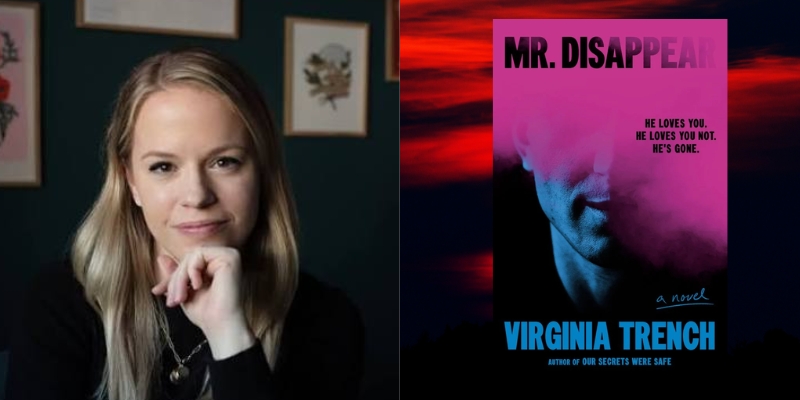
Virginia Trench
Virginia Trench is the author of Our Secrets Were Safe. She studied English at Vanderbilt University before earning an MA in secondary education at University of Colorado Boulder. When she’s not writing, she can be found exploring the Rocky Mountains, struggling on a yoga mat while her cat judges her, or devouring the latest crime novels. She lives in Colorado with her family.