5 Page-Turning Wilderness Thrillers and Nature Novels
Steve Hawk recommends Peter Heller, Charles Portis, and more
I’ve spent much of my career writing and editing nonfiction articles about people who venture into untamed terrain, so I’m drawn to bold and original descriptions of wild places. But the truth is that most nature writing fails to excite me, even the adventurous stuff, because it too often lacks the crackle of human conflict.
Hero climbs menacing mountain, gets battered by storm, loses fingers to frostbite: No thanks.
Hero climbs menacing mountain, gets stalked by maniac, loses fingers in knife fight: I’m in.
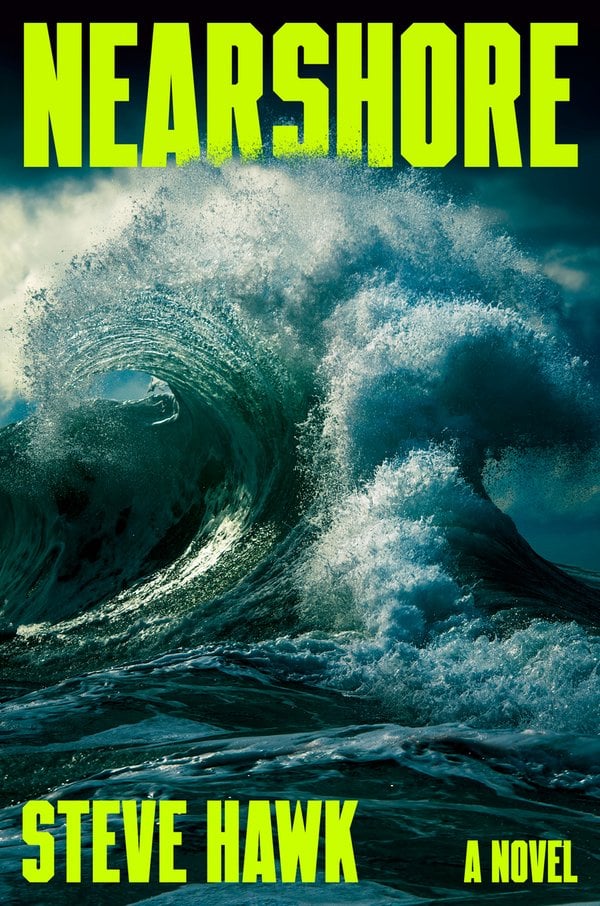
Here are five novels (including some of my favorite books ever) that paint unforgettable pictures of wild landscapes while also keeping readers breathless and aghast at the horrible things people sometimes do to each other. Most of these books were floating around in my head as I wrote my first novel, Nearshore, which takes place in that magical treacherous zone where land and sea collide.
*
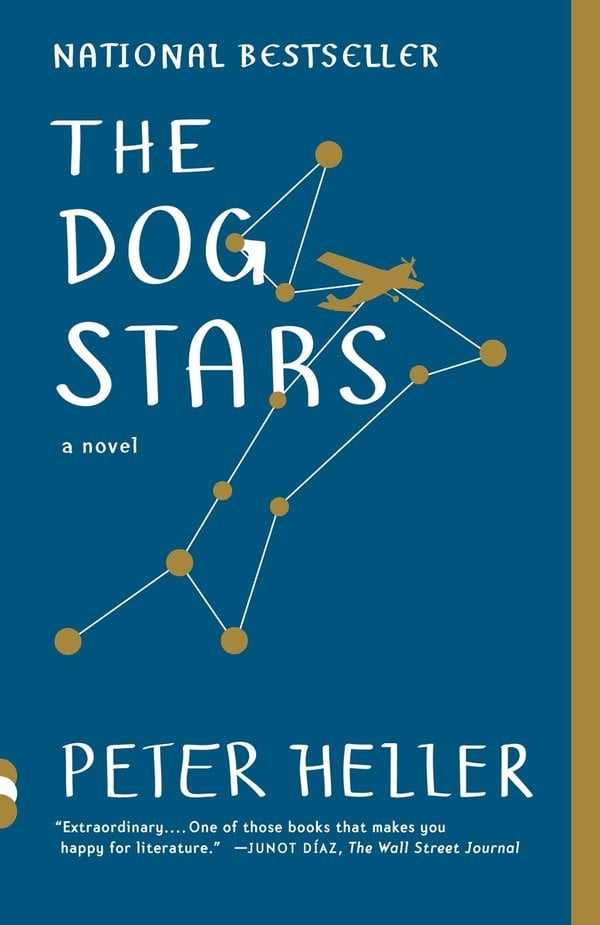
Peter Heller, The Dog Stars
Heller’s early life as both a poet and wilderness explorer are on full display in The Dog Stars, his first novel after a successful career as an adventure journalist. It’s clear throughout that he has an abiding affection for wild places and the profound private moments that can be found there—even in this dog-eat-dog (and, sometimes, dog-eat-man), post-pandemic dystopia of deprivation and mayhem.
To me, that’s where this haunting book finds its power: in its lyrical and sure-handed portraits of the natural world, which have a twisted kind of beauty, given all the marauders lurking at the perimeter. Again and again, Heller allows the protagonist, Hig, to bask in the same Walden Pond zen-state he once knew, before society collapsed. When he goes flyfishing with his dog, or admires the Milky Way on a clear mountain night, it almost pushes from the reader’s mind the horror that drives the story.
Almost, but not quite.
The Dog Stars is a book best read twice, maybe even three times, because it’s easy to get swept downstream by the gruesome plot and thus fail to savor Heller’s soft and luscious take on something as simple as a campfire: “The wood was dry and full of resin and popped and cracked which was a domestic song above the syllabic murmur of the creek and the wind in the high boughs. Darkness was already in the forest, it filled the little canyon like a slow tide, and the flames deepened it but the sky was still bright with the thinnest blue and I could see two stars.”
This Henry-David-Thoreau-meets-Stephen-King disconnect is not lost on Hig himself, who manages to find meaning in the divide: “It caught me sometimes: that this was okay. Just this. That simple beauty was still bearable beauty, and that if I lived moment to moment…I could have peace. It was like living in doubleness, and doubleness was the virulent insistence of life in its blues and greens laid over the scaling grays of death, and I could toggle one to the other.”
Although we’ve never met, Heller and I have each published articles in the same outdoor-adventure magazines, and we have a few editors and acquaintances in common. I first heard of The Dog Star when the elegant quarterly Adventure Journal ran an excerpt from the book while I was working there as a freelance editor. I loved the novel, devoured it, and came away thinking, “Hey, maybe I should take a leap and try something like that myself someday.”
So, Peter: Thanks for the inspiration. I don’t think my first novel would exist if not for yours. I hope I get to buy you a beer someday. I also can’t wait to see the movie version, directed by Ridley Scott, which comes out on Aug. 28.
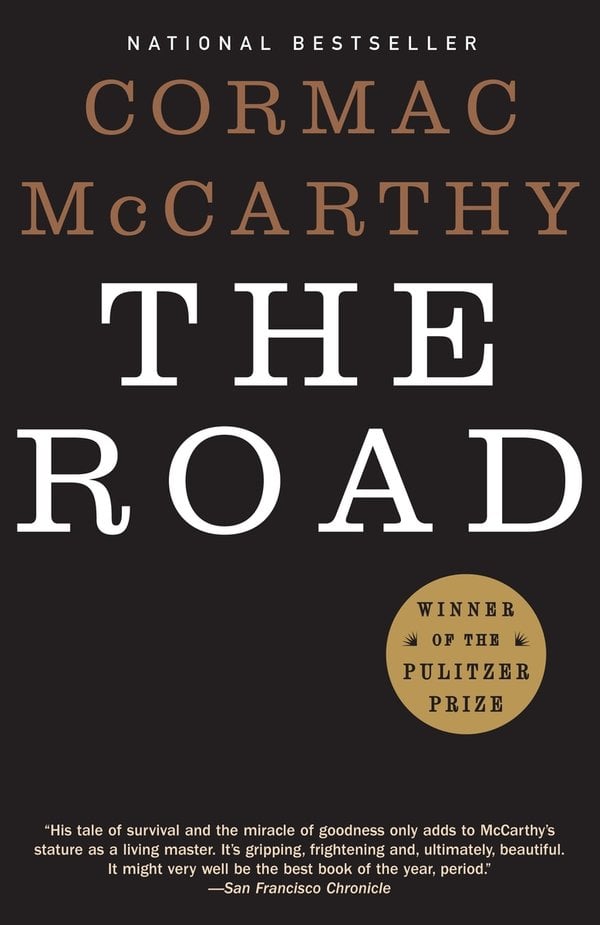
Cormac McCarthy, The Road
No one has mixed feelings about The Road, a parental love story set in the bottommost ring of human hell. You either love it or you hate it.
I’m a lover.
McCarthy is a master (perhaps the master) at crafting mesmerizing descriptions of wilderness amid scenes of suspense and terror. But unlike the harsh landscapes he brings to life in his Border Trilogy and other novels, The Road’s milieu is entirely of his own imagining, and it is bleak beyond measure: a dark and lifeless wasteland, choked by nuclear winter, in which a nameless man struggles to protect his nameless son from cold, starvation, and cannibals.
The book has gore aplenty, but as a lifelong surfer I was less disturbed by the spit-roasting corpses than by McCarthy’s vision of a lifeless sea: “Out on the tidal flats lay a tanker half careened. Beyond that the ocean vast and cold and shifting heavily like a slowly heaving vat of slag and then the gray squall line of ash.”
And this: “The wind coming off the water smelled faintly of iodine. That was all. There was no sea smell to it.”
There are only a few snippets in which the protagonist allows himself to revisit happy memories from his childhood, and McCarthy’s brief descriptions of that vanished world make The Road’s barren setting all the bleaker: “In that long ago somewhere very near this place he’d watched a falcon fall down the long blue wall of the mountain and break with the keel of its breastbone the midmost from a flight of cranes and take it to the river below all gangly and wrecked and trailing its loose and blowsy plumage in the still autumn air.”
That awesome remembrance is quickly erased, just four pages later, when the man and his young son come to a nuked-out city: “The mummied dead everywhere. The flesh cloven along the bones, the ligaments dried to tug and taut as wires.”
The first time I finished The Road, I wanted nothing more than to rinse away its grimness in the clean, blue, pre-apocalyptic ocean near my house. Then I went back and read it again. And again. Read, rinse, repeat.
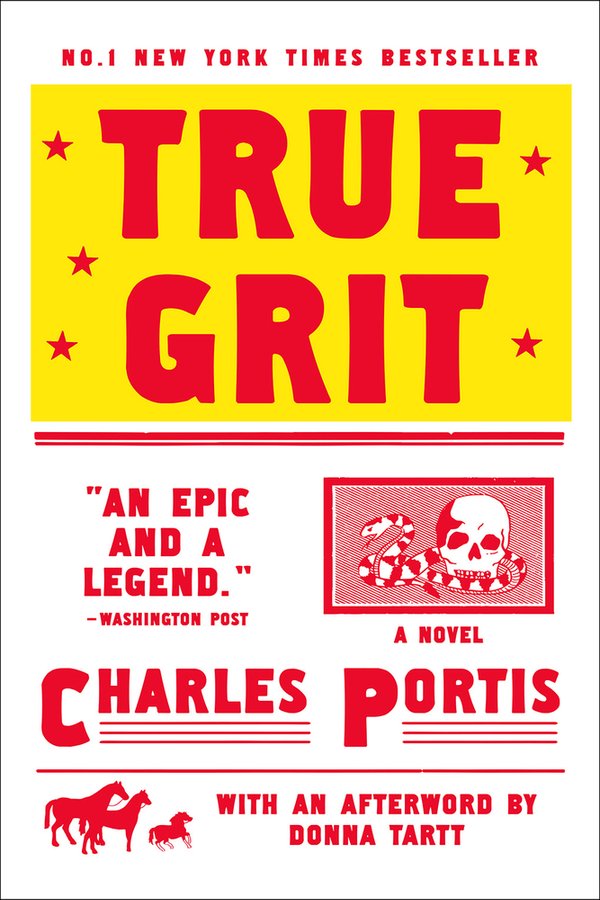
Charles Portis, True Grit
True Grit’s genius lies in its singular, unwavering, hilarious point of view. The narrator is Mattie Ross, a pious spinster looking back decades later on her life’s one great adventure, when, as a teenager, she rode into lawless Indian country with a pair of bounty hunters to hunt down the man who’d murdered her father.
Published in 1968, the novel was once taught alongside such American classics as Adventures of Huckleberry Finn and To Kill a Mockingbird. Twice it was adapted into movies. The homogenized 1969 version, with John Wayne, diminished its literary status. The Coen brothers’ 2010 version got it almost exactly right, but mainly because they lifted most of the dialogue directly from the book.
Mattie is a combative and scolding storyteller, with an affect as flat as farmland. As a result, she has little time for loving descriptions of the wilderness in which the drama ensues.
“Now I will say something about the land,” she huffs when she finally deigns to focus on the terrain.”Some people think the present state of Oklahoma is all treeless plains. They are wrong. The eastern part (where we were traveling) is hilly and fairly well timbered with post oak and blackjack and similar hard scrub.”
Then she quickly shifts back to the action, which has the feel of a fable and is nonstop fun.
If you’ve never read True Grit, you really must. The book surpasses its cinematic adaptations and is a masterclass on the power of a steadfast and original POV. The audio version, narrated by Donna Tartt, is pitch-perfect, funny as hell, and proves that some books are truly meant to be read aloud.
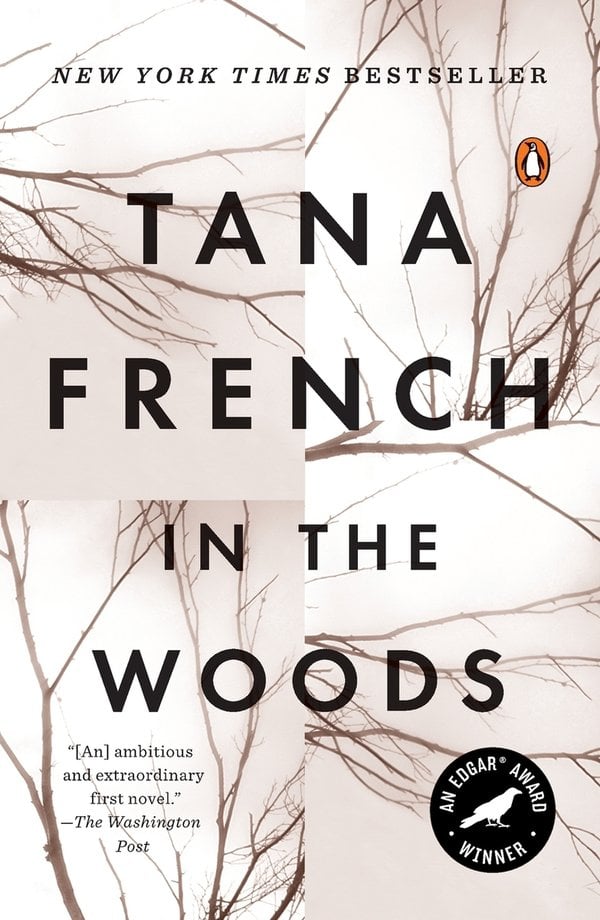
Tana French, In the Woods
The first book in Tana French’s Dublin Murder Squad Series, In the Woods won several well-deserved awards (Edgar, Barry, Macavity, and more) for its complex plotting, deft character studies, and intertwined psychological mysteries. But In the Woods doesn’t actually spend a lot of time in the woods; it’s more of a homicide procedural with an occasional foray into the forest.
Which is a little disappointing, because the few times French follows her characters into Ireland’s untrammeled landscape, the writing is dreamy. I’m especially fond of the rushing pastoral scenes written from a POV of a child who is not yet encumbered by the forthcoming murderous trauma:
The wood is all flicker and murmur and illusion. Its silence is a pointillist conspiracy of a million tiny noises—rustles, flurries, nameless truncated shrieks; its emptiness teems with secret life, scurrying just beyond the corner of your eye. Careful: bees zip in and out of cracks in the leaning oaks; stop to turn any stone and strange larvae will wriggle irritably, while an earnest threading of ants twines up your ankle.
That scene arrives early, on page two, and it’s another three hundred pages or so before such music reappears, when the lead detective starts to unearth his own long-suppressed childhood memories:
The wood had never been so lush or so feral. Leaves threw off dazzles of sunlight like sparklers and the colors were so bright you could live on them….We shot through humming clouds of midges and leaped ditches and rotten logs, branches swirled around us like water, swallows trapezed across our path and in the trees alongside I swear three deer kept pace with us.
Between those two passages, French constructs a gripping whodunit filled with damaged cops, clever and plausible red herrings, an unblinking portrait of modern-day Ireland, and a sibling rivalry that will stoke your nightmares.
Kem Nunn, The Dogs of Winter
Kem Nunn pretty much invented the “surf noir” genre with his debut, Tapping the Source, a finalist for the 1984 National Book Award. But The Dogs of Winter, his fourth novel, is a higher form of art, even if it didn’t win many medals. The writing in Dogs is more sure-handed, the characters are more original, and the misty Pacific Northwest setting is several shades creepier.
When Dogs came out, in 1997, I was working as the editor of Surfer magazine. The story’s protagonist, Jack Fletcher, is a legendary surf photographer trying to get back in the good graces of the surf mag that once employed him. Because of all that, I was poised to nitpick when I cracked it open. But Nunn got the surf-media machinations exactly right, and any skepticism I might have had about some kook interloper invading my tribe’s literary space quickly disappeared as I found myself swept up in the churning plot.
If Dogs had been made into a movie (which, sadly, has yet to happen with any of Nunn’s surf-noir books), the elevator pitch might have been: Deliverance meets Point Break. There’s an accidental death. A chase through wild waters. Some truly scary bad guys. A horrific rape scene. A battle with primitive weapons.
And yet, among all that grotesquery, Nunn manages to concoct enchanting moments of grace in the surfers’ pursuit of waves. Like this: “It was approaching what had always been one of his favorite hours of play—that hour in which the sun was low in the sky, so that in paddling out, one was apt to lose it now and again behind the lines of approaching swells, only to find its light burning through the lip of a translucent face, an hour when the winds might be seen as blowing sparks from the tops of the waves.”
A warning for the queasy: Such idyllic passages are few and far between in this gritty book. But the afterglow is as delightful as stripping out of your wetsuit and donning warm clothes following a long session in cold water.
***

Steve Hawk
Steve Hawk is the former editor of Surfer, Sierra, and Stanford Business magazines, and of surfline.com. His first book, Waves, explores the science and aesthetics of ocean waves. He is currently cowriting a book with his brother, Tony Hawk, about the history and culture of skateboarding. He lives near Half Moon Bay, California, where he spends as much time as possible frolicking in the ocean. Nearshore is his first novel.