
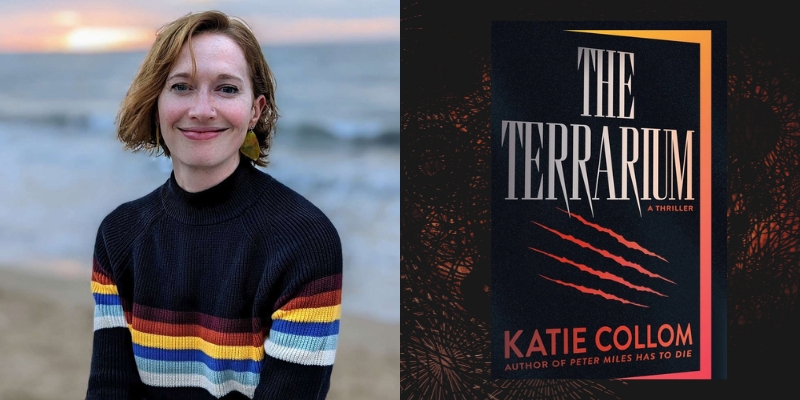
Katie Collom on exploring her relationship with true crime in a suspense novel
The author of The Terrarium unpacks her long history with an addictive genre
True crime and I go way back.
My first encounter with the genre was during an annual trip to visit my grandma. Each year, I’d dive into the pile of Reader’s Digest she’d acquired, devouring them cover to cover. It was in one these that I read an article about a criminal profiler who suffered a mental breakdown.
This left a deep impression on my eleven-year-old mind. I couldn’t believe there were human beings who could commit acts so horrific, they actually drove their pursuers insane. More importantly, there were people whose jobs were to figure out how sociopaths think!
I was hooked.
I continued to seek out more content about criminals and their crimes. The effect could be…less than healthy. I recall spending a night at a friend’s house and being unable to sleep because it was located somewhat near a railroad track. Just the week before, I’d watched a show about a killer who chose his victims by their proximity to the trains he freight-hopped.
Later as a teenager, my worries became more specific: I’d fret daily about my parents properly locking the windows and doors in our home before we all went to bed. Thankfully we didn’t have a basement or an attic because if we did, I probably wouldn’t have ever gotten a solid night’s sleep.
It wasn’t until I was an adult that these types of articles and shows were given a label. By then, true-crime podcasts and TV series had become so trendy they were their own genre. The sudden abundance of content seemed tailor-made for someone like me: a person who’d been consuming these stories steadily from childhood. Even better, there was a whole community out there, who shared similar obsessions.
(If you’re here, reading this essay, it’s fair to say you know exactly what I mean. You’re one of my people!)
In my new thriller, The Terrarium, my main character is a true-crime obsessed cat sitter named Annie. The isolating nature of her job—going into people’s homes to care for their cats—lends itself to a lot of introspection. For Annie, it manifests in her fanaticism for a podcast called Cuppa Crime.
Her relationship with Cuppa Crime is an emotional crutch. Its hosts, Gail and Gary, Annie’s voices of reason. Whenever she’s anxious, afraid, or bored, she escapes into the tales of heinous crimes that Gail and Gary spin on their podcast. I was interested in seeing how far I could push Annie’s obsession. In turn, this made me stop and study my own relationship with true crime.
Like Annie, I’m a bit of a cliché: a millennial woman who probably consumes just a little too much true crime. It’s no secret that the audience leans very heavily toward women. Additionally, the victims in most popular stories—whether that be books, podcasts, or TV series—also tend to be disproportionately women.
In some ways, this makes it easy to explain away any discomfort I might feel around the genre. I rationalize that I consume it to learn how to protect myself as a woman. Or because I can empathize deeply with the female victims. Or because I want to gain an understanding of how evil people think.
In The Terrarium, Annie drip-feeds herself a constant stream of true crime. Her fascination with it veers into paranoia, and yet, she doesn’t see a problem with it because her overconsumption is for the ‘right’ reasons. Annie’s goal is to unravel the mysteries featured in the Cuppa Crime episodes she listens to. She wants justice and therefore struggles to see when it’s all too much.
Granted, a lot of Annie’s choices are downright chaotic and not things I’d ever do. But I also know how easy it is to cross the line between a healthy amount of true crime and consuming so much that it starts to have a very real effect on your life.
While all my reasons for engaging with the genre ring true, there is a point where too much knowledge becomes a jumble of information with few tangible benefits. Will listening to yet another podcast episode or watching another documentary really teach me how to better protect myself, to empathize, to understand the way the mind of a psychopath works (spoiler: you can’t and never will)?
Since these books, podcasts, and shows are presented as entertainment, it can be easy to consume it the same way you might binge Love is Blind. When the subject matter is so dark, too much too fast can be dicey.
I’m not planning to give up true crime any time soon—like I said, we go way back. But I’m learning to find a balance between prioritizing my mental health and still enjoying a hobby I’ve had since I was a kid.
Real mysteries continue to fascinate me (I am a thriller writer after all) and there’s nothing quite like sinking your teeth into a well-done series. And…if it’s okay to wear shirts with a stranger’s name on them and get way too invested in a bunch of guys throwing a ball around, I think spending your time engaging with true crime is equally valid.
It just doesn’t hurt to be a little more intentional. To pause and consider my reasons for listening to, watching, or reading something in the genre and the impact it can have on me. I remind myself that it’s okay to take a break! These stories will still be there when I’m ready to come back to them.
In some ways, I see myself in the paranoid cat-sitter I’ve created, and I hope you will too. Annie was a fun character to write and, hopefully, a fun character to read in a sort of peek-through-your-fingers way. She certainly has some entertaining ways of coping with her love for true crime, but that’s what makes her so compelling.
Like Annie does with Cuppa Crime, you might just get more than you bargained for when you step into The Terrarium. But don’t worry, you’ll be fine. Just keep your wits about you and (as Gail and Gary like to say) always trust your gut.
***


Katie Collom
Katie Collom is the author of Peter Miles Has to Die. She grew up in Mazatlan, Mexico, and is a life-long expat and world traveler. She spent four years in Texas and has carried a piece of it with her ever since. Currently, she resides in York, England, with her husband and three cats.