A Different Kind of Truth: On Reporting, Fiction, and Betraying the Facts
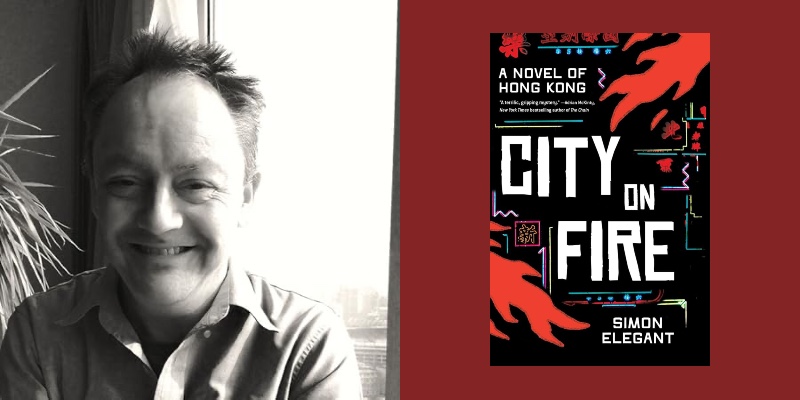
Simon Elegant on journey to writing his new Hong Kong novel, 'City on Fire'
Riordan saw that the police station was wreathed in oily black smoke from the Molotov cocktails, below that a heaving mass of protesters chanting slogans, the roar of the crowd underlaid by a staccato bass line from riot squads banging truncheons on their shields as they advanced up Nullah Road, the cacophony punctuated by the wailing sirens, the banging of trash can lids, random screams.
The Police Tactical Unit squads to the south of the intersection were invisible, blocked by the protesters. But the tinny sound of the warnings being shouted through a loudhailer was audible above the din. Riordan saw a couple of flaming bottles tumble through the air over the heads of the crowd. He didn’t see them land, but heard the whump of the explosions, then the answering crack of the Federal CS guns and the popping of the Pepper Pot shotguns.
Sandbag rounds.
Hopefully.
Those paragraphs were originally part of my Hong Kong mystery, City on Fire. They are good reporting. But as I came to realize painfully slowly, that doesn’t mean they deserve a place in a crime novel. The distinction between vivid reportage and a scene that builds character or drives the plot is the first thing a journalist must grasp when learning to tell a different kind of truth.
Hemingway, of course, put it memorably. In Death in the Afternoon he said a story should be like an iceberg, with roughly seven-eighths of what the writer knows kept beneath the surface.
The reporter’s besetting sin is the opposite instinct — to dump in the entire notebook because everything in it is hard-won. But the mass beneath the waterline is what gives the visible portion its weight. And an overloaded scene topples over.
In my case, there was more. A lot more: the candlenut trees wreathed in white wisps of tear gas had to go. As did the mini bomb factory under the shelter of umbrellas and the 75-yard-long line of protesters passing the Molotovs to their brethren on the front line. So did many other vivid details—every one of them a small distraction to the reader’s attention that the scene could not afford to pay.
I knew when I stood on Nathan Road in the summer of 2019 that the scenes I was seeing belonged in a novel, not on the front page. And specifically in a crime novel, where there was a proud tradition of other reporters making the same decision. The pipeline from newsroom to mystery is older than the genre itself — Dickens, Collins and Poe all worked as journalists or editors before writing the first detective fiction.
Between them they assembled the architecture of crime fiction — the locked room, the logically deductive detective, the wrongful accusation, the sensation novel’s marriage of melodrama and social indictment — before anyone thought to call it a genre.
That it was built by working journalists is not incidental. Every element of the form traces back to a reporter’s professional preoccupations: institutional rot, carefully disguised motives, the gap between the public account and the private truth.
Jump forward to one of today’s best known crime writers and a personal favorite, former crime reporter Michael Connelly. He covered the LAPD for the Los Angeles Times for more than a decade before Harry Bosch existed, and the procedural authority of the Bosch novels — the radio codes, the jurisdictional frictions, the dead-end grind of a case that will not close — is the authority of a reporter who lived the life.
Connelly has plenty of company. Edna Buchanan won a Pulitzer covering homicide for the Miami Herald before she wrote her novels based in the city. Ditto with Laura Lippman, who worked at the Baltimore Sun for a decade before penning her acclaimed, Baltimore-set Tess Monaghan PI series.
It is no coincidence that cities such as Baltimore, LA and Miami figure as virtual characters of their own in many modern crime novels. The conviction and atmosphere supplied by a vividly rendered urban backdrop have become indispensable.
That was what I was aiming for when I set out to write City on Fire, which is set in my birthplace, Hong Kong. And that was why I spent so much time talking to the fervent, often-young frontliner demonstrators when I was doing research in the turbulent summer of 2019. Hong Kongers were turning out on the streets in their hundreds of thousands, vainly attempting to avoid what seemed to be their fate, to bow down their heads and accept rule from Beijing.
After decades in the business, I had turned away from reporting a few years before, trying out other work ranging from restauranting to teaching undergraduates. Now, talking to these protesters, hearing their passionate, futile idealism, I realized that my view of the city, held for decades, was utterly wrong. This was no longer the money-obsessed, coldly pragmatic city of refugees I had known. This new Hong Kong was so passionately attached to its freedoms that it would rather self-immolate than surrender. If we burn, you burn with us.
The experience –seeing physical manifestation of the adage that nothing, absolutely nothing can be substituted for on the ground reporting— was so moving that it pushed me back to journalism, first via freelancing and eventually to a job with the Washington Post covering China. (That ended abruptly a couple of months ago on a whim of Jeff Bezos, but that is another tale).
Interviewing those ardent young demonstrators on Nathan Road and elsewhere also made me even more reluctant to give up on that hard-earned reporting when I sat down to write City on Fire. No surprise then that the first draft came out at a whopping 128,000 words.
But being a reporter also inures you to another truth espoused by Papa Hemingway, that the first draft of everything is shit. And that writing is rewriting. And cutting. The second draft came in at 93,000 words. The third –the draft that eventually found a publisher—was 75,000.
What the reporter’s experience gives the crime novelist is that seductive, granular credibility, the authority to say: this is how it happens in the real world, trust me. What it takes away is harder to see, because it masquerades as a virtue. The reporter is trained to honor the reported fact. Fiction asks you to betray it — to compress two interviews into one, to move a street three blocks for the sake of geography, to give a composite informant a single memorable face.
At first, every concession feels like a kind of crime. It took me a long time to understand that a novel’s fidelity is to a different truth, and that the scene I had witnessed on Nathan Road — however accurate, however indelible — was not a chapter in a novel. It was research.
Readers will forgive a great many sins. They will not forgive a mystery that forgets to be a mystery.
***

Simon Elegant
Simon Elegant is China bureau chief for The Washington Post, based in Taiwan. Previously, he held a variety of reporting and editing jobs in Asia including Beijing bureau chief and Southeast Asia correspondent for Time magazine. Elegant was the founding partner and investor in Temple Restaurant Beijing, which won the 2019 readers’ choice award from TripAdvisor as the world’s best restaurant. He is the author of two previous novels, A Chinese Wedding (Piatkus), and A Floating Life (Ecco/Harper), about China’s greatest poet, Li Bai, a novel that succeeded “in summoning up the man and his age in ways that are both deliciously foreign and all too familiar,” according to the New York Times.